
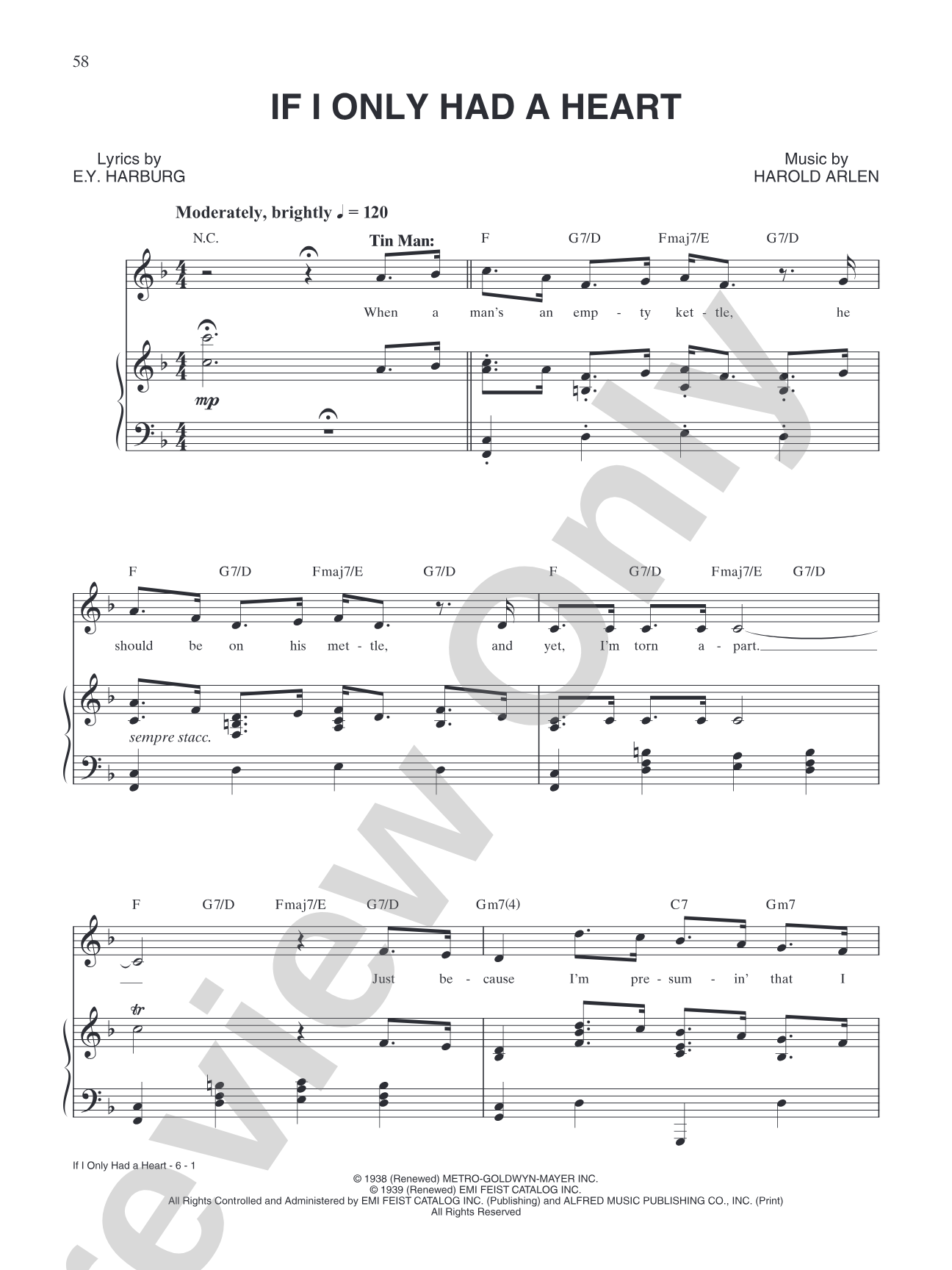
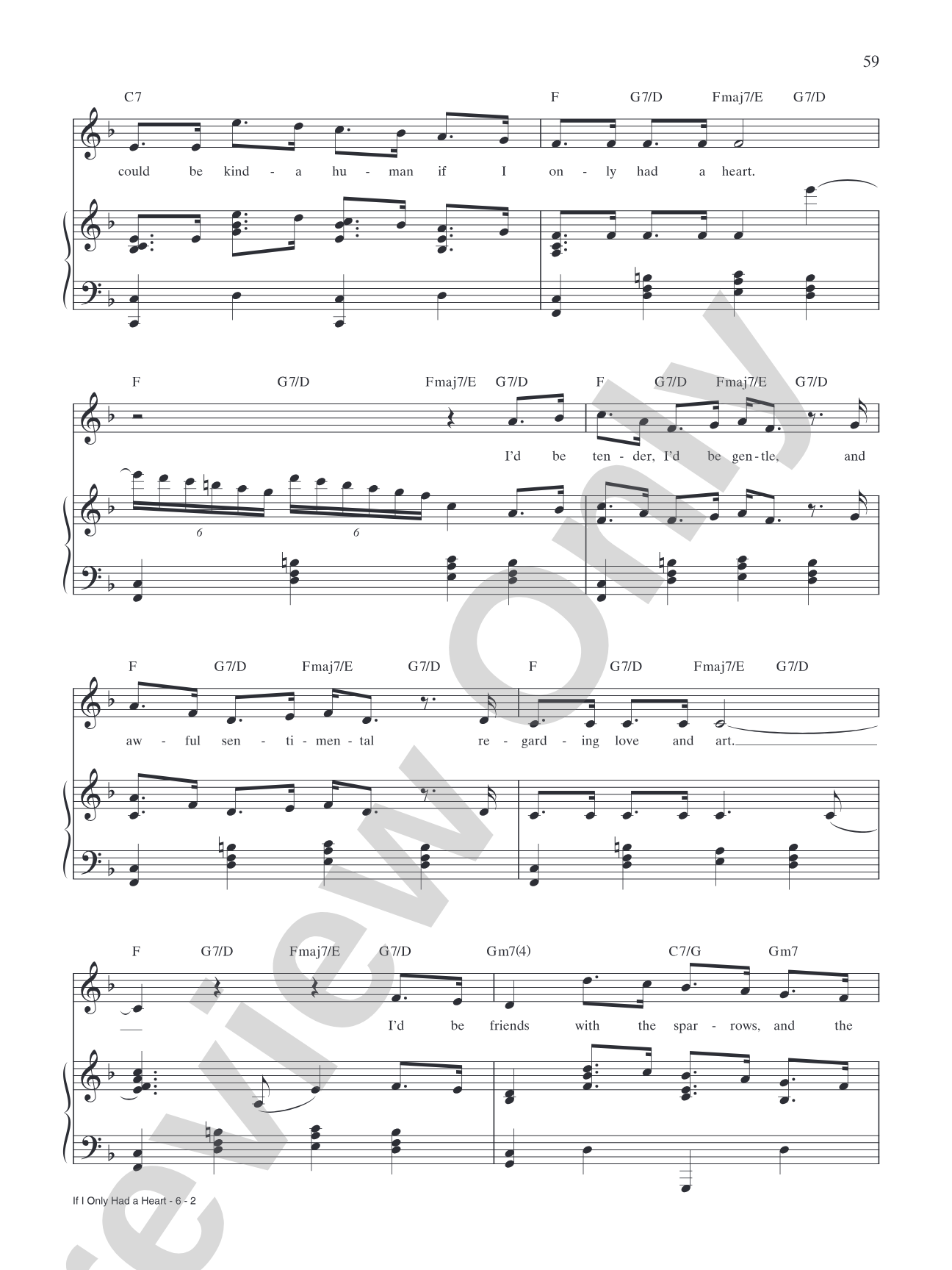

If I Only Had a Heart (from Andrew Lloyd Webber's "The Wizard of Oz"): Piano/Vocal/Chords
Music by Harold Arlen, lyrics by E. Y. Harburg, with new songs by Andrew Lloyd Webber and Tim Rice
Item: 00-XS-0000427
$5.99
One moment…
Related Items
If I Only Had a Brain (from Andrew Lloyd Webber's "The Wizard of Oz"): Piano/Vocal/Chords |
$4.99
|
View | |
The Merry Old Land of Oz (from Andrew Lloyd Webber's "The Wizard of Oz"): Piano/Vocal/Chords |
$5.99
|
View | |
Munchkin Land/Ding Dong! The Witch Is Dead (from Andrew Lloyd Webber's "The Wizard of Oz"): Piano/Vocal/Chords |
$9.99
|
View | |
We're Outta the Woods (from Andrew Lloyd Webber's "The Wizard of Oz"): Piano/Vocal/Chords |
$4.99
|
View | |
Over the Rainbow (from Andrew Lloyd Webber's "The Wizard of Oz"): Piano/Vocal/Chords |
$4.99
|
View | |
If I Only Had the Nerve/We're Off to See the Wizard (from Andrew Lloyd Webber's "The Wizard of Oz"): Piano/Vocal/Chords |
$5.99
|
View | |
Hail-Hail! The Witch is Dead (from Andrew Lloyd Webber's "The Wizard of Oz"): Piano/Vocal/Chords |
$5.99
|
View | |
The Wizard of Oz: Selections from Andrew Lloyd Webber's New Stage Production: Piano/Vocal/Guitar Book |
$21.99
|
View |
Description
Upon its 2011 debut, Andrew Lloyd Webber's spectacular new stage production of The Wizard of Oz dazzled London audiences and embarked on a course for productions around the world. Building upon the original story and the classic movie score with music by Harold Arlen and lyrics by E.Y. Harburg, Lloyd Webber masterfully transforms the work by contributing more than a half-dozen new, original songs that at last successfully adapt the world's most beloved movie musical for live theatre. This collectible songbook contains piano/vocal sheet music for every song on the original cast recording, along with several pages of brilliant color photos from the original London production. Titles: Nobody Understands Me * Over the Rainbow * Wonders of the World * Munchkinland / Ding-Dong! The Witch Is Dead * Follow the Yellow Brick Road * If I Only Had a Brain * If I Only Had a Heart * If I Only Had the Nerve / We're Off to See the Wizard * We're Outta the Woods * The Merry Old Land of Oz * Bring Me the Broomstick * Red Shoes Blues * The Rescue * Hail-Hail! The Witch Is Dead * The Wizard's Departure * Already Home.


If I Only Had a Heart (from Andrew Lloyd Webber's "The Wizard of Oz"): Piano/Vocal/Chords isn't in MakeMusic Cloud just yet...but it could be. Let us know you'd like to see it, and you'll help shape what comes next. In the meantime, start a free trial and dive into thousands of interactive titles your students can play along with today.
Request This Title
Tell us you want it.
Start Your Free Trial
Explore everything that's ready to play right now.
Sample Audio
No sample audio found.
Sample Video
No sample videos found.
Additional Details
Publisher:
Alfred Music
Page Count:
116
SKU:
00-XS-0000427
More about this title
About the Composer: Harold Arlen
Harold Arlen (1905–1986) shaped the sound of American musical theatre through melodies that feel both timeless and immediately singable. His gift for crafting memorable, emotionally direct songs made him a cornerstone of Hollywood's golden age, and his work remains a staple in voice studios, recital halls, and performance programs worldwide.
Arlen's ability to write music that serves the story while standing alone as a song has made his catalogue enduringly teachable. Singers and pianists return to his work because the melodies reward careful attention to phrasing, the harmonies sit naturally under the voice, and the emotional clarity of each piece translates across levels of musical maturity.
Why we love this
This collection captures a transformative moment in Arlen's legacy: the marriage of his classic melodies with Andrew Lloyd Webber's theatrical sensibility. Singers encounter some of musical theatre's most singable material here, with Arlen's warm, conversational vocal writing that rewards attention to diction and emotional storytelling. For pianists, the accompaniments balance accessibility with enough textural interest to keep rehearsals engaging.
What to expect
Arlen's music carries a bittersweet warmth. Even in moments of longing or vulnerability, there is always an underlying optimism, a sense that feeling deeply is itself worthwhile. The melodies sit in the voice like they were always meant to be there, asking only for honesty and restraint.
Who it's for
This is essential for singers working on American musical theatre repertoire, pianists accompanying vocalists, and guitarists learning to voice Arlen's harmonies. It also serves music teachers building a curriculum that connects classic Hollywood songwriting to contemporary stage production.
How to get the most out of it
- Treat the vocal line as speech set to music. Arlen's melodies follow the natural rhythm of English phrasing, so listen for where words want to breathe rather than forcing them into rigid beats.
- Pay close attention to the harmonic shifts in the accompaniment, particularly around the title phrase; these changes often signal emotional turning points that deserve subtle dynamic shaping.
- If performing with a guitarist, ensure the chord symbols are clearly marked and that rhythm section players lock in on the pulse without rushing. Arlen's songs often have a gentle lilt that falls apart if the tempo drifts.
- Explore the relationship between voice and piano as dialogue rather than accompanist and soloist. The piano part often comments on or anticipates what the voice is about to sing, creating opportunities for musical conversation.
How to use it
Program individual songs from this collection in recitals focused on American songwriting or musical theatre standards. The emotional range across songs makes it possible to build a set that tells a cohesive story; alternatively, single selections work well alongside art songs or contemporary vocal music to highlight the theatrical vernacular. Voice studios can use these songs as core material for teaching legit musical theatre technique.
Skills your students will build
- Singing dialogue-driven melodies with conversational phrasing
- Playing piano accompaniments that balance harmonic sophistication with rhythmic clarity
- Reading chord symbols and understanding Arlen's harmonic language
- Coordinating vocal and instrumental parts in ensemble contexts
- Interpreting character and emotional subtext through musical choices