
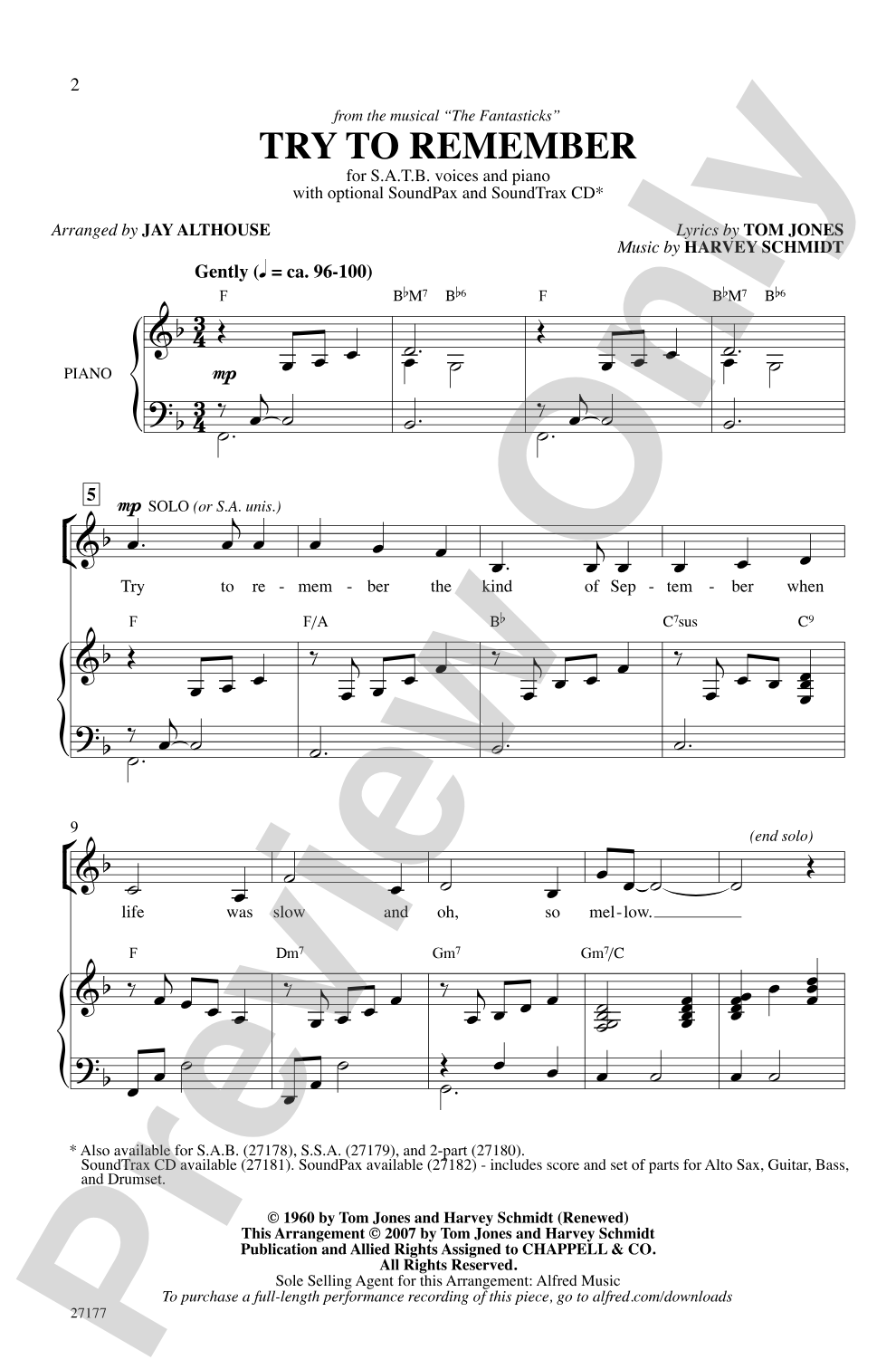

Try to Remember (from The Fantasticks): SATB Choral Octavo
From The Fantasticks
Lyrics by Harvey Schmidt, music by Tom Jones / arr. Jay Althouse
Item: 00-PO-0002913
$2.25
Minimum order quantity: 20 copies
One moment…
Related Items
Try to Remember: SoundTrax Digital Audio Download |
$22.95
|
View | |
Try to Remember (from The Fantasticks): SAB Choral Octavo |
$2.25
|
View | |
Try to Remember: SSA Choral Octavo |
$1.85
|
View | |
Try to Remember: 2-Part Choral Octavo |
$1.85
|
View | |
Try to Remember (from The Fantasticks): Choral SoundPax |
$25.00
|
View | |
Try to Remember: SATB Choral Octavo |
$2.25
|
View | |
Try to Remember: SAB Choral Octavo |
$2.25
|
View | |
Try to Remember: SSA Choral Octavo |
$1.85
|
View | |
Try to Remember: 2-Part Choral Octavo |
$1.85
|
View | |
Try to Remember: Choral Octavo SoundTrax CD |
$27.99
|
View | |
Try to Remember: Choral SoundPax |
$25.00
|
View |
Description
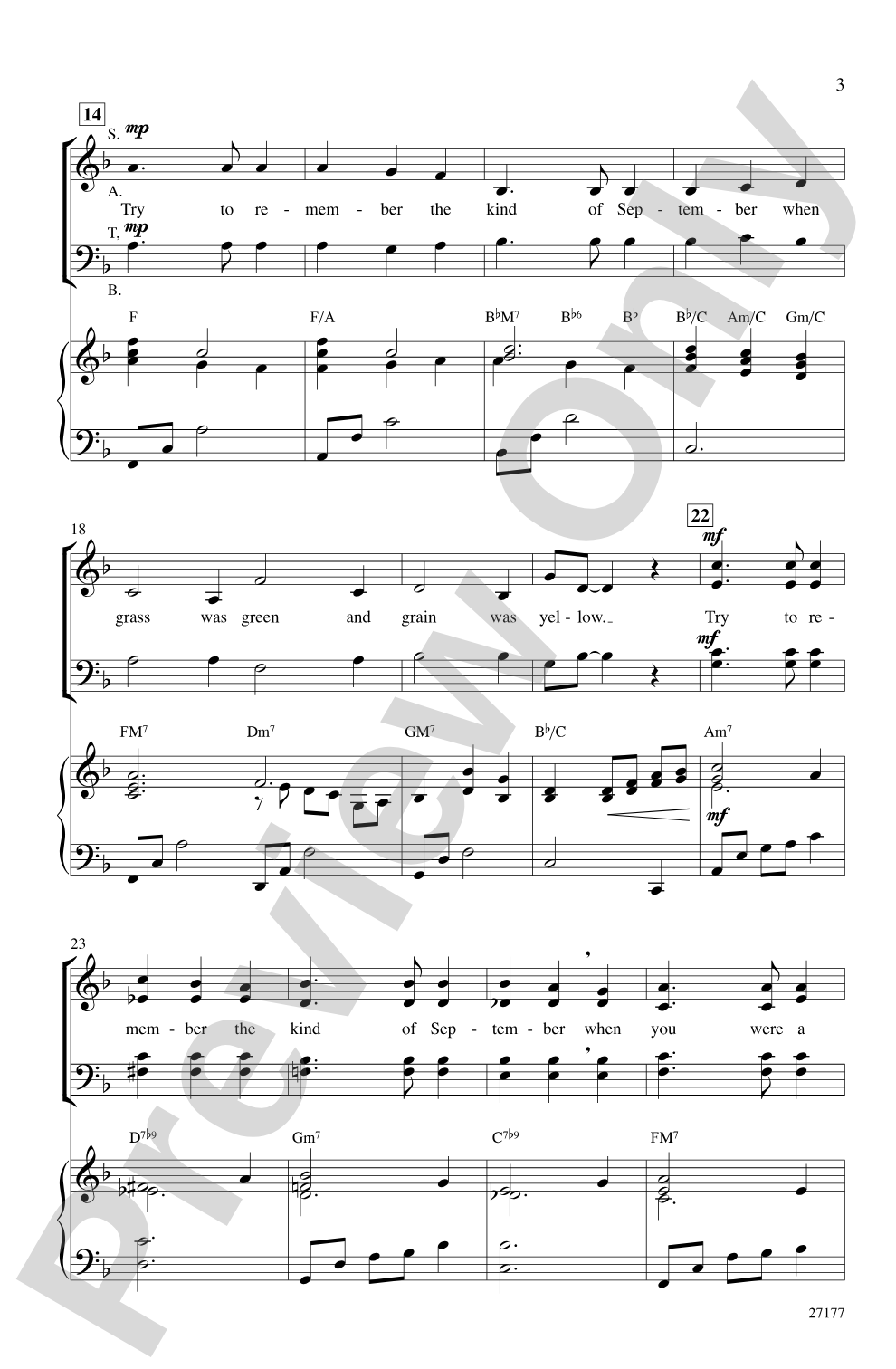
After running for more than 30 years off-Broadway, the musical legend The Fantasticks has re-opened to great reviews. The show is timeless, and so is its music. In this arrangement of the elegant opening number, the tune is stated first in a straightforward manner, then becomes a light jazz waltz. Perfectly arranged for all your groups, large or small, regardless of age.


Try to Remember (from The Fantasticks): SATB Choral Octavo isn't in MakeMusic Cloud just yet...but it could be. Let us know you'd like to see it, and you'll help shape what comes next. In the meantime, start a free trial and dive into thousands of interactive titles your students can play along with today.
Request This Title
Tell us you want it.
Start Your Free Trial
Explore everything that's ready to play right now.
Sample Audio
1
Audio File
--:--
0:00
0:00
Sample Video
No sample videos found.
Additional Details
Series:
Alfred Archive Edition: Alfred Pop Choral Series
Publisher:
Alfred Music
Page Count:
8
SKU:
00-PO-0002913
More about this title
About the Composer: Harvey Schmidt
Harvey Schmidt composed the score for The Fantasticks alongside lyricist Tom Jones, creating one of the longest-running theatrical works in American history. The musical opened off-Broadway in 1960 and became a touchstone of American musical theater, beloved for its accessible melodies, intimate storytelling, and timeless emotional resonance. Schmidt's gift for memorable songwriting in an understated style has made his work particularly valuable for choral and educational contexts.
Why we love this
Jay Althouse's arrangement captures the elegance of the original while making it genuinely singable for mixed ensembles of varying sizes and ability levels. The progression from straightforward melody into a light jazz waltz gives your choir a dynamic arc within a single piece, preventing any sense of stasis while remaining accessible. This is a song that audiences recognize and love, which means your singers get the confidence boost of performing something prestigious without the technical demands that would exclude younger or developing singers.
What to expect
You begin in a place of wistful remembrance, moving through a simple, transparent melody that feels almost like a folk song. Then the harmonic ground shifts beneath you, and you're floating in a gentle jazz waltz, nostalgic and sophisticated at once, suspended between childhood memory and adult understanding.
Who it's for
This octavo works for virtually any mixed choir, from high school ensembles to adult community groups and everything in between. The straightforward opening is accessible to developing singers, while the jazz waltz section offers satisfying harmonic and rhythmic challenges for more advanced singers.
How to get the most out of it
- Shape the opening section with genuine legit tone, allowing the tune to breathe naturally rather than oversinging. The beauty lies in simplicity.
- Bring the jazz waltz section into focus through lighter articulation and a sense of ease; the rhythm section (or recorded accompaniment) will anchor the harmonic movement, so trust it and let your voices float on top.
- Balance the parts carefully in the jazz section so that moving lines remain clear without dominating the overall texture.
- Pay attention to the transition between sections so it feels intentional and musical rather than abrupt.
How to use it
Program this early in a concert as a bridge between classical choral material and more contemporary pop or jazz selections. Its theatrical roots make it equally at home in a Broadway-themed concert or as a palate-cleansing moment in a mixed repertoire program. It also works beautifully as a closer, leaving audiences with something memorable and emotionally resonant.
Skills your students will build
- Singing jazz inflections and interpretation in a classical voicing context
- Maintaining triplet feel and waltz rhythm while navigating chord changes
- Blending legit and lighter vocal production within the same piece
- Reading and balancing moving inner-voice parts in jazz harmony