
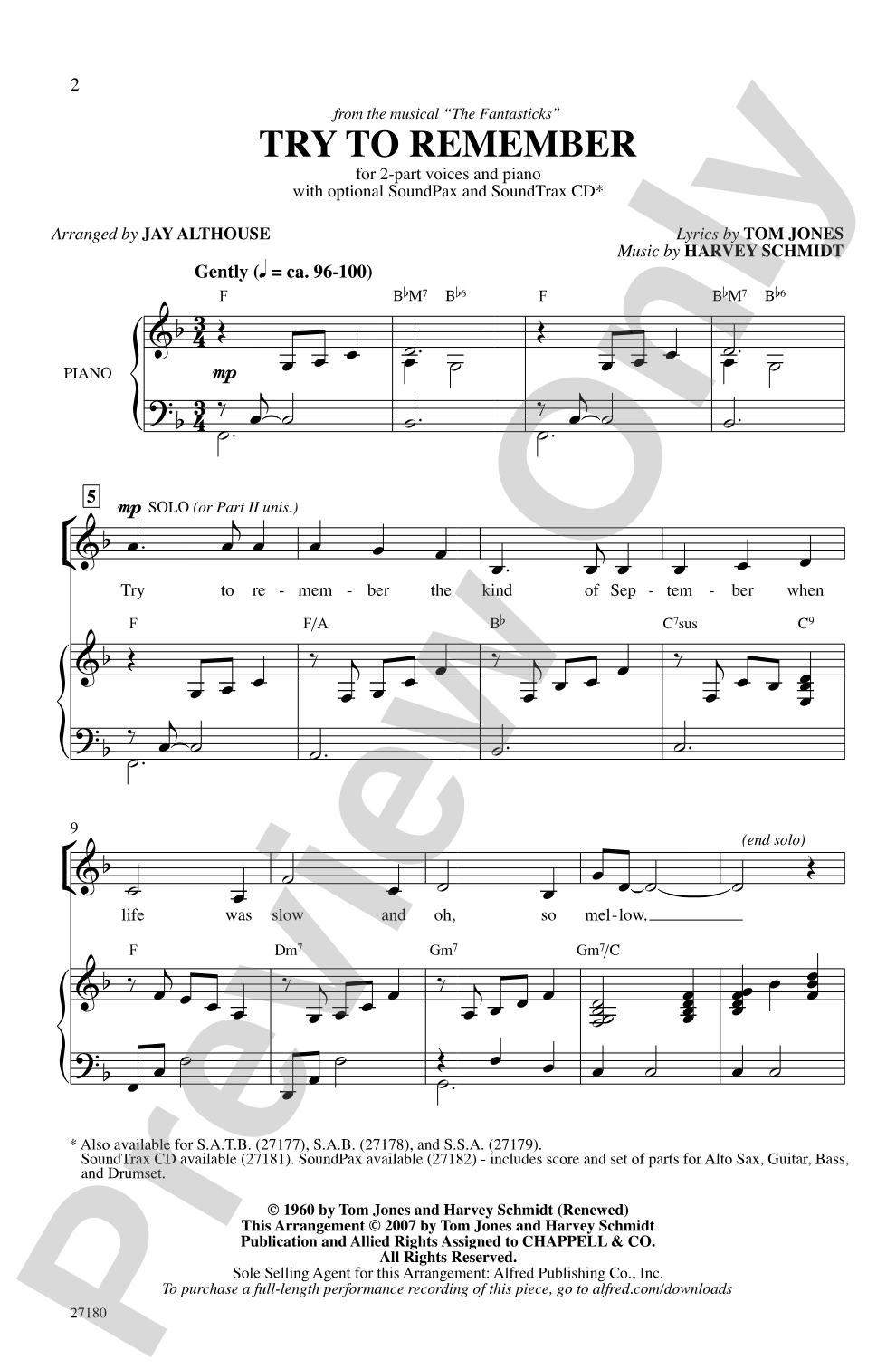

Try to Remember: 2-Part Choral Octavo
From The Fantasticks
Lyrics by Harvey Schmidt, music by Tom Jones / arr. Jay Althouse
Item: 00-PO-0007969
$1.85
Minimum order quantity: 20 copies
Pickup currently not available
Related Items
Try to Remember: SoundTrax Digital Audio Download |
$22.95
|
View | |
Try to Remember (from The Fantasticks): SATB Choral Octavo |
$2.25
|
View | |
Try to Remember (from The Fantasticks): SAB Choral Octavo |
$2.25
|
View | |
Try to Remember: SSA Choral Octavo |
$1.85
|
View | |
Try to Remember (from The Fantasticks): Choral SoundPax |
$25.00
|
View | |
Try to Remember: SATB Choral Octavo |
$2.25
|
View | |
Try to Remember: SAB Choral Octavo |
$2.25
|
View | |
Try to Remember: SSA Choral Octavo |
$1.85
|
View | |
Try to Remember: 2-Part Choral Octavo |
$1.85
|
View | |
Try to Remember: Choral Octavo SoundTrax CD |
$27.99
|
View | |
Try to Remember: Choral SoundPax |
$25.00
|
View |
Description
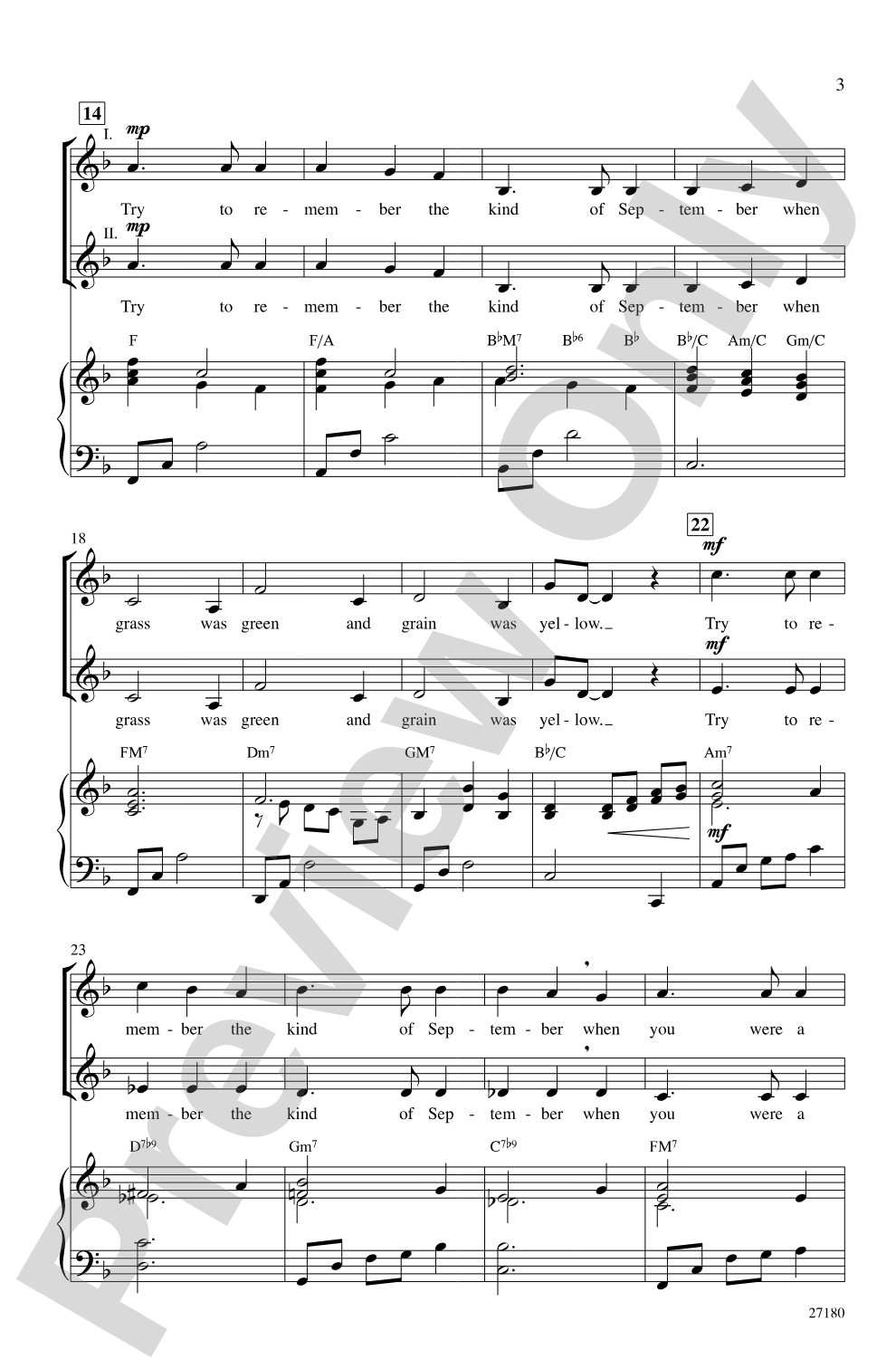
After running for more than 30 years off-Broadway, the musical legend The Fantasticks has re-opened to great reviews. The show is timeless, and so is its music. In this arrangement of the elegant opening number, the tune is stated first in a straightforward manner, then becomes a light jazz waltz. Perfectly arranged for all your groups, large or small, regardless of age.


Discover MakeMusic Cloud: thousands of interactive titles your students can play along with today.
Sample Audio
1
Audio File
--:--
0:00
0:00
Sample Video
No sample videos found.
Additional Details
Series:
Alfred Pop Choral Series
Publisher:
Alfred Music
Page Count:
8
SKU:
00-PO-0007969
More about this title
About the Composer: Harvey Schmidt
Harvey Schmidt composed the music for The Fantasticks with lyricist Tom Jones in 1960, creating one of the most enduring works in American musical theater. The show's 42-year initial run off-Broadway (and its subsequent revival in 2006) testifies to Schmidt's gift for melody that feels both intimate and universal. His ability to craft songs that work across ages and voice types has made his music a staple of educational and community choral programs.
Why we love this
This arrangement captures what makes The Fantasticks so durable: a melody so elegant it needs almost no embellishment, paired with a structure that keeps your singers engaged. Jay Althouse's choice to present the tune straight, then reimagine it as a light jazz waltz, gives you two distinct interpretive moments in a single piece, and that contrast alone makes the arrangement feel fresh rather than retreaded.
What to expect
Wistful and warm. The opening melody carries a quality of tender remembrance, and when the jazz waltz emerges, there's a gentle swing that never tips into novelty. This is what yearning sounds like when it's not overwrought; it's nostalgic without being maudlin.
Who it's for
This works for any choir needing accessible repertoire that still offers musical substance. Smaller groups and larger ones both find success here; the 2-part voicing keeps technical demands low while the arrangement's sophistication appeals to singers who want to dig into something real.
How to get the most out of it
- Balance the melody between parts during the opening section; the straightforward voicing depends entirely on blend and intonation to sound graceful rather than sparse.
- Approach the jazz waltz section with rhythmic precision. The syncopation will feel natural only if your singers lock into the accompaniment's groove, so rehearse with the recorded track early.
- Let the text breathing happen naturally with the phrase shape rather than at every bar line. This tune rewards singers who trust the melody's arc.
- Shape the dynamics across the full form rather than within each section. The return to the opening material lands harder if you've gently pulled back energy in the middle passage.
How to use it
Program this as a palate cleanser in a concert built around more dramatic or rhythmically complex work. The piece also shines as an encore or as a bridge between classical and contemporary repertoire, showing your audience that jazz sensibility and melodic integrity go hand in hand.
Skills your students will build
- Sustaining long phrases with consistent vowel shape and breath support
- Distinguishing between legit and jazz interpretation of the same melodic material
- Responding to swing rhythm and syncopation in the waltz section
- Blending in open 2-part voicing where tuning and balance matter more than complexity