
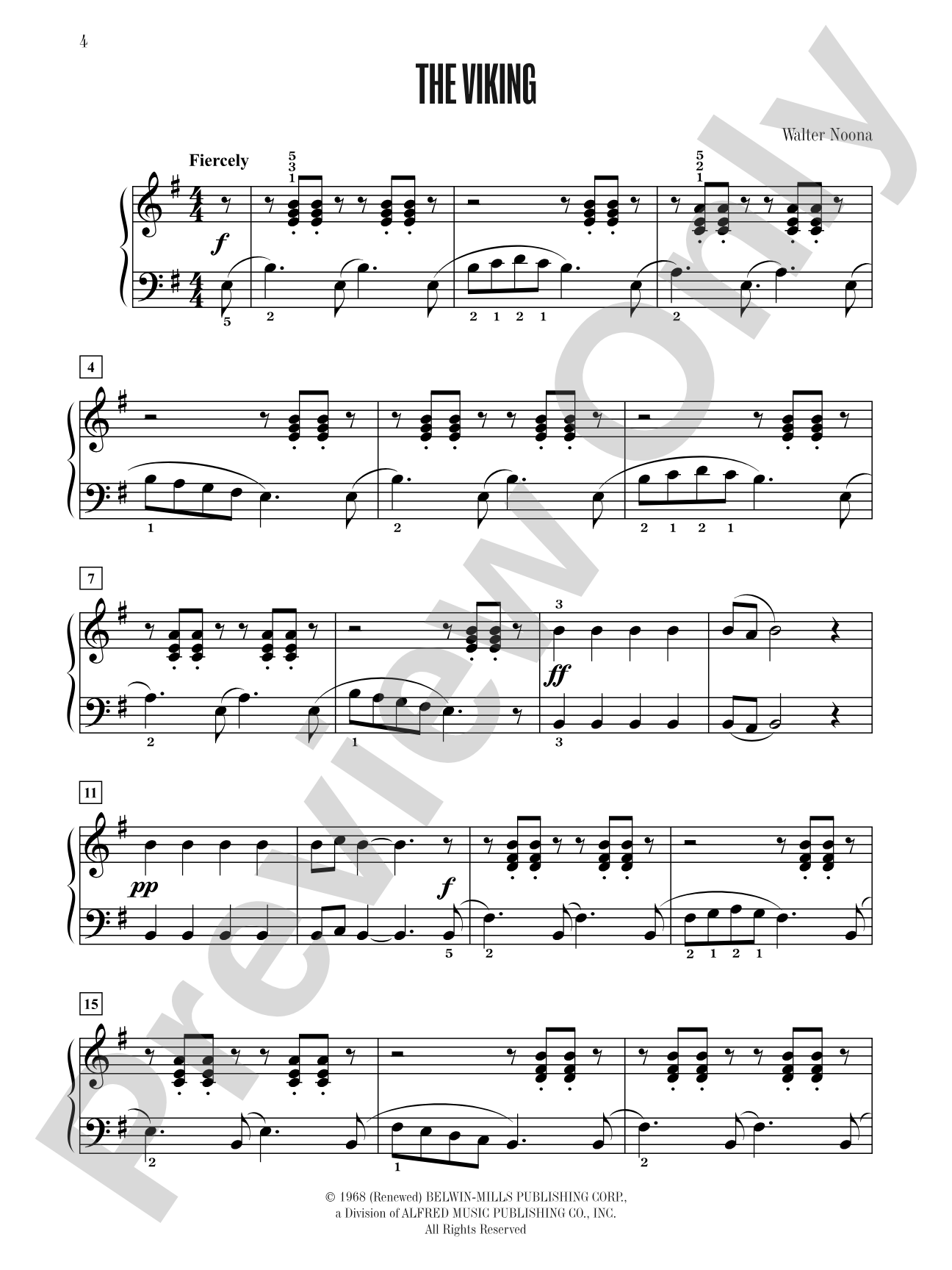

The Viking - Piano Solo: Piano Solo
12 Original Piano Solos from the Libraries of Belwin-Mills and Summy-Birchard
Level: Early Intermediate / Intermediate
Item: 00-PS-0017622
$8.99
Pickup currently not available
Related Items
¡Olé! - Piano Solo: Piano Solo |
$4.99
|
View | |
Aeolian Harp - Piano Solo: Piano Solo |
$4.99
|
View | |
Braziliana - Piano Solo: Piano Solo |
$4.99
|
View | |
Ceremonial - Piano Solo: Piano Solo |
$4.99
|
View | |
Coffee Beans - Piano Solo: Piano Solo |
$4.99
|
View | |
Hopak - Piano Solo: Piano Solo |
$4.99
|
View | |
Reflections of the Moon - Piano Solo: Piano Solo |
$4.99
|
View | |
Shadows on the Moon - Piano Solo: Piano Solo |
$4.99
|
View | |
Sonatina in A Minor - Piano Solo: Piano Solo |
$5.99
|
View | |
Spanish Serenade - Piano Solo: Piano Solo |
$4.99
|
View | |
The Spider Dance - Piano Solo: Piano Solo |
$4.99
|
View | |
Belwin Contest Winners, Book 3: Piano Book |
$8.99
|
View |
Description
Exciting piano solos are motivating for students, as well as thrilling for audiences. Thoughtfully written and carefully graded original compositions are essential for every piano studio and produce successful learning experiences for students. Over the years, Belwin-Mills and Summy-Birchard produced extensive libraries of quality elementary and intermediate supplementary piano music. The pieces included in this series represent the two companies' most popular and effective solos drawn from festival and contest lists. Book 3 is for early intermediate through intermediate students and the pieces are placed in approximate order of difficulty. Titles: Aeolian Harp * Braziliana * Ceremonial * Coffee Beans * Hopak * ¡Olé! * Reflections of the Moon * Shadows on the Moon * Sonatina in A Minor * Spanish Serenade * The Spider Dance * The Viking. A Federation Festivals 2024-2028 selection.


The Viking - Piano Solo: Piano Solo isn't in MakeMusic Cloud just yet...but it could be. Let us know you'd like to see it, and you'll help shape what comes next. In the meantime, start a free trial and dive into thousands of interactive titles your students can play along with today.
Request This Title
Tell us you want it.
Start Your Free Trial
Explore everything that's ready to play right now.
Sample Audio
No sample audio found.
Sample Video
No sample videos found.
Additional Details
Series:
Belwin Contest Winners
Publisher:
Alfred Music
Page Count:
32
SKU:
00-PS-0017622
More about this title
About the Composer: Walter Noona
Walter Noona's contributions to piano pedagogy span decades, with a catalog that balances musical integrity and realistic student demands. His work for Belwin-Mills and Summy-Birchard established him as a composer who understood what makes early intermediate pianists feel successful without sacrificing genuine musicality.
Why we love this
Noona's writing balances technical clarity with genuine musical character. These pieces live on festival lists because they reward careful practice without requiring students to sacrifice interpretive joy for mechanics.
What to expect
Noona writes accessible music that doesn't feel simplified. The Viking captures rhythmic vitality and forward motion; Aeolian Harp shimmers with textural interest. These pieces feel substantial enough to own, not merely exercises to complete.
Who it's for
Early intermediate through intermediate piano students preparing for recitals, festivals, or competitions. The collection offers variety in style and character, so students can find pieces that match their strengths while developing new technical and interpretive skills.
How to get the most out of it
- Build the rhythmic momentum gradually in The Viking. Resist rushing the opening; let the energy accumulate through repetition and dynamic layering.
- Listen closely to the balance between hands in pieces with extended passages in the treble register. The left hand often carries harmonic color that shouldn't disappear beneath the melody.
- Mark phrase endings clearly in your score before the first run-through. Noona's phrasing isn't always obvious at sight, and identifying it early prevents choppy playing later.
- Experiment with pedal strategically in the more atmospheric pieces like Shadows on the Moon and Reflections of the Moon. These pieces benefit from resonance, but clarity matters more than wash.
How to use it
Select individual pieces for recital programming rather than performing the entire collection at once. The range of styles means you can build a balanced program that demonstrates technical variety: pair a rhythmic piece like Hopak with something introspective like Reflections of the Moon, or lead with a character piece and close with something spirited.
Skills your students will build
- Legato and staccato articulation across different hand positions
- Pedal technique for sustain without muddiness
- Phrasing and shaping at the early intermediate level
- Right-hand melodic control with active left-hand accompaniment
- Rhythmic confidence in mixed meters and syncopated figures
- Sight-reading fluency across contrasting musical styles