
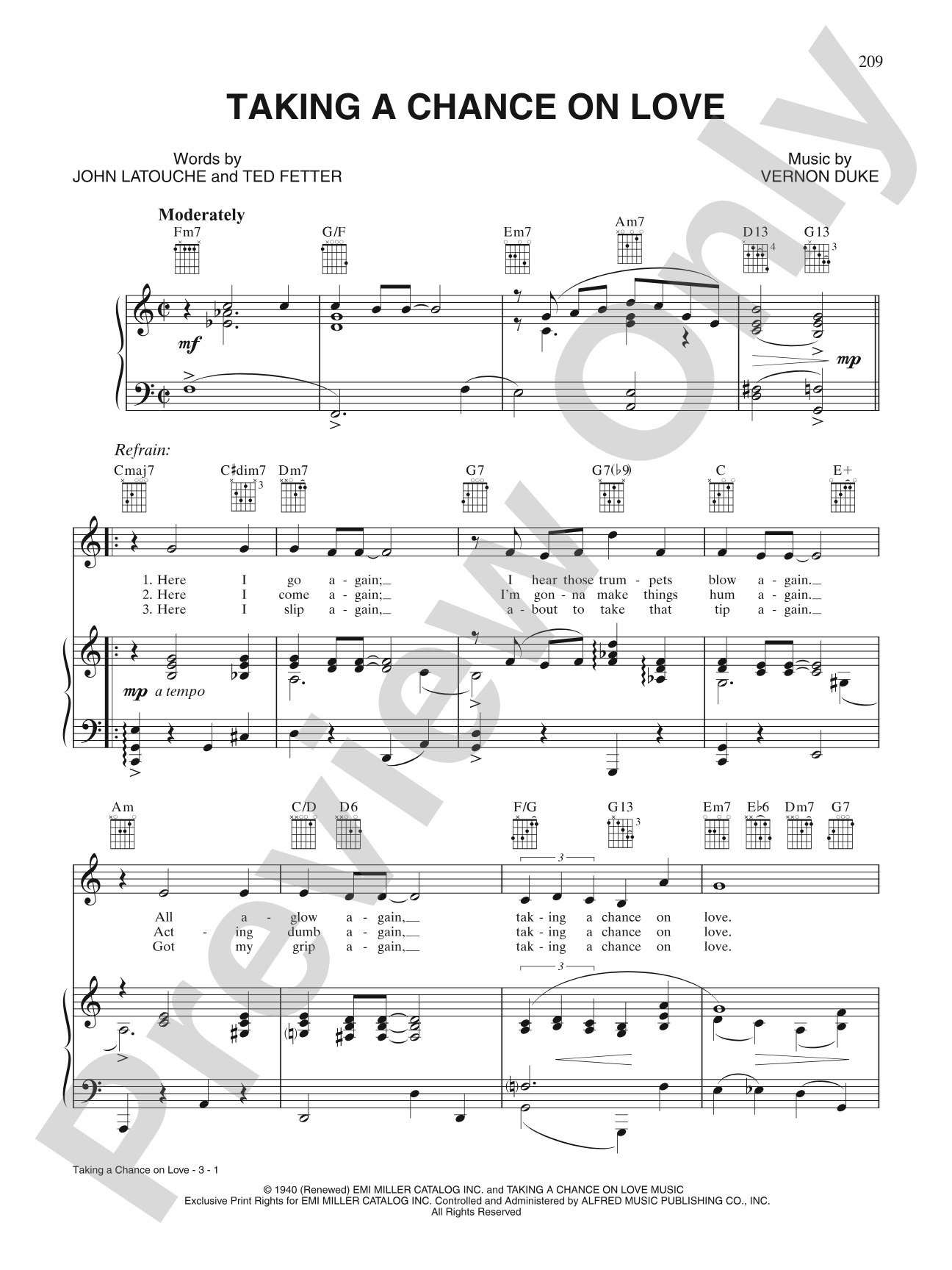

Taking a Chance on Love: Piano/Vocal/Chords
Item: 00-PS-0015631
$4.99
One moment…
Related Items
This Masquerade: Piano/Vocal/Chords |
$4.99
|
View | |
Misty: Piano/Vocal/Chords |
$4.99
|
View | |
Deep Purple: Piano/Vocal/Chords |
$4.99
|
View | |
Chattanooga Choo Choo: Piano/Vocal/Chords |
$4.99
|
View | |
Elmer's Tune: Piano/Vocal/Chords |
$4.99
|
View | |
Hey There: Piano/Vocal/Chords |
$4.99
|
View | |
Somewhere My Love (Lara's Theme): Piano/Vocal/Chords |
$4.99
|
View | |
You Stepped Out of a Dream: Piano/Vocal/Chords |
$4.99
|
View | |
Take the "A" Train: Piano/Vocal/Chords |
$4.99
|
View | |
Star Dust: Piano/Vocal/Chords |
$4.99
|
View | |
Mood Indigo: Piano/Vocal/Chords |
$4.99
|
View | |
Butterfly: Piano/Vocal/Chords |
$4.99
|
View | |
Dear Mr. Gable/You Made Me Love You (I Didn't Want to Do It): Piano/Vocal/Chords |
$4.99
|
View | |
I Let a Song Go Out of My Heart: Piano/Vocal/Chords |
$4.99
|
View | |
Smoke Rings: Piano/Vocal/Chords |
$4.99
|
View | |
Reach for Tomorrow: Piano/Vocal/Chords |
$4.99
|
View |
Description
This massive songbook is packed with sheet music for 75 of the most memorable standards for all occasions! Dozens of gems from the golden years of 20th Century pop and jazz are joined by traditional melodies in this collection of essential songs that belong in every musician's repertoire. Titles: Ain't Misbehavin' * All of Me * America the Beautiful * At Last * The Best Is Yet to Come * Blue Moon * Butterfly * Chattanooga Choo Choo * Dance Little Bird (a.k.a. The Chicken Dance) * Danny Boy (Londonderry Air) * Deep Purple * Don't Get Around Much Anymore * Don't Sit Under the Apple Tree * Dream a Little Dream of Me * Elmer's Tune * Fly Me to the Moon * Havah Nagilah * Heart * Hernando's Hideaway * Hey There! * Hi-Lili, Hi-Lo * Hit the Road Jack * I Don't Know Why (I Just Do) * I Let a Song Go out of My Heart * I Put a Spell on You * I Wanna Be Loved by You * I'm a Little Mixed Up * I'm Gonna Sit Right Down and Write Myself a Letter * I'm in the Mood for Love * Laura * Leaving on a Jet Plane * The Lion Sleeps Tonight * Love Is a Many Splendored Thing * Love Story (Where Do I Begin) * Misty * Mood Indigo * Moonlight Serenade * My Man * Theme from New York, New York * On the Atchison, Topeka, and the Santa Fe * Orange Colored Sky * Over the Rainbow * The Pink Panther * Reach for Tomorrow * Rock Around the Clock * The Shadow of Your Smile * Singin' in the Rain * Smoke Rings * Somewhere My Love * Stairway to the Stars * Star Dust * Star Eyes * Stars Fell on Alabama * Straighten Up and Fly Right * Swinging on a Star * Take Five * Take the "A" Train * Taking a Chance on Love * That's Amore * There Will Never Be Another You * This Masquerade * Those Were the Days * Tie a Yellow Ribbon 'Round the Ole Oak Tree * The Trolley Song * The Twelfth of Never * We Just Couldn't Say Goodbye * What a Wonderful World * Whatever Lola Wants * When the Saints Go Marching In * Who's Sorry Now? * Yesterday When I Was Young * You Don't Have to Say You Love Me * You Made Me Love You * You Stepped Out of a Dream * Young at Heart.


Taking a Chance on Love: Piano/Vocal/Chords isn't in MakeMusic Cloud just yet...but it could be. Let us know you'd like to see it, and you'll help shape what comes next. In the meantime, start a free trial and dive into thousands of interactive titles your students can play along with today.
Request This Title
Tell us you want it.
Start Your Free Trial
Explore everything that's ready to play right now.
Sample Audio
No sample audio found.
Sample Video
No sample videos found.
Additional Details
Series:
The Giant Book of Sheet Music
Publisher:
Alfred Music
Page Count:
276
SKU:
00-PS-0015631
More about this title
About the Composer: Vernon Duke
Vernon Duke (1903–1969) was a Russian-American composer whose gift for melody and harmonic sophistication made him a fixture of American musical theater and popular song. Born Vladimir Dukelsky, he studied under Glière in Russia before emigrating to the United States, where he adopted his anglicized name and became known for his lyrical, jazz-inflected compositions that bridged classical training and vernacular idiom.
Duke's catalog includes scores for Broadway musicals, Hollywood films, and hundreds of standards that capture the wit and elegance of the mid-twentieth century. His work demonstrates that popular song and serious musicianship are not at odds; his harmonic language and melodic gift continue to reward performers and listeners alike.
Why we love this
This collection delivers 75 genuine standards in one volume, sparing pianists and vocalists the need to hunt through a dozen songbooks. The mix of jazz classics, show tunes, and American standards means you can program almost any occasion from this single source, whether building a cabaret evening, assembling material for a jazz singer, or filling repertoire gaps for a piano student exploring the Great American Songbook.
What to expect
Opening this book is like stepping into a jazz lounge circa 1940–1960, where every standard captures a specific mood or historical moment. Some songs swing with optimism and rhythmic buoyancy; others settle into introspective minor-key reflections or sentimental ballad territory. The variety keeps performers engaged and reminds you why these melodies have endured.
Who it's for
This book serves jazz pianists building a working repertoire, vocalists seeking reliable leadsheet arrangements across multiple styles and eras, and classroom teachers who need authentic standards for performance contexts ranging from recitals to ensemble features. Guitar players with leadsheet literacy will also find it valuable for rhythm section work or solo interpretations.
How to get the most out of it
- Treat the chord symbols as starting points, not gospel. Harmonic substitutions and reharmonizations are part of the jazz standard tradition; use them to match the vocalist's voice type and your own musical instincts.
- Balance the melody with the underlying groove. Many of these songs sit comfortably on half-time or swing feels; lock into the rhythmic character before worrying about ornamentation.
- Pay attention to the lyrical content when voicing the piano part. Songs like 'At Last' demand a fuller, more romantic sound, while 'Rock Around the Clock' benefits from a leaner, driving touch.
- Use the chord inversions and bass line implications to create voice leading that serves both the singer and the song. A smooth descending bass often matters more than thick four-part voicings.
How to use it
Draw from this collection to build a themed concert (a night of Tin Pan Alley, a standards-based gala, or a jazz-inflected recital). It also works well as a resource for pairing with instrumental soloists or as supplementary repertoire for jazz ensemble singers who need consistent, accessible material. The digital format makes it convenient for aria preparation across multiple styles without committing to purchase of individual songbooks.
Skills your students will build
- Reading leadsheet notation and interpreting chord symbols in jazz and popular music contexts
- Voice leading for piano accompaniment across varied harmonic vocabularies and song styles
- Stylistic interpretation: recognizing and executing the specific rhythmic and harmonic character of swing, ballad, novelty, and theatrical standards
- Transposition and adaptation of melodies to fit the vocal range and tessitura of individual singers
- Sight-reading fluency across multiple pages of standards-based repertoire