
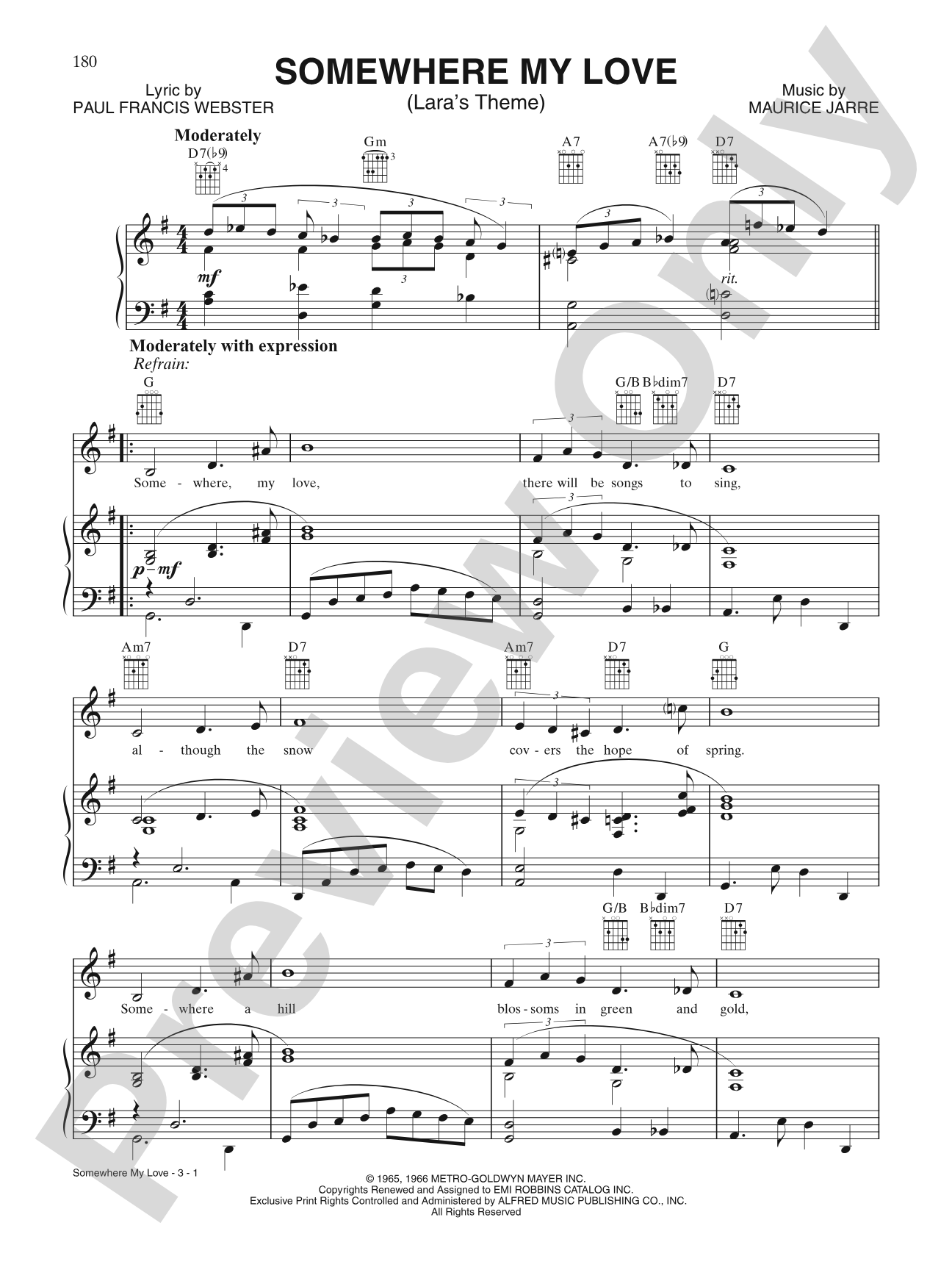

Somewhere My Love (Lara's Theme): Piano/Vocal/Chords
Item: 00-PS-0015637
$4.99
One moment…
Related Items
This Masquerade: Piano/Vocal/Chords |
$4.99
|
View | |
Misty: Piano/Vocal/Chords |
$4.99
|
View | |
Taking a Chance on Love: Piano/Vocal/Chords |
$4.99
|
View | |
Deep Purple: Piano/Vocal/Chords |
$4.99
|
View | |
Chattanooga Choo Choo: Piano/Vocal/Chords |
$4.99
|
View | |
Elmer's Tune: Piano/Vocal/Chords |
$4.99
|
View | |
Hey There: Piano/Vocal/Chords |
$4.99
|
View | |
You Stepped Out of a Dream: Piano/Vocal/Chords |
$4.99
|
View | |
Take the "A" Train: Piano/Vocal/Chords |
$4.99
|
View | |
Star Dust: Piano/Vocal/Chords |
$4.99
|
View | |
Mood Indigo: Piano/Vocal/Chords |
$4.99
|
View | |
Butterfly: Piano/Vocal/Chords |
$4.99
|
View | |
Dear Mr. Gable/You Made Me Love You (I Didn't Want to Do It): Piano/Vocal/Chords |
$4.99
|
View | |
I Let a Song Go Out of My Heart: Piano/Vocal/Chords |
$4.99
|
View | |
Smoke Rings: Piano/Vocal/Chords |
$4.99
|
View | |
Reach for Tomorrow: Piano/Vocal/Chords |
$4.99
|
View |
Description
This massive songbook is packed with sheet music for 75 of the most memorable standards for all occasions! Dozens of gems from the golden years of 20th Century pop and jazz are joined by traditional melodies in this collection of essential songs that belong in every musician's repertoire. Titles: Ain't Misbehavin' * All of Me * America the Beautiful * At Last * The Best Is Yet to Come * Blue Moon * Butterfly * Chattanooga Choo Choo * Dance Little Bird (a.k.a. The Chicken Dance) * Danny Boy (Londonderry Air) * Deep Purple * Don't Get Around Much Anymore * Don't Sit Under the Apple Tree * Dream a Little Dream of Me * Elmer's Tune * Fly Me to the Moon * Havah Nagilah * Heart * Hernando's Hideaway * Hey There! * Hi-Lili, Hi-Lo * Hit the Road Jack * I Don't Know Why (I Just Do) * I Let a Song Go out of My Heart * I Put a Spell on You * I Wanna Be Loved by You * I'm a Little Mixed Up * I'm Gonna Sit Right Down and Write Myself a Letter * I'm in the Mood for Love * Laura * Leaving on a Jet Plane * The Lion Sleeps Tonight * Love Is a Many Splendored Thing * Love Story (Where Do I Begin) * Misty * Mood Indigo * Moonlight Serenade * My Man * Theme from New York, New York * On the Atchison, Topeka, and the Santa Fe * Orange Colored Sky * Over the Rainbow * The Pink Panther * Reach for Tomorrow * Rock Around the Clock * The Shadow of Your Smile * Singin' in the Rain * Smoke Rings * Somewhere My Love * Stairway to the Stars * Star Dust * Star Eyes * Stars Fell on Alabama * Straighten Up and Fly Right * Swinging on a Star * Take Five * Take the "A" Train * Taking a Chance on Love * That's Amore * There Will Never Be Another You * This Masquerade * Those Were the Days * Tie a Yellow Ribbon 'Round the Ole Oak Tree * The Trolley Song * The Twelfth of Never * We Just Couldn't Say Goodbye * What a Wonderful World * Whatever Lola Wants * When the Saints Go Marching In * Who's Sorry Now? * Yesterday When I Was Young * You Don't Have to Say You Love Me * You Made Me Love You * You Stepped Out of a Dream * Young at Heart.


Somewhere My Love (Lara's Theme): Piano/Vocal/Chords isn't in MakeMusic Cloud just yet...but it could be. Let us know you'd like to see it, and you'll help shape what comes next. In the meantime, start a free trial and dive into thousands of interactive titles your students can play along with today.
Request This Title
Tell us you want it.
Start Your Free Trial
Explore everything that's ready to play right now.
Sample Audio
No sample audio found.
Sample Video
No sample videos found.
Additional Details
Series:
The Giant Book of Sheet Music
Publisher:
Alfred Music
Page Count:
276
SKU:
00-PS-0015637
More about this title
About the Composer: Maurice Jarre
Maurice Jarre (1924-2009) was a French film composer whose sweeping orchestral scores defined the sound of epic cinema for decades. He won three Academy Awards and composed for some of Hollywood's most ambitious productions, including Lawrence of Arabia, Doctor Zhivago, and Passage to India. His gift for melody and dramatic underscore earned him a place among the most performed film composers in concert halls and recital rooms worldwide.
Jarre's influence extends far beyond the screen. His themes have become standards in their own right, recorded countless times by jazz musicians, singers, and instrumentalists across every genre. For music educators, his work represents the intersection of popular appeal and sophisticated harmonic language—accessible enough for students to engage with immediately, yet rich enough to reward deeper musical study.
Why we love this
This collection gives you a curated snapshot of the American songbook and international standards that form the foundation of jazz and popular music literacy. The breadth here is remarkable: you get iconic film themes alongside jazz classics, tin pan alley standards, and folk songs that have shaped American music culture. For rehearsals, performances, or individual study, having all 75 titles in one volume eliminates the hunt for scattered octavos and lead sheets.
What to expect
Opening this book is like stepping into a time capsule of American musical memory. There's a warmth and familiarity in these melodies, yet each song carries distinctive character: the sophisticated swing of Fly Me to the Moon, the wistful yearning of Laura, the infectious energy of Chattanooga Choo Choo. You'll recognize many of these instantly; others will feel like rediscoveries of songs that shaped generations of musicians.
Who it's for
Pianists, guitarists, and singers preparing for performances, jam sessions, or auditions will find this collection indispensable. Music students building their jazz and standards repertoire benefit from having so many iconic titles in one reference. Whether you're accompanying a vocalist, performing solo in a recital setting, or simply expanding your working repertoire, these 75 songs represent essential material.
How to get the most out of it
- Lean into the lyrical quality of the melody line even when playing solo piano versions. These songs were born from vocal writing, and honoring that phrasing makes the music breathe naturally.
- Pay attention to the chord symbols for comping and improvisation. Many of these standards reward subtle harmonic reharmonization once you know the basic changes cold.
- Use the piano reduction to understand the original arrangement, then experiment with different textures. Some songs shine in a sparse, intimate treatment while others need fuller voicings to land properly.
- Balance melody and accompaniment according to the song's context. A slow ballad like Misty may call for transparent left-hand voicings, while an uptempo number like Rock Around the Clock can handle more driving rhythmic support.
How to use it
Build a standards-focused recital or informal cabaret concert around selections from this collection. The variety means you can program contrasting moods and tempos that hold audience attention. For jazz ensembles, use these arrangements as starting points for your own big band or small group interpretations. Music students can work through this chronologically to understand how American popular melody evolved across the 20th century.
Skills your students will build
- Reading lead sheets with chord symbols and melody lines
- Improvising and comping changes over jazz and standard progressions
- Accompanying singers with appropriate harmonic textures and rhythmic support
- Recognizing and interpreting common harmonic progressions in popular music
- Transitioning between ensemble and solo performance styles
- Building fluency with the Great American Songbook repertoire