
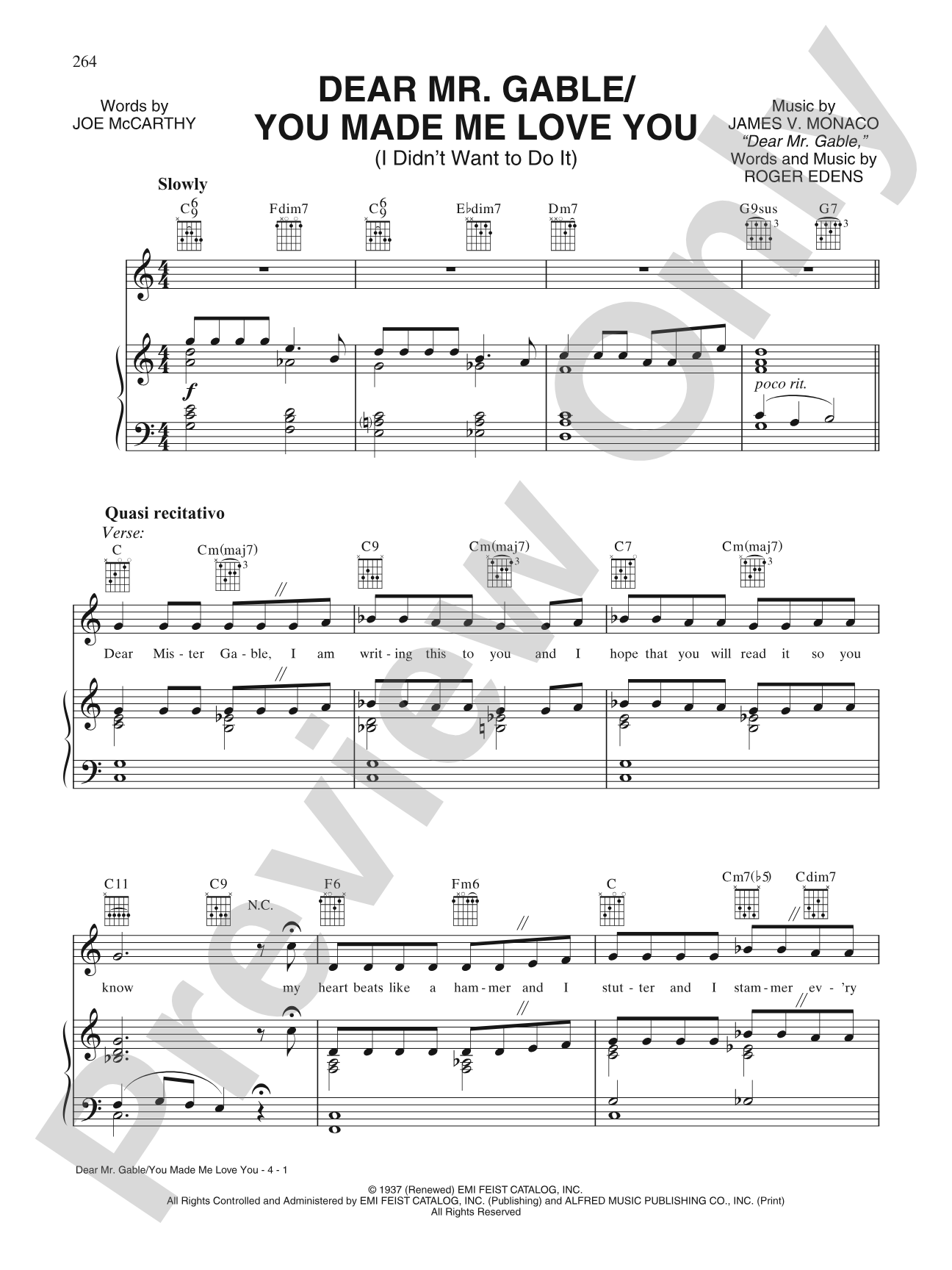

Dear Mr. Gable/You Made Me Love You (I Didn't Want to Do It): Piano/Vocal/Chords
Item: 00-PS-0015644
$4.99
One moment…
Related Items
This Masquerade: Piano/Vocal/Chords |
$4.99
|
View | |
Misty: Piano/Vocal/Chords |
$4.99
|
View | |
Taking a Chance on Love: Piano/Vocal/Chords |
$4.99
|
View | |
Deep Purple: Piano/Vocal/Chords |
$4.99
|
View | |
Chattanooga Choo Choo: Piano/Vocal/Chords |
$4.99
|
View | |
Elmer's Tune: Piano/Vocal/Chords |
$4.99
|
View | |
Hey There: Piano/Vocal/Chords |
$4.99
|
View | |
Somewhere My Love (Lara's Theme): Piano/Vocal/Chords |
$4.99
|
View | |
You Stepped Out of a Dream: Piano/Vocal/Chords |
$4.99
|
View | |
Take the "A" Train: Piano/Vocal/Chords |
$4.99
|
View | |
Star Dust: Piano/Vocal/Chords |
$4.99
|
View | |
Mood Indigo: Piano/Vocal/Chords |
$4.99
|
View | |
Butterfly: Piano/Vocal/Chords |
$4.99
|
View | |
I Let a Song Go Out of My Heart: Piano/Vocal/Chords |
$4.99
|
View | |
Smoke Rings: Piano/Vocal/Chords |
$4.99
|
View | |
Reach for Tomorrow: Piano/Vocal/Chords |
$4.99
|
View |
Description
This massive songbook is packed with sheet music for 75 of the most memorable standards for all occasions! Dozens of gems from the golden years of 20th Century pop and jazz are joined by traditional melodies in this collection of essential songs that belong in every musician's repertoire. Titles: Ain't Misbehavin' * All of Me * America the Beautiful * At Last * The Best Is Yet to Come * Blue Moon * Butterfly * Chattanooga Choo Choo * Dance Little Bird (a.k.a. The Chicken Dance) * Danny Boy (Londonderry Air) * Deep Purple * Don't Get Around Much Anymore * Don't Sit Under the Apple Tree * Dream a Little Dream of Me * Elmer's Tune * Fly Me to the Moon * Havah Nagilah * Heart * Hernando's Hideaway * Hey There! * Hi-Lili, Hi-Lo * Hit the Road Jack * I Don't Know Why (I Just Do) * I Let a Song Go out of My Heart * I Put a Spell on You * I Wanna Be Loved by You * I'm a Little Mixed Up * I'm Gonna Sit Right Down and Write Myself a Letter * I'm in the Mood for Love * Laura * Leaving on a Jet Plane * The Lion Sleeps Tonight * Love Is a Many Splendored Thing * Love Story (Where Do I Begin) * Misty * Mood Indigo * Moonlight Serenade * My Man * Theme from New York, New York * On the Atchison, Topeka, and the Santa Fe * Orange Colored Sky * Over the Rainbow * The Pink Panther * Reach for Tomorrow * Rock Around the Clock * The Shadow of Your Smile * Singin' in the Rain * Smoke Rings * Somewhere My Love * Stairway to the Stars * Star Dust * Star Eyes * Stars Fell on Alabama * Straighten Up and Fly Right * Swinging on a Star * Take Five * Take the "A" Train * Taking a Chance on Love * That's Amore * There Will Never Be Another You * This Masquerade * Those Were the Days * Tie a Yellow Ribbon 'Round the Ole Oak Tree * The Trolley Song * The Twelfth of Never * We Just Couldn't Say Goodbye * What a Wonderful World * Whatever Lola Wants * When the Saints Go Marching In * Who's Sorry Now? * Yesterday When I Was Young * You Don't Have to Say You Love Me * You Made Me Love You * You Stepped Out of a Dream * Young at Heart.


Dear Mr. Gable/You Made Me Love You (I Didn't Want to Do It): Piano/Vocal/Chords isn't in MakeMusic Cloud just yet...but it could be. Let us know you'd like to see it, and you'll help shape what comes next. In the meantime, start a free trial and dive into thousands of interactive titles your students can play along with today.
Request This Title
Tell us you want it.
Start Your Free Trial
Explore everything that's ready to play right now.
Sample Audio
No sample audio found.
Sample Video
No sample videos found.
Additional Details
Series:
The Giant Book of Sheet Music
Publisher:
Alfred Music
Page Count:
276
SKU:
00-PS-0015644
More about this title
About the Composer: James V. Monaco
James V. Monaco (1885-1945) was a prolific American composer and pianist who shaped popular song during the 1920s and 1930s. Working in both Broadway theater and Tin Pan Alley, he crafted melodies that balanced sophistication with immediate appeal, creating standards that remain central to the jazz and pop vocal repertoire.
Monaco's gifts lay in melody writing and harmonic sensibility. Songs like "Zing Went the Strings of My Heart" and "What Do You Do Sunday, Mary?" showcase his ability to craft memorable tunes that work equally well in concert halls, nightclubs, and living rooms. His compositions have been recorded by generations of singers and remain essential reference points for interpreters of American song.
Why we love this
This collection captures the full spectrum of what makes standards enduring: witty novelty songs alongside sophisticated ballads, familiar jazz vehicles next to folk traditions, and pieces that work equally well in formal recital and casual performance settings. The breadth here means you can build entire programs around different moods and themes without reaching for multiple books, and the inclusion of both well-known favorites and deeper catalog cuts gives performers and students genuine discovery opportunities alongside comfortable ground.
What to expect
You move through eras and moods fluidly here. One moment you're in the bright, rhythmic world of novelty swing ("Chattanooga Choo Choo," "Rock Around the Clock"), the next you're navigating the intimate introspection of a Tin Pan Alley ballad. The piano writing balances support with character; these arrangements respect the voice while maintaining their own voice, creating a sense of genuine partnership between singer and accompanist.
Who it's for
This book serves singers developing a standards repertoire, pianists and guitarists seeking reliable accompanying materials for teaching and performance, and any musician building a working knowledge of 20th-century American popular song. It works equally well for solo recital preparation, jazz ensemble contexts, and vocal coaching.
How to get the most out of it
- Attend closely to chord voicings in the piano part. These arrangements are written for performers, not as skeletal lead sheets, so the accompaniment carries harmonic color and voice leading that matters for interpretation.
- Use the chord symbols as a springboard for improvisation during rehearsal. Many of these standards have deep jazz roots, and singers benefit from exploring how chords function as a harmonic foundation rather than as fixed harmonic objects.
- Shape introductions and endings carefully. Piano/vocal standards rely on the accompanist to establish mood and tempo, so the few measures before the vocal entry set the entire tone for what follows.
- Balance text intelligibility with musical line. These songs value both melodic contour and lyrical clarity; resisting the urge to oversing ensures both the story and the music land.
How to use it
Build a standards-focused recital entirely from this collection, mixing tempos and textures to create shape and variety. Use individual songs as additions to themed programs (seasonal galas, jazz nights, heritage concerts) without needing to source multiple anthologies. This also works as a systematic resource for a vocal studio, allowing students to move through repertoire that builds both stylistic literacy and performance comfort.
Skills your students will build
- Interpreting jazz chord symbols and understanding harmonic function in popular song
- Balancing legato phrasing with rhythmic precision in swing and up-tempo standards
- Navigating the relationship between melodic line and lyrical text across multiple song styles
- Reading piano/vocal score layouts and coordinating with an accompanist
- Recognizing and performing period-appropriate stylistic conventions (diction, vibrato, articulation) across jazz, pop, and novelty song genres