
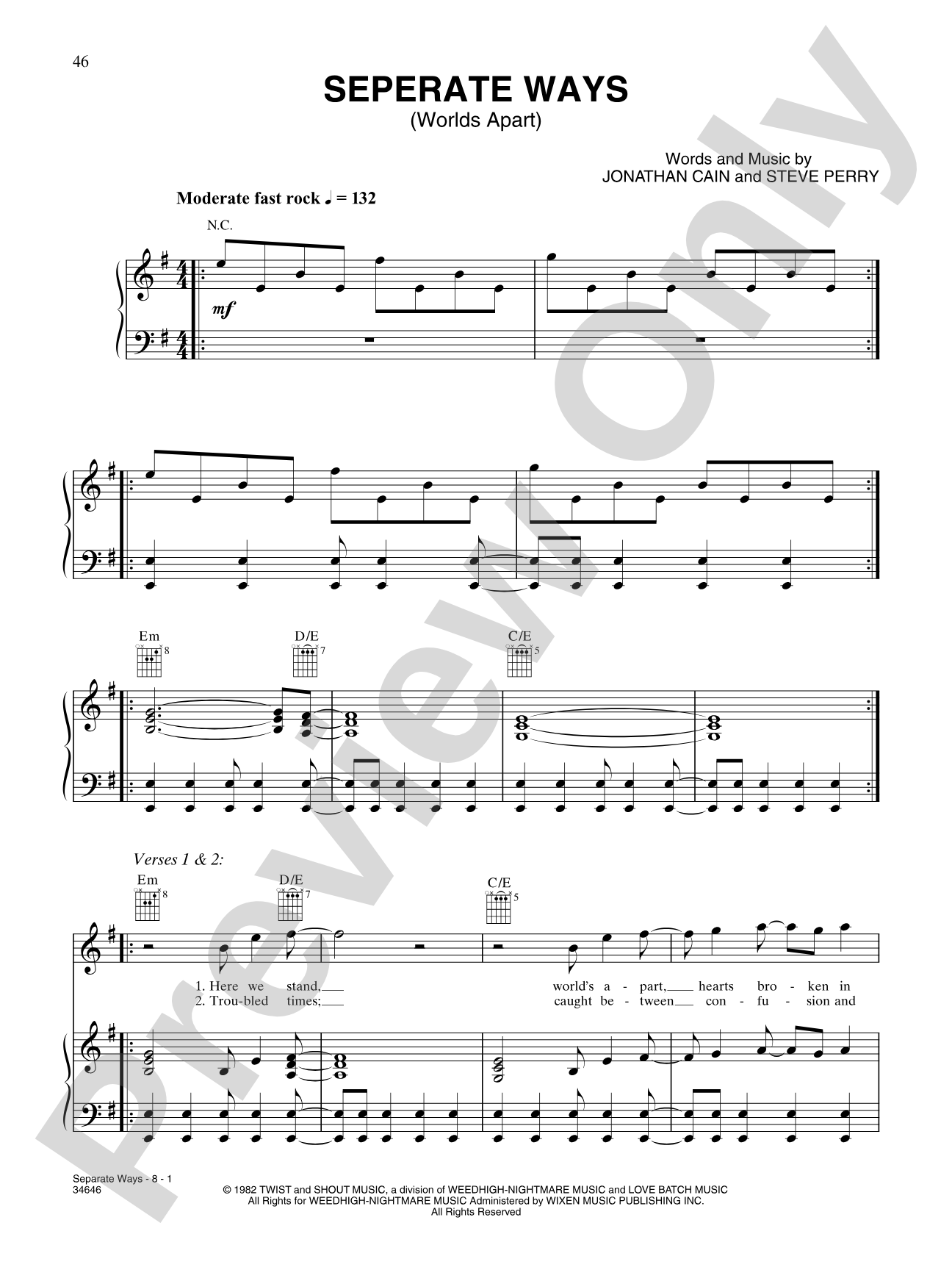
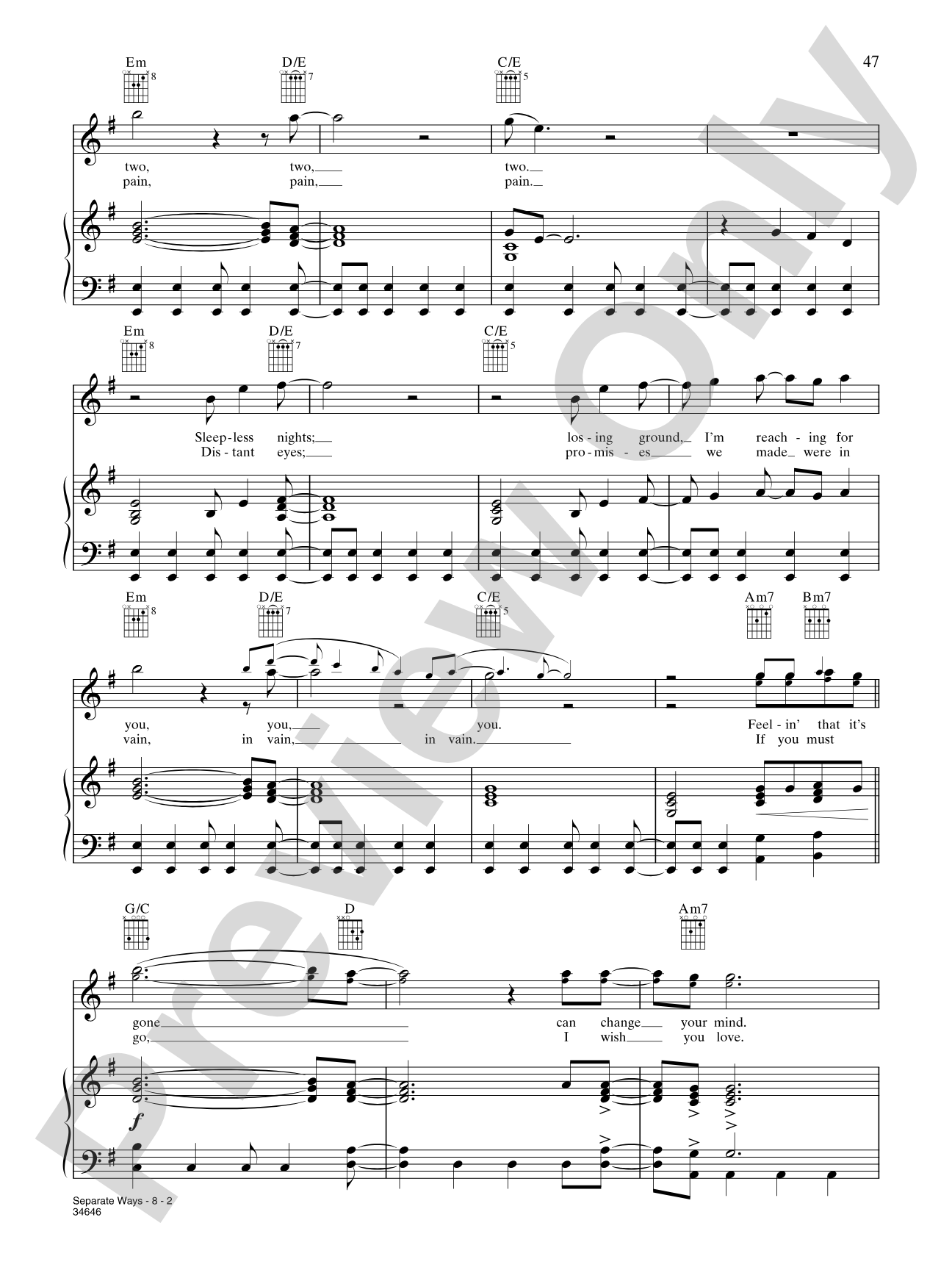

Separate Ways: Piano/Vocal/Chords
Journey
Item: 00-XS-0000011
$5.99
Pickup currently not available
Related Items
Don't Stop Believin': Piano/Vocal/Chords |
$4.99
|
View | |
Faithfully: Piano/Vocal/Chords |
$4.99
|
View | |
Send Her My Love: Piano/Vocal/Chords |
$4.99
|
View | |
Open Arms: Piano/Vocal/Chords |
$4.99
|
View | |
Who's Crying Now: Piano/Vocal/Chords |
$4.99
|
View | |
Any Way You Want It: Piano/Vocal/Chords |
$5.99
|
View | |
Lovin', Touchin', Squeezin': Piano/Vocal/Chords |
$5.99
|
View | |
Wheel In The Sky: Piano/Vocal/Chords |
$5.99
|
View | |
Only The Young: Piano/Vocal/Chords |
$5.99
|
View | |
Ask The Lonely: Piano/Vocal/Chords |
$5.99
|
View | |
Lights: Piano/Vocal/Chords |
$4.99
|
View | |
Journey: Greatest Hits (Updated Edition): Piano/Vocal/Guitar Book |
$24.99
|
View |
Description
Pianists will delight in this updated songbook, in which the piano/vocal arrangements have been notably improved (compared to older published sheet music renditions) to accurately reflect what was played on the band's original hit recordings. Basic guitar chord grids are also included. (A note-for-note guitar tablature edition is also available; sold separately.) Titles: Only the Young * Don't Stop Believin' * Wheel in the Sky * Faithfully * I'll Be Alright Without You * Any Way You Want It * Ask the Lonely * Who's Crying Now * Separate Ways (Worlds Apart) * Lights * Lovin', Touchin', Squeezin' * Open Arms * Girl Can't Help It * Send Her My Love * Be Good to Yourself.


Separate Ways: Piano/Vocal/Chords isn't in MakeMusic Cloud just yet...but it could be. Let us know you'd like to see it, and you'll help shape what comes next. In the meantime, start a free trial and dive into thousands of interactive titles your students can play along with today.
Request This Title
Tell us you want it.
Start Your Free Trial
Explore everything that's ready to play right now.
Sample Audio
No sample audio found.
Sample Video
No sample videos found.
Additional Details
Publisher:
Alfred Music
Page Count:
84
SKU:
00-XS-0000011
More about this title
About the Composer: Johathan Cain
Johathan Cain joined Journey in 1980 as keyboardist and songwriter, becoming instrumental in shaping the band's sound during their most commercially successful period. His compositions and co-writes form the backbone of Journey's catalog, including some of rock music's most enduring anthems. Cain's work bridges accessible pop sensibility with solid musicianship, making his songs natural choices for musicians learning to interpret rock repertoire with maturity.
Why we love this
These arrangements cut through decades of inconsistent sheet music to finally deliver what actually happens in the original recordings. Pianists and singers get arrangements that honor the source material without requiring them to reverse-engineer the records, and the addition of guitar chord grids makes this genuinely useful for ensemble playing or self-teaching musicians.
What to expect
These songs carry the confidence and warmth that defined Journey's mainstream success. The piano writing is often lush and supportive, creating space for vocals to breathe while maintaining the rich harmonic foundation that gives these tracks their emotional weight. You feel the scale and production value of stadium rock filtered through arrangements that work in intimate settings.
Who it's for
Pianists and keyboardists who perform Journey's catalog or want to learn from well-researched rock arrangements. Singers preparing these songs for recitals, auditions, or ensemble performance will benefit from having both accurate accompaniments and chord references. Guitar players can use the chord grids alongside piano players to develop secure ensemble coordination.
How to get the most out of it
- Study the original recordings alongside these charts. The piano voicings and rhythmic interpretations are designed to match what you hear, so listening reference points will clarify the arrangement choices.
- Pay attention to dynamic shaping in the piano part. These songs succeed through careful control of energy and space, not through playing everything at full volume.
- Balance the vocal line with the piano accompaniment carefully. The keyboard parts are substantial and can easily overshadow a singer if you're not deliberate about levels and texture.
- Coordinate with guitarists using the included chord grids to unify your rhythmic approach, especially in sections where the piano and guitar share harmonic responsibility.
How to use it
Build a contemporary rock recital or pops concert featuring these recognizable titles alongside other classic rock material. Use individual pieces as encore selections or as contrasting repertoire in a mixed-genre recital. These arrangements also serve pianists preparing for jazz/popular music study or auditions, since they require both classical technique and stylistic flexibility.
Skills your students will build
- Reading and executing rock rhythm patterns (syncopation, backbeat coordination)
- Interpreting lead sheet chord symbols and applying them to keyboard performance
- Balancing melodic and harmonic roles in ensemble settings
- Adapting classical keyboard technique to contemporary popular music idioms
- Coordinating ensemble parts from different instruments using shared harmonic information