
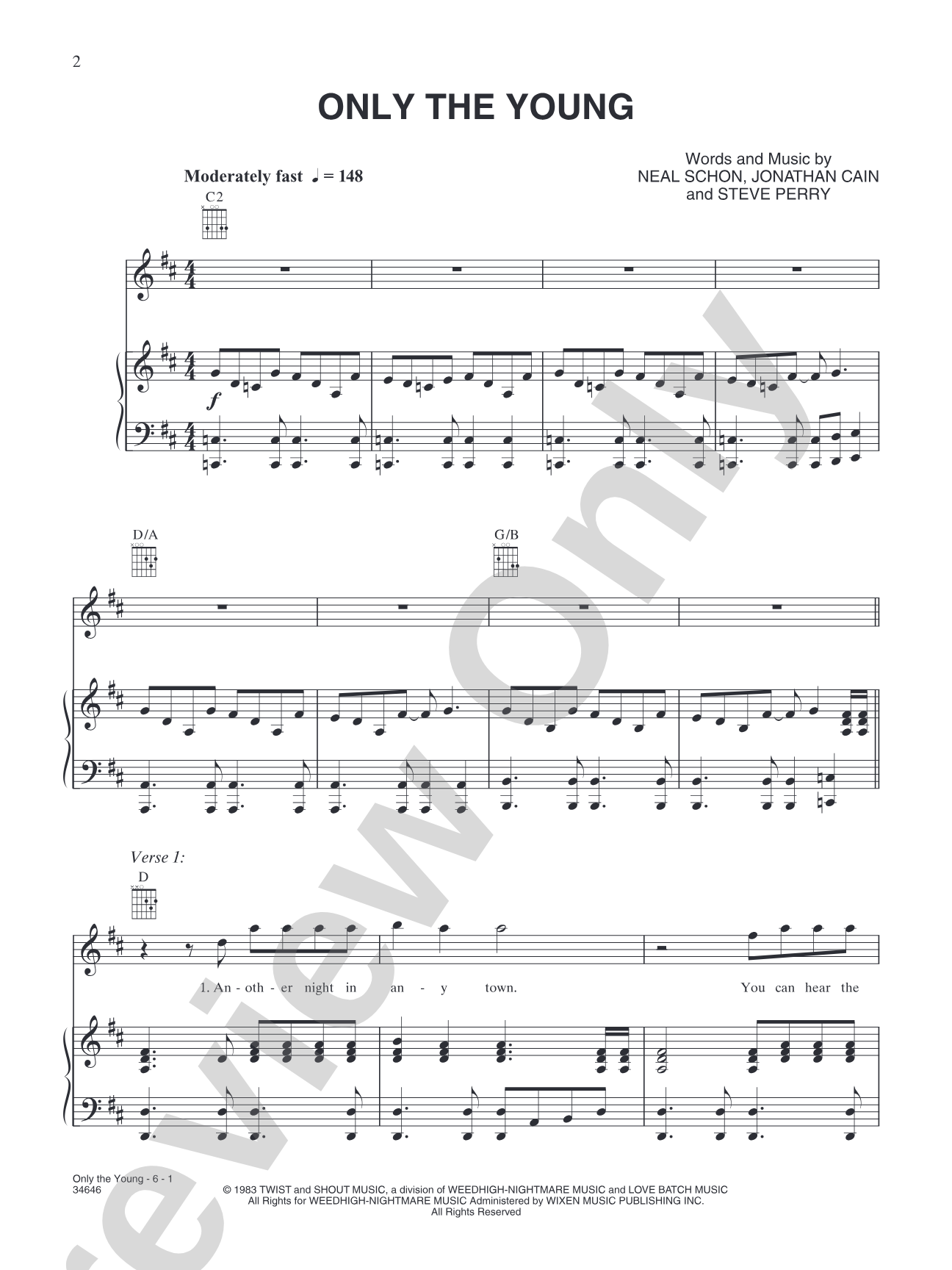
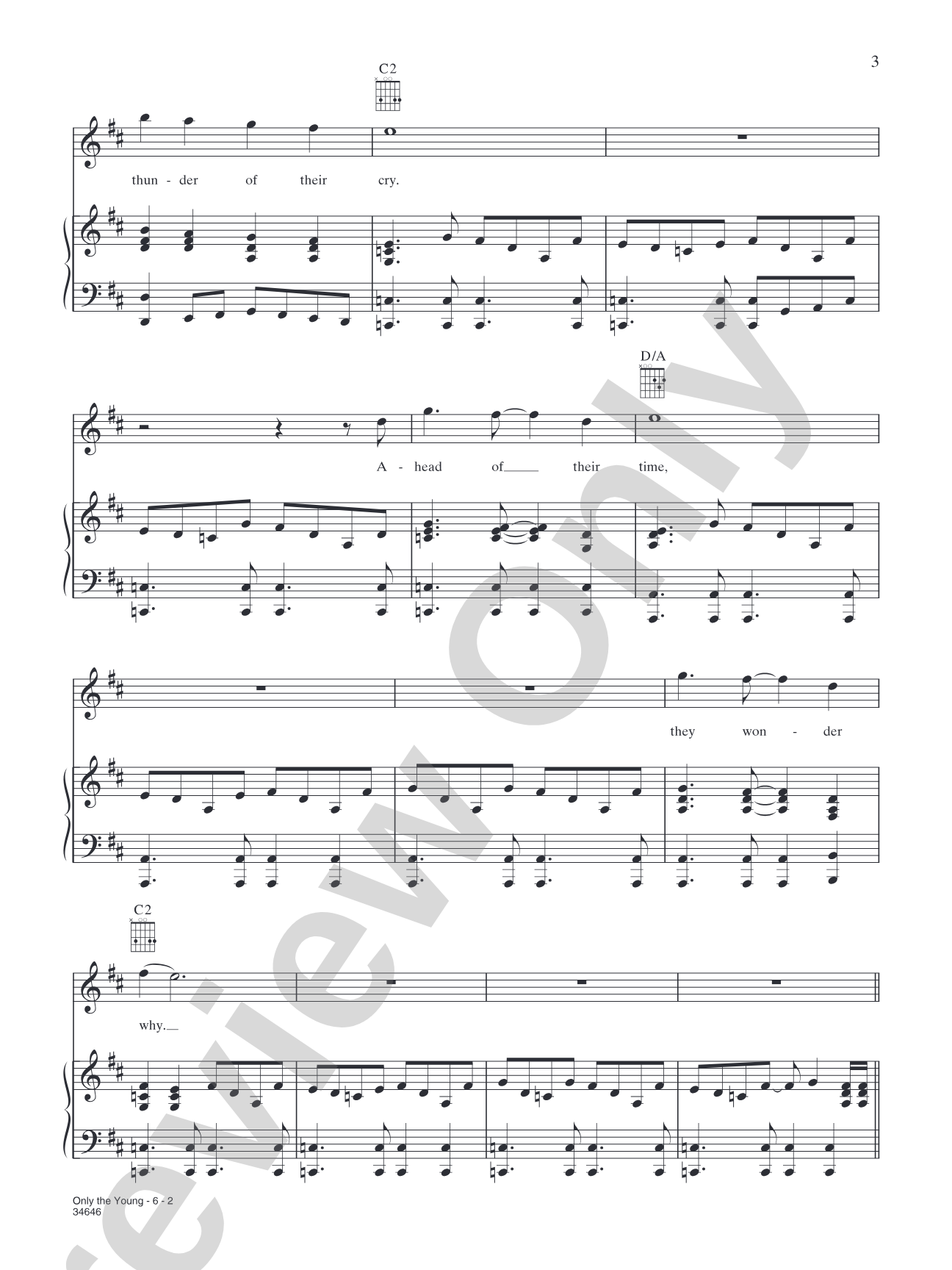

Only The Young: Piano/Vocal/Chords
Journey
Item: 00-XS-0000229
$5.99
Pickup currently not available
Related Items
Separate Ways: Piano/Vocal/Chords |
$5.99
|
View | |
Don't Stop Believin': Piano/Vocal/Chords |
$4.99
|
View | |
Faithfully: Piano/Vocal/Chords |
$4.99
|
View | |
Send Her My Love: Piano/Vocal/Chords |
$4.99
|
View | |
Open Arms: Piano/Vocal/Chords |
$4.99
|
View | |
Who's Crying Now: Piano/Vocal/Chords |
$4.99
|
View | |
Any Way You Want It: Piano/Vocal/Chords |
$5.99
|
View | |
Lovin', Touchin', Squeezin': Piano/Vocal/Chords |
$5.99
|
View | |
Wheel In The Sky: Piano/Vocal/Chords |
$5.99
|
View | |
Ask The Lonely: Piano/Vocal/Chords |
$5.99
|
View | |
Lights: Piano/Vocal/Chords |
$4.99
|
View | |
Journey: Greatest Hits (Updated Edition): Piano/Vocal/Guitar Book |
$24.99
|
View |
Description
Pianists will delight in this updated songbook, in which the piano/vocal arrangements have been notably improved (compared to older published sheet music renditions) to accurately reflect what was played on the band's original hit recordings. Basic guitar chord grids are also included. (A note-for-note guitar tablature edition is also available; sold separately.) Titles: Only the Young * Don't Stop Believin' * Wheel in the Sky * Faithfully * I'll Be Alright Without You * Any Way You Want It * Ask the Lonely * Who's Crying Now * Separate Ways (Worlds Apart) * Lights * Lovin', Touchin', Squeezin' * Open Arms * Girl Can't Help It * Send Her My Love * Be Good to Yourself.


Discover MakeMusic Cloud: thousands of interactive titles your students can play along with today.
Sample Audio
No sample audio found.
Sample Video
No sample videos found.
Additional Details
Publisher:
Alfred Music
Page Count:
84
SKU:
00-XS-0000229
More about this title
About the Composer: Neal Schon
Neal Schon founded Journey in 1973 and has remained the band's guitarist and primary musical architect throughout their five-decade career. His compositions and arrangements shaped the sound of arena rock in the 1970s and 1980s, blending progressive rock instrumentation with accessible melodic hooks that made Journey's catalog both technically interesting and commercially dominant.
Why we love this
These arrangements capture what actually appeared on Journey's hit recordings rather than generic transcriptions, making them rewarding to perform and accurate reference points for students learning from the original source. The mix of uptempo rockers and power ballads gives pianists and singers a complete stylistic toolkit, and the inclusion of guitar chords means band arrangements can be built from this single resource.
What to expect
The music swings between soaring, emotionally direct ballads and driving, rhythm-section-forward rockers, all grounded in the crystalline keyboard production that defined Journey's sound. There's an unironic sincerity to these melodies and an almost orchestral complexity to the harmonic progressions that made Journey's songs endure across generations.
Who it's for
Pianists and keyboardists seeking polished, arrangement-accurate versions of Journey's catalog for recitals, ensemble performance, or study of 1980s rock idiom. Singers building a rock or contemporary repertoire will find reliable vocal lines paired with functional chord charts and a professional piano score.
How to get the most out of it
- Study the original recordings alongside the sheet music to understand the dynamic contours and keyboard textures; the piano part should sit somewhere between exact transcription and interpretive freedom depending on whether you're accompanying a vocalist or performing solo.
- Pay attention to the chord voicings and rhythm notation, particularly in the ballads, since Journey's keyboard work often drives the harmonic color and the piano needs to project clearly in an ensemble setting.
- When accompanying a vocalist, lock the rhythmic feel to the original recording's tempo and groove; these songs were written to sit in a specific pocket, and rushing or dragging will expose weak arrangement choices.
How to use it
Slot these songs into a rock history or contemporary music unit, programming a ballad like 'Open Arms' or 'Faithfully' alongside an uptempo number like 'Don't Stop Believin'' to showcase Journey's range. Pianists can extract individual pieces for recital programs, or ensembles can use the guitar chords to build band or small-group arrangements on top of the keyboard foundation.
Skills your students will build
- Reading piano/vocal score layouts with chord annotations
- Performing 1980s rock keyboard textures and voicings
- Accompanying singers in contemporary commercial music
- Translating guitar chord grids into pianistic voicings
- Interpreting rhythmic notation and syncopation in rock contexts