
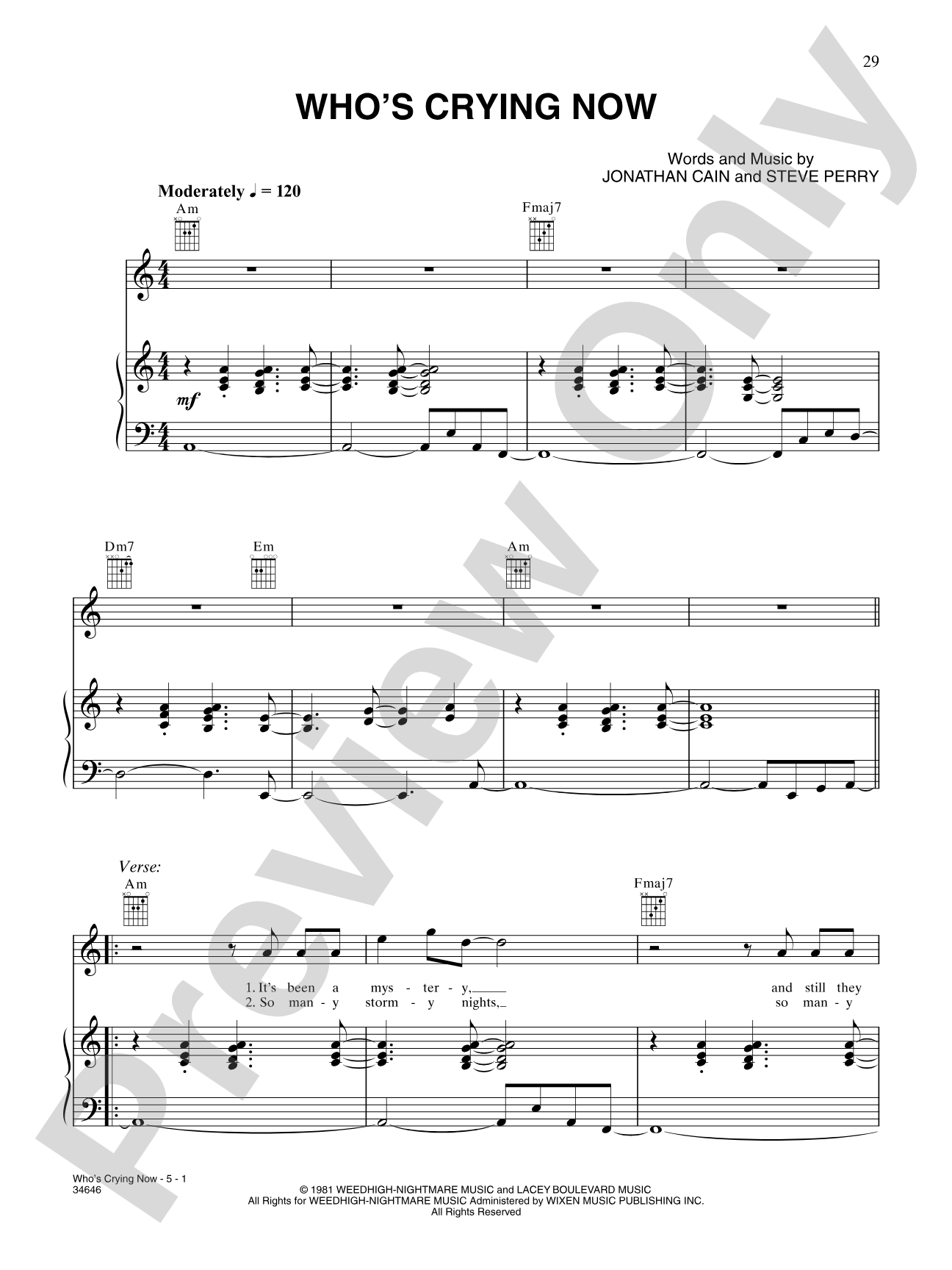

Who's Crying Now: Piano/Vocal/Chords
Journey
Item: 00-XS-0000225
$4.99
Pickup currently not available
Related Items
Separate Ways: Piano/Vocal/Chords |
$5.99
|
View | |
Don't Stop Believin': Piano/Vocal/Chords |
$4.99
|
View | |
Faithfully: Piano/Vocal/Chords |
$4.99
|
View | |
Send Her My Love: Piano/Vocal/Chords |
$4.99
|
View | |
Open Arms: Piano/Vocal/Chords |
$4.99
|
View | |
Any Way You Want It: Piano/Vocal/Chords |
$5.99
|
View | |
Lovin', Touchin', Squeezin': Piano/Vocal/Chords |
$5.99
|
View | |
Wheel In The Sky: Piano/Vocal/Chords |
$5.99
|
View | |
Only The Young: Piano/Vocal/Chords |
$5.99
|
View | |
Ask The Lonely: Piano/Vocal/Chords |
$5.99
|
View | |
Lights: Piano/Vocal/Chords |
$4.99
|
View | |
Journey: Greatest Hits (Updated Edition): Piano/Vocal/Guitar Book |
$24.99
|
View |
Description
Pianists will delight in this updated songbook, in which the piano/vocal arrangements have been notably improved (compared to older published sheet music renditions) to accurately reflect what was played on the band's original hit recordings. Basic guitar chord grids are also included. (A note-for-note guitar tablature edition is also available; sold separately.) Titles: Only the Young * Don't Stop Believin' * Wheel in the Sky * Faithfully * I'll Be Alright Without You * Any Way You Want It * Ask the Lonely * Who's Crying Now * Separate Ways (Worlds Apart) * Lights * Lovin', Touchin', Squeezin' * Open Arms * Girl Can't Help It * Send Her My Love * Be Good to Yourself.


Discover MakeMusic Cloud: thousands of interactive titles your students can play along with today.
Sample Audio
No sample audio found.
Sample Video
No sample videos found.
Additional Details
Publisher:
Alfred Music
Page Count:
84
SKU:
00-XS-0000225
More about this title
About the Composer: Jonathan Cain
Jonathan Cain joined Journey in 1980 as keyboardist and became a central creative force in the band's most commercially successful era. A multi-instrumentalist and composer, Cain co-wrote many of Journey's biggest hits, including "Faithfully," "Open Arms," and "Who's Crying Now." His contributions shaped the sound of stadium rock in the 1980s, blending synthesizer sophistication with memorable melodic hooks.
Beyond Journey, Cain has maintained an active career as a solo artist and session musician, demonstrating deep facility with both keyboard arrangement and songwriting across multiple rock subgenres. His work remains a touchstone for understanding how synthesizers and keyboards became essential to arena rock composition.
Why we love this
These arrangements honor what audiences actually heard on the records rather than offering generic approximations, making them genuinely useful for pianists learning from the original recordings. The pairing of piano arrangements with guitar chords gives singers and accompanists flexibility to work in different instrumental settings without needing multiple purchases. Journey's catalog sits at an ideal level for intermediate to advanced pianists seeking repertoire with immediate cultural recognition and satisfying harmonic complexity.
What to expect
Glossy, confident, soaring. These are songs about longing and endurance wrapped in the sheen of 1980s studio production: keyboards that shimmer and sustain, vocal lines that climb toward emotional peaks, chord progressions that feel both sophisticated and instantly singable. The arrangements capture that particular blend of rock sincerity and production polish that made Journey stadium staples.
Who it's for
Pianists seeking accurate, rewarding arrangements of songs they already know and want to perform. Singers and vocal coaches looking for reliable accompaniments with chord symbols for flexible instrumentation. Intermediate and advanced players building a repertoire of recognizable rock standards that challenge musicianship without requiring transcendental technique.
How to get the most out of it
- Anchor the left hand's synth-based patterns early in rehearsal; Journey's keyboard sound depends on rhythmic precision and consistent harmonic foundation.
- Reference the original recordings while learning the arrangements; hearing how the parts interact will clarify voicing choices that sheet notation alone won't fully capture.
- Balance sustain pedal carefully in the softer ballads like "Open Arms" and "Faithfully" to maintain clarity while capturing the lush production of the originals.
- Coordinate with your vocalist on rubato and phrasing in slower songs; Journey's vocal delivery often stretches across bar lines in ways the music notation doesn't always make obvious.
How to use it
Feature these in a popular music or songbook-style recital where audiences respond to songs they recognize and can sing along with. Use them as ear-training supplements for students exploring how hit songs translate to the page compared to recorded versions. Include "Open Arms" or "Faithfully" in a piano recital's lighter second half to showcase both technical control and musical storytelling.
Skills your students will build
- Interpreting synth-based keyboard textures and translating recorded production into performance
- Managing complex left-hand patterns while supporting vocal melodic line
- Coordinating piano arrangement with guitar chord symbols in a duo or small-group setting
- Phrasing and pedal control in power ballads
- Reading and understanding how studio layering translates to single-instrument arrangements