
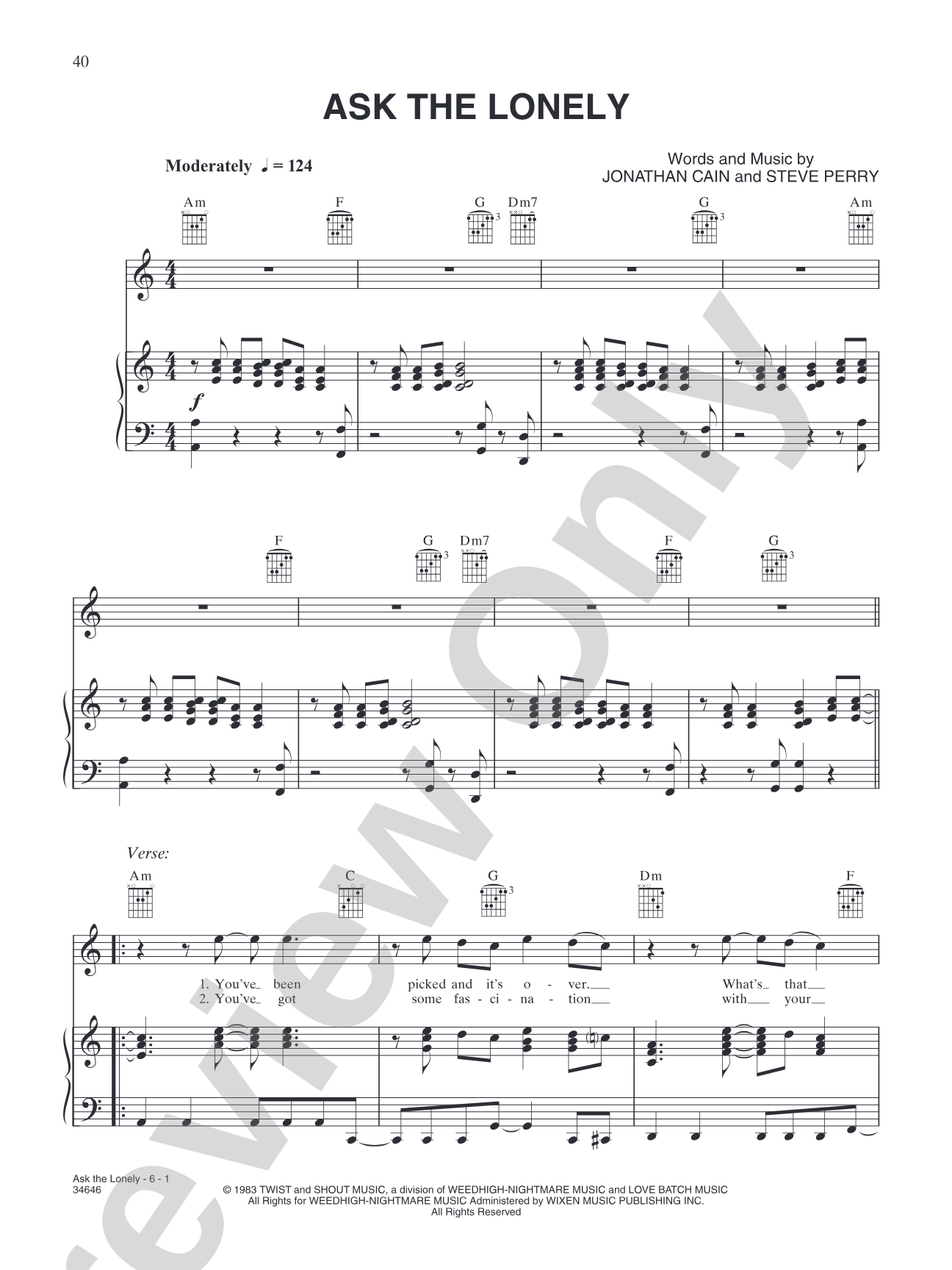
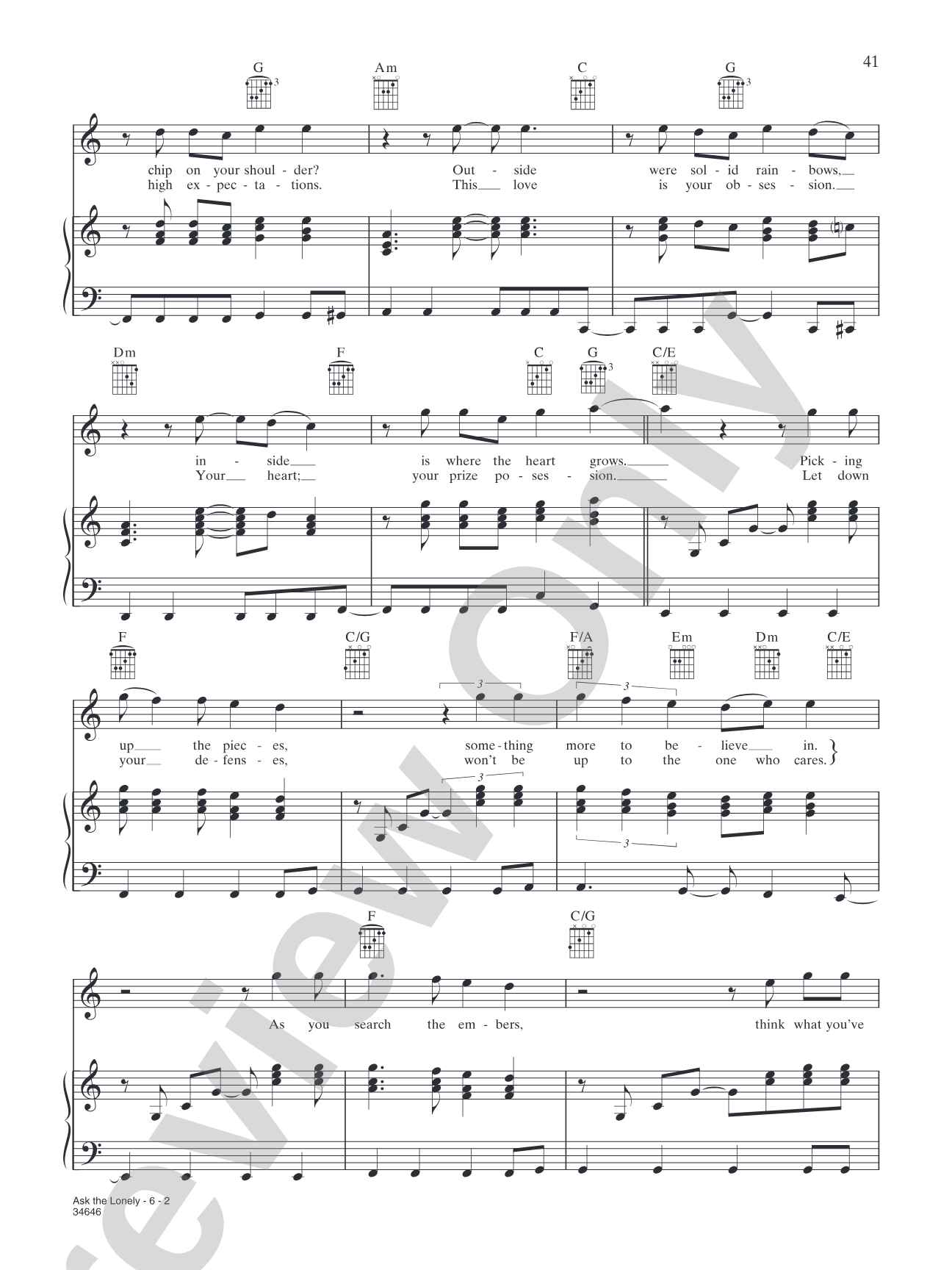

Ask The Lonely: Piano/Vocal/Chords
Journey
Item: 00-XS-0000230
$5.99
Pickup currently not available
Related Items
Separate Ways: Piano/Vocal/Chords |
$5.99
|
View | |
Don't Stop Believin': Piano/Vocal/Chords |
$4.99
|
View | |
Faithfully: Piano/Vocal/Chords |
$4.99
|
View | |
Send Her My Love: Piano/Vocal/Chords |
$4.99
|
View | |
Open Arms: Piano/Vocal/Chords |
$4.99
|
View | |
Who's Crying Now: Piano/Vocal/Chords |
$4.99
|
View | |
Any Way You Want It: Piano/Vocal/Chords |
$5.99
|
View | |
Lovin', Touchin', Squeezin': Piano/Vocal/Chords |
$5.99
|
View | |
Wheel In The Sky: Piano/Vocal/Chords |
$5.99
|
View | |
Only The Young: Piano/Vocal/Chords |
$5.99
|
View | |
Lights: Piano/Vocal/Chords |
$4.99
|
View | |
Journey: Greatest Hits (Updated Edition): Piano/Vocal/Guitar Book |
$24.99
|
View |
Description
Pianists will delight in this updated songbook, in which the piano/vocal arrangements have been notably improved (compared to older published sheet music renditions) to accurately reflect what was played on the band's original hit recordings. Basic guitar chord grids are also included. (A note-for-note guitar tablature edition is also available; sold separately.) Titles: Only the Young * Don't Stop Believin' * Wheel in the Sky * Faithfully * I'll Be Alright Without You * Any Way You Want It * Ask the Lonely * Who's Crying Now * Separate Ways (Worlds Apart) * Lights * Lovin', Touchin', Squeezin' * Open Arms * Girl Can't Help It * Send Her My Love * Be Good to Yourself.


Discover MakeMusic Cloud: thousands of interactive titles your students can play along with today.
Sample Audio
No sample audio found.
Sample Video
No sample videos found.
Additional Details
Publisher:
Alfred Music
Page Count:
84
SKU:
00-XS-0000230
More about this title
About the Composer: Jonathan Cain
Jonathan Cain joined Journey as keyboardist in 1980 and became a primary songwriter for the band during their most commercially successful era. His work as both performer and composer shaped the sound of arena rock throughout the 1980s, blending synthesizer textures with memorable melodic hooks that defined a generation of rock music.
Why we love this
These arrangements capture the actual keyboard and vocal textures from Journey's studio recordings rather than generic interpretations, making them immediately recognizable and satisfying to play. Pianists get authentic parts that feel like playing alongside the original band, while the included guitar chords allow for flexible ensemble configurations. The collection spans the band's essential catalog, giving you 15 of their most iconic songs in one resource.
What to expect
These arrangements embody the anthemic, soaring quality of 1980s arena rock: driving rhythmic patterns that propel the music forward, lush synthesizer voicings that fill the space, and vocal lines that sit perfectly on top of a sophisticated harmonic foundation. There's both accessibility and depth here—the songs are singable and immediately memorable, yet the keyboard writing shows the craft behind their original recording.
Who it's for
Pianists performing Journey repertoire in recitals, tributes, or community events will find these arrangements directly aligned with what audiences hear on the recordings. Keyboardists in tribute bands or rehearsal settings benefit from accurate voicings and textures. Singers working with piano accompaniment gain a resource where the keyboard part actively supports rather than simply provides harmonic foundation.
How to get the most out of it
- Lock the rhythmic foundation in the left hand before layering the right-hand melody; these arrangements rely on steady, driving patterns that anchor the vocal line.
- Pay attention to the synth-style voicings and arpeggios in the keyboard part; they're notated to reflect what listeners know from the recordings, so precision here matters for authenticity.
- Balance your accompaniment volume carefully if singers are performing with you; these arrangements are detailed enough to support but not overwhelm a vocal performance.
- Use the guitar chord grids as a reference point for harmonic color even when playing piano; understanding the harmonic progression helps shape your dynamic choices in the introduction and transitions.
How to use it
Build a complete Journey showcase for a rock or popular music concert, selecting five to seven songs that showcase range from the epic (Open Arms, Faithfully) to the uptempo (Don't Stop Believin', Any Way You Want It). These arrangements work equally well for piano recitals celebrating rock songwriting or as solo performance pieces in contemporary music settings. Singers preparing audition or performance repertoire can work from these reliable accompaniments without needing separate orchestral reductions.
Skills your students will build
- Interpreting synth-style voicings and arpeggios on acoustic piano
- Balancing accompaniment dynamics to support vocal performance
- Reading piano/vocal/guitar format and transferring harmonic information across instruments
- Executing rhythmic patterns that anchor rock-style grooves
- Stylistically interpreting 1980s arena rock keyboard textures