
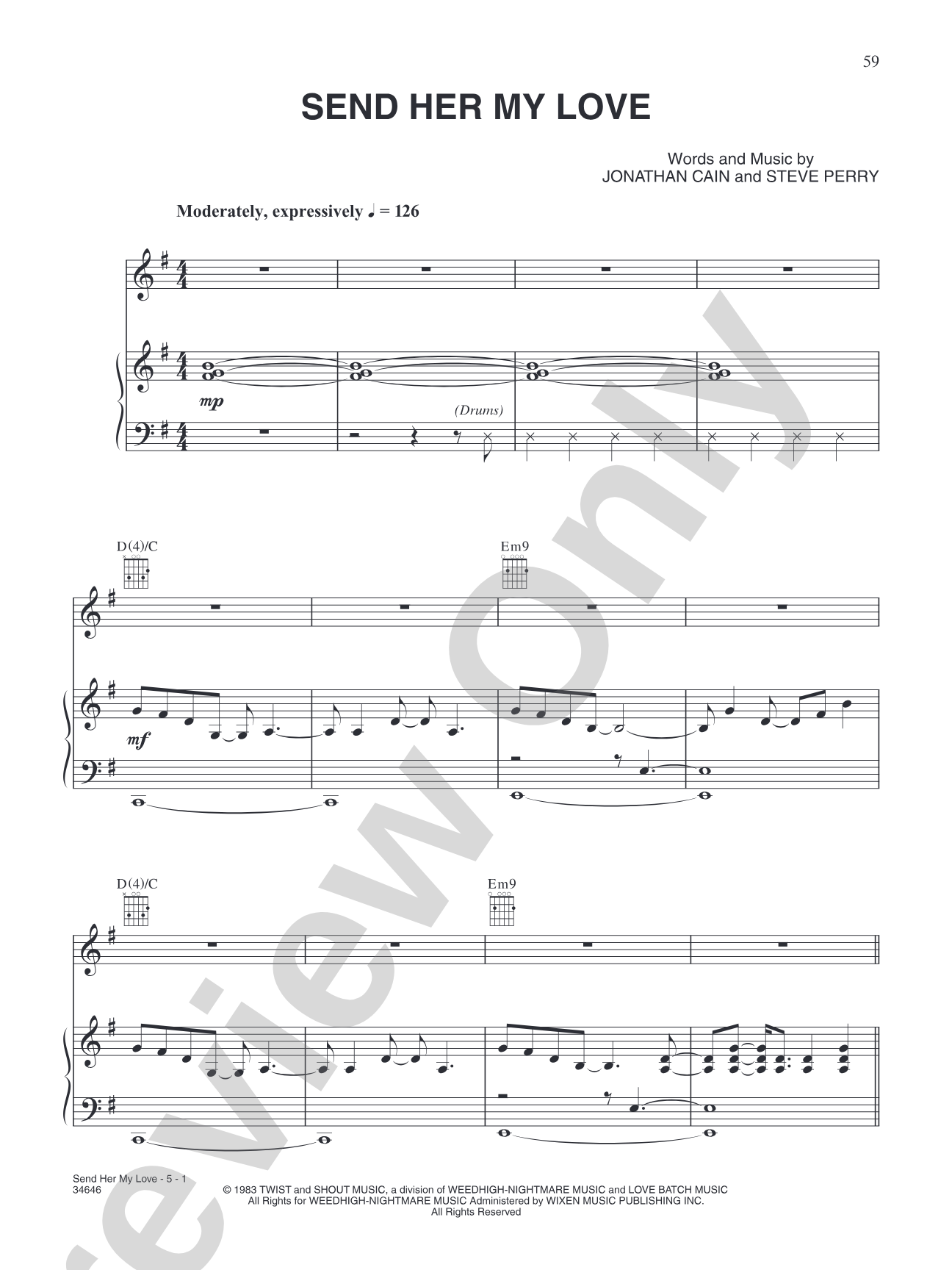

Send Her My Love: Piano/Vocal/Chords
Journey
Item: 00-XS-0000223
$4.99
One moment…
Related Items
Separate Ways: Piano/Vocal/Chords |
$5.99
|
View | |
Don't Stop Believin': Piano/Vocal/Chords |
$4.99
|
View | |
Faithfully: Piano/Vocal/Chords |
$4.99
|
View | |
Open Arms: Piano/Vocal/Chords |
$4.99
|
View | |
Who's Crying Now: Piano/Vocal/Chords |
$4.99
|
View | |
Any Way You Want It: Piano/Vocal/Chords |
$5.99
|
View | |
Lovin', Touchin', Squeezin': Piano/Vocal/Chords |
$5.99
|
View | |
Wheel In The Sky: Piano/Vocal/Chords |
$5.99
|
View | |
Only The Young: Piano/Vocal/Chords |
$5.99
|
View | |
Ask The Lonely: Piano/Vocal/Chords |
$5.99
|
View | |
Lights: Piano/Vocal/Chords |
$4.99
|
View | |
Journey: Greatest Hits (Updated Edition): Piano/Vocal/Guitar Book |
$24.99
|
View |
Description
Pianists will delight in this updated songbook, in which the piano/vocal arrangements have been notably improved (compared to older published sheet music renditions) to accurately reflect what was played on the band's original hit recordings. Basic guitar chord grids are also included. (A note-for-note guitar tablature edition is also available; sold separately.) Titles: Only the Young * Don't Stop Believin' * Wheel in the Sky * Faithfully * I'll Be Alright Without You * Any Way You Want It * Ask the Lonely * Who's Crying Now * Separate Ways (Worlds Apart) * Lights * Lovin', Touchin', Squeezin' * Open Arms * Girl Can't Help It * Send Her My Love * Be Good to Yourself.


Discover MakeMusic Cloud: thousands of interactive titles your students can play along with today.
Sample Audio
No sample audio found.
Sample Video
No sample videos found.
Additional Details
Publisher:
Alfred Music
Page Count:
84
SKU:
00-XS-0000223
More about this title
About the Composer: Jonathan Cain
Jonathan Cain joined Journey in 1980 as keyboardist and became a primary songwriter for the band's most commercially successful era. His contributions shaped the sound of arena rock throughout the 1980s, blending synthesizer textures with memorable melodies that defined the band's identity. Cain's work as both performer and composer demonstrates the integration of keyboard artistry with songwriting craft, making him a significant figure in rock music education and repertoire.
As an educator, Cain's compositions offer pianists insight into how synthesizer parts and keyboard arrangements function within a rock ensemble context. His music illustrates the relationship between instrumental accompaniment and vocal melody, providing valuable models for students exploring contemporary songwriting and arrangement.
Why we love this
These arrangements capture what actually happened in the studio and on stage, giving pianists and singers access to the authentic keyboard voicings and comping patterns from Journey's recordings rather than simplified or inaccurate transcriptions. The inclusion of guitar chord grids alongside the vocal line makes this resource genuinely useful for collaborative rehearsals and multi-instrumentalist settings. The collection spans the band's most recognizable catalog, offering a cohesive set of rock repertoire that engages students through songs they know and want to play.
What to expect
These songs capture the sweeping melodic confidence and radio-friendly sophistication of 1980s arena rock, with keyboard arrangements that feel spacious and emotionally direct. The collection balances uptempo rock energy with introspective ballads, creating a dynamic arc that moves between driving rhythmic grooves and lush, synth-based textures. Whether playing the soaring intro of 'Open Arms' or navigating the rhythmic precision of 'Don't Stop Believin',' you're working with melodies and harmonies designed for maximum emotional impact.
Who it's for
Pianists preparing for auditions, recitals, or performances in rock and popular music contexts will find these arrangements immediately useful and performer-friendly. Singers and vocalists studying rock repertoire can use these scores for rehearsal and performance, particularly in educational or community settings. Multi-instrumentalists working in ensemble or jam session settings will appreciate the chord grids and accurate harmonic information.
How to get the most out of it
- Study the original recordings carefully before working through the sheet music. The piano arrangements reflect specific studio performances, so listening actively helps you understand phrasing, dynamic shape, and the interplay between keyboard and vocal lines.
- Pay attention to the voicing of chords in the piano part. These aren't generic rock progressions; Cain's keyboard voice-leading creates much of the harmonic color, so maintain clarity in the left hand even when the vocal line draws focus.
- Use the guitar chord grids as a reference point for harmonic rhythm and to understand how the keyboard comping relates to typical rock chord progressions. This strengthens your ability to play from chord charts in ensemble settings.
- Balance the melody and accompaniment carefully in the right hand. Since these arrangements prioritize the original recordings, the piano often carries both the vocal melody and instrumental textures; avoid obscuring the vocal line while maintaining the full sound of the arrangement.
How to use it
Include one or two selections in a popular music or rock history unit to demonstrate how keyboard arranging functions in commercial rock contexts. These pieces work well in informal performance settings, coffee house concerts, or showcase events where contemporary repertoire connects with student and audience interests. Consider pairing selections with lessons on chord voicing and harmonic function in popular music, using the written arrangements as teaching models for how studio recordings translate to live performance.
Skills your students will build
- Reading and interpreting keyboard voicings from studio recordings
- Coordinating melody, accompaniment, and bass line in the right and left hands
- Understanding chord progressions and harmonic rhythm in rock and popular music
- Accompanying singers with appropriate dynamics and phrasing
- Translating between keyboard notation and guitar chord grids