
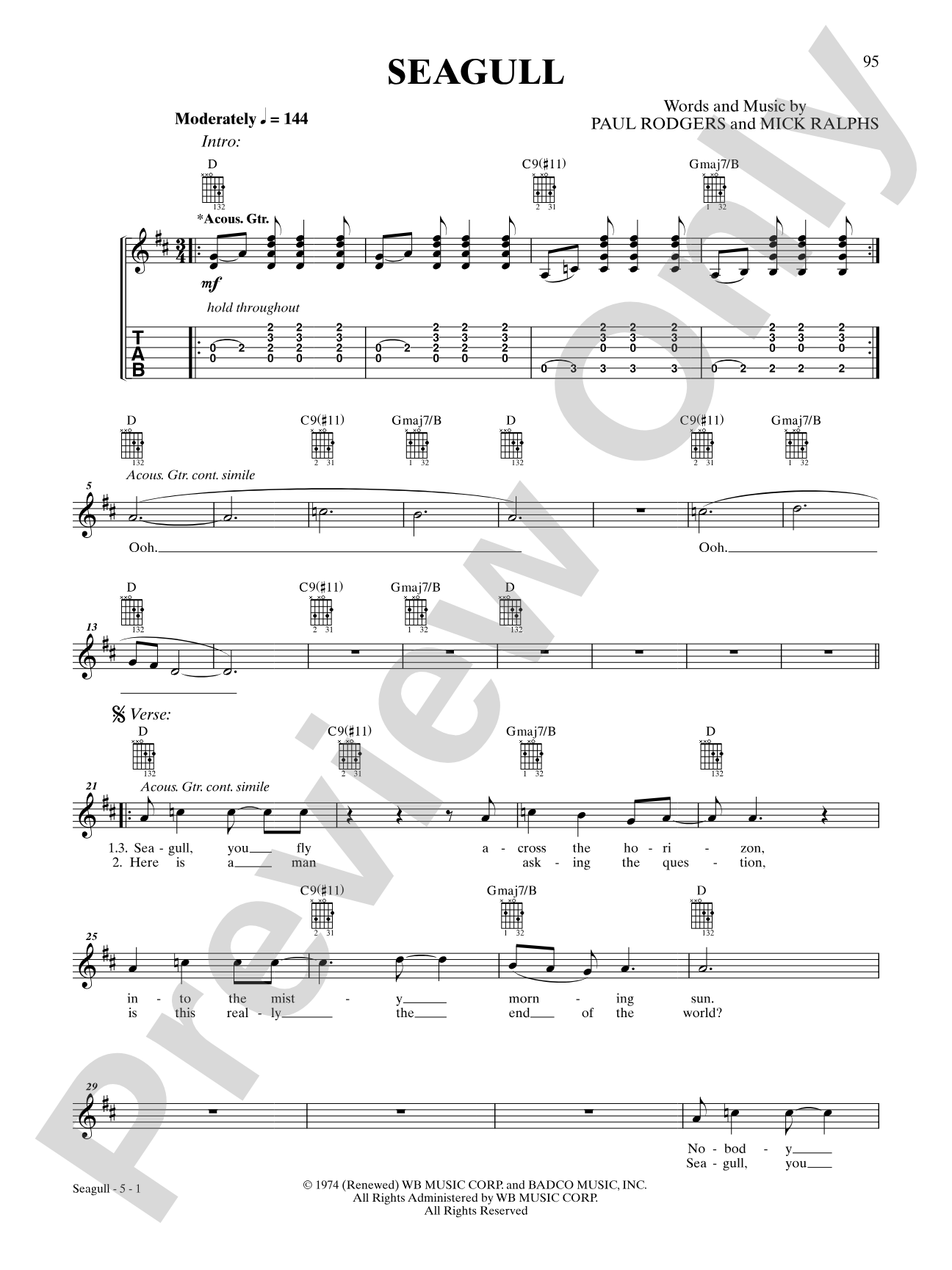

Seagull: Authentic Guitar TAB
Bad Company
Item: 00-PS-0013281
$4.99
One moment…
Related Items
Run With the Pack: Authentic Guitar TAB |
$5.99
|
View | |
Can't Get Enough (of Your Love): Authentic Guitar TAB |
$5.99
|
View | |
Ready for Love: Authentic Guitar TAB |
$4.99
|
View | |
Movin' On: Authentic Guitar TAB |
$5.99
|
View | |
Live for the Music: Authentic Guitar TAB |
$5.99
|
View | |
Rock Steady: Authentic Guitar TAB |
$5.99
|
View | |
Bad Company: Authentic Guitar TAB |
$9.99
|
View | |
Burnin' Sky: Authentic Guitar TAB |
$4.99
|
View | |
Rock & Roll Fantasy: Authentic Guitar TAB |
$5.99
|
View | |
Good Lovin' Gone Bad: Authentic Guitar TAB |
$5.99
|
View | |
Silver, Blue & Gold: Authentic Guitar TAB |
$5.99
|
View | |
Feel Like Makin' Love: Authentic Guitar TAB |
$5.99
|
View | |
Shooting Star: Authentic Guitar TAB |
$9.99
|
View |
Description
One of the first and most successful of the classic rock era super groups, Bad Company was formed by previous members of Free, Mott the Hoople, and King Crimson. This folio features full guitar TAB transcriptions of all their classic songs. Titles: Bad Company * Burnin' Sky * Can't Get Enough * Feel Like Makin' Love * Good Lovin' Gone Bad * Movin' On * Ready for Love * Rock 'n' Roll Fantasy * Rock Steady * Seagull * Shooting Star * Simple Man * Silver, Blue & Gold * Run with the Pack * Gone, Gone, Gone * Live for the Music * Electric Land * Deal with the Preacher.


Seagull: Authentic Guitar TAB isn't in MakeMusic Cloud just yet...but it could be. Let us know you'd like to see it, and you'll help shape what comes next. In the meantime, start a free trial and dive into thousands of interactive titles your students can play along with today.
Request This Title
Tell us you want it.
Start Your Free Trial
Explore everything that's ready to play right now.
Sample Audio
No sample audio found.
Sample Video
No sample videos found.
Additional Details
Series:
Guitar TAB Anthology
Publisher:
Alfred Music
Page Count:
120
SKU:
00-PS-0013281
More about this title
About the Composer: Paul Rodgers
Paul Rodgers fronted Free in the late 1960s, establishing himself as one of rock's most distinctive vocalists and songwriters before co-founding Bad Company in 1973. His ability to craft memorable hooks and emotionally direct lyrics became the foundation of the band's commercial success, with hits like "Can't Get Enough" and "Feel Like Makin' Love" showcasing his gift for blending blues-rock sensibility with mainstream appeal.
Why we love this
This folio captures the guitar work that defined 1970s arena rock. The TAB transcriptions are sourced from verified recordings, making them reliable for study and performance. Whether you're teaching classic rock repertoire or students want to learn songs that actually appear on the radio, these arrangements deliver immediate gratification and authentic musicianship.
What to expect
These songs carry the confidence and swagger of a band that dominated stadiums. You'll feel the shift between the blues-soaked simplicity of early tracks and the harder-edged, more orchestrated sound of later Bad Company recordings. It's rock that sounds effortless but rewards careful listening and intentional playing.
Who it's for
Guitar students ready to tackle full songs with both rhythm and lead parts are the natural fit here. Players working toward understanding 1970s rock vocabulary, from open-position blues licks to power chord progressions, will find 18 songs' worth of genuine material to develop their ears and hands.
How to get the most out of it
- Anchor the rhythm parts by locking into the kick drum pattern; Bad Company's groove depends on tight pocket playing rather than rushing the syncopation.
- Pay attention to dynamics across the full 120 pages. The band moves confidently from stripped-down blues figures to layered, overdrive-heavy textures. Don't play everything at the same volume.
- Use the TAB as a reference point, not gospel. Listen closely to studio recordings to catch nuances in muting, sustain, and tone that transcription alone cannot capture.
- Approach lead lines with phrasing rather than mechanical precision. The blues-based bending and vibrato in songs like "Seagull" require intentional control of pitch and timing.
How to use it
This works well as a supplementary resource for ensemble guitarists learning to balance rhythm and melodic responsibility, or as solo repertoire for students building a contemporary rock portfolio. It's equally valuable in a year-end rock showcase or as part of a music history unit exploring the 1970s hard rock lineage.
Skills your students will build
- Reading and performing full guitar TAB notation across rhythm and lead parts
- Identifying and executing blues-based phrasing, bending, and vibrato techniques
- Analyzing power chord voicings and open-position chord progressions
- Developing rhythmic pocket awareness through classic rock grooves
- Understanding song form and structure in arena rock arrangements