
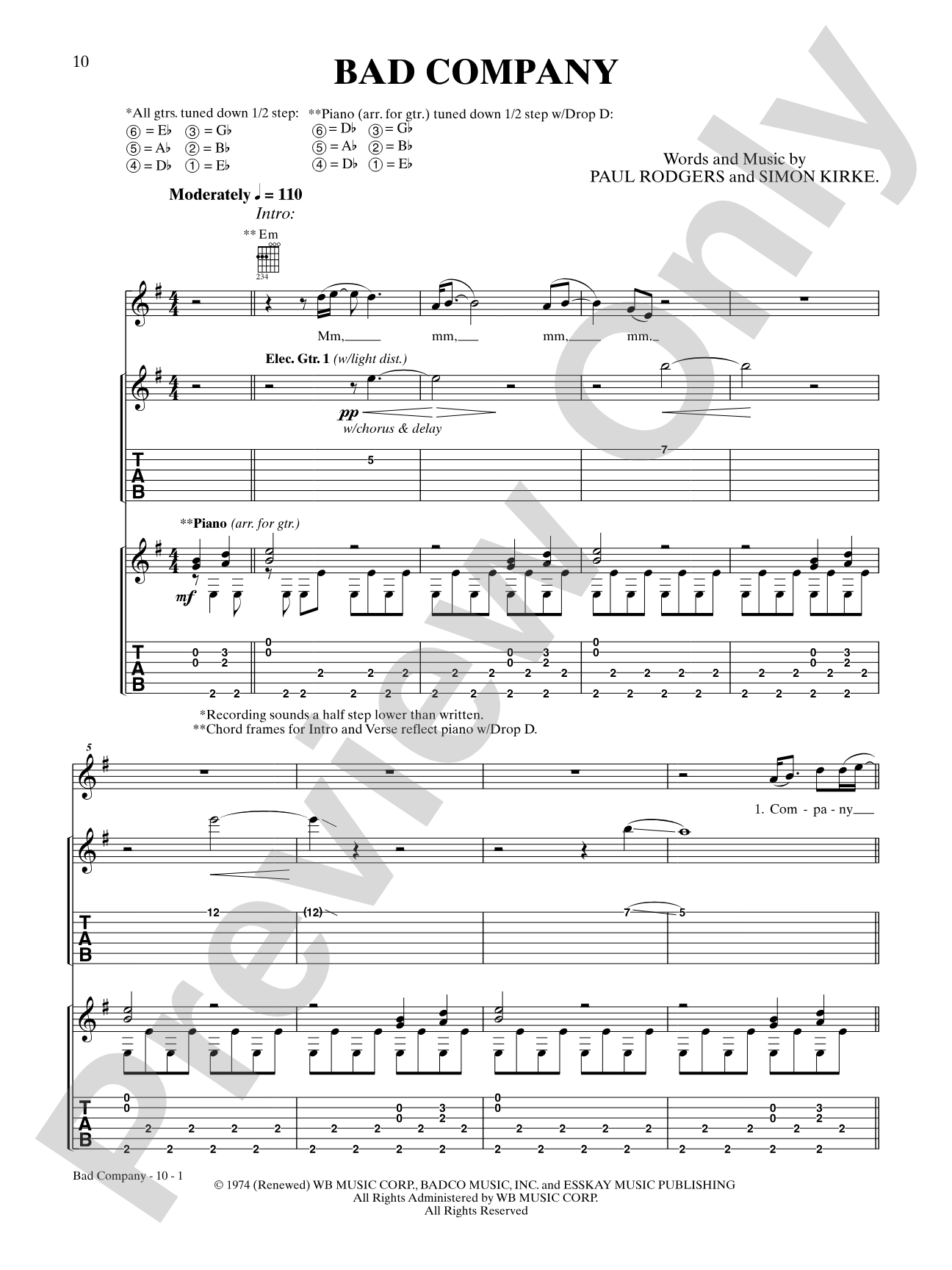
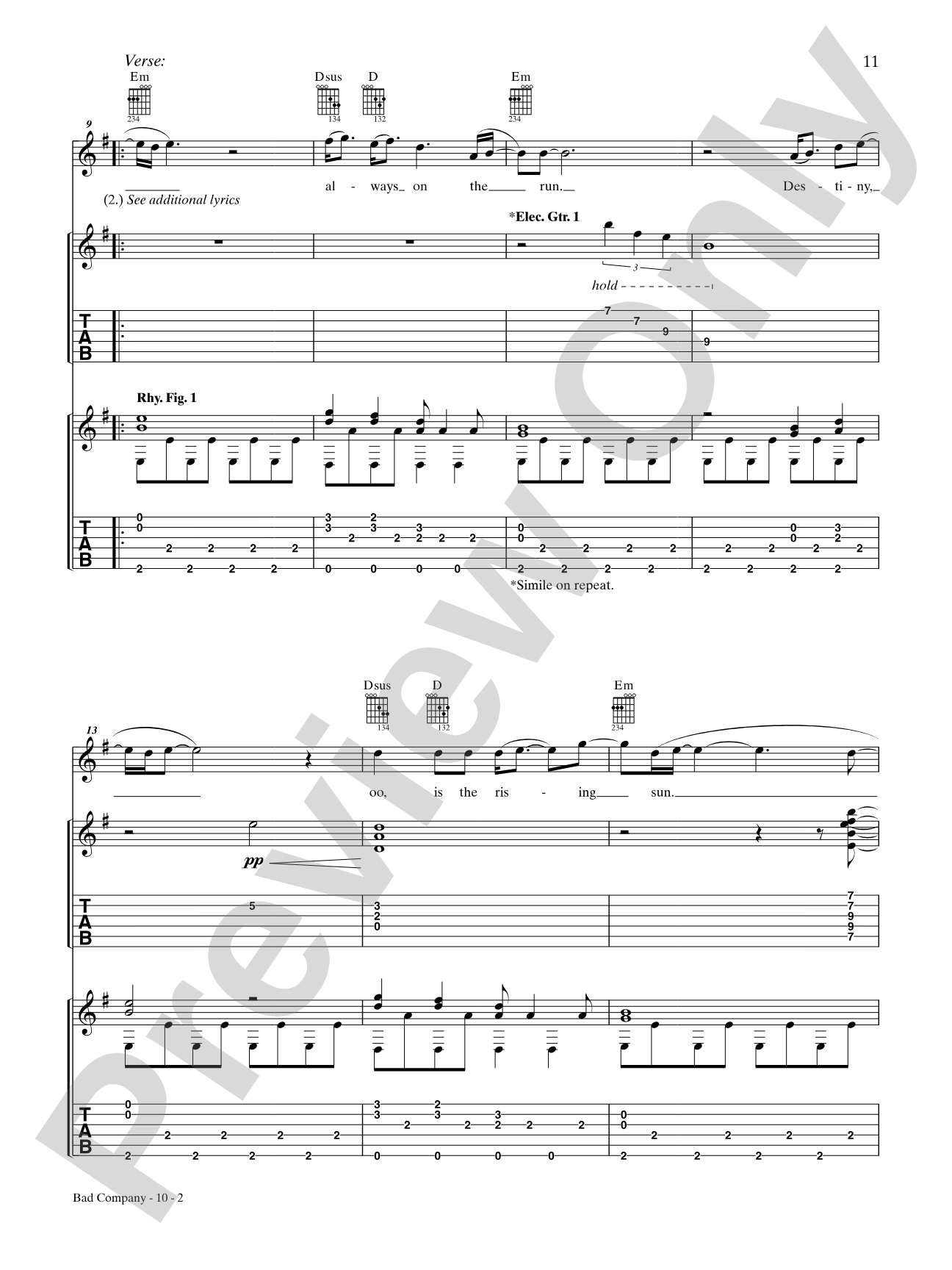

Bad Company: Authentic Guitar TAB
Bad Company
Item: 00-PS-0013284
$9.99
One moment…
Related Items
Run With the Pack: Authentic Guitar TAB |
$5.99
|
View | |
Can't Get Enough (of Your Love): Authentic Guitar TAB |
$5.99
|
View | |
Ready for Love: Authentic Guitar TAB |
$4.99
|
View | |
Movin' On: Authentic Guitar TAB |
$5.99
|
View | |
Seagull: Authentic Guitar TAB |
$4.99
|
View | |
Live for the Music: Authentic Guitar TAB |
$5.99
|
View | |
Rock Steady: Authentic Guitar TAB |
$5.99
|
View | |
Burnin' Sky: Authentic Guitar TAB |
$4.99
|
View | |
Rock & Roll Fantasy: Authentic Guitar TAB |
$5.99
|
View | |
Good Lovin' Gone Bad: Authentic Guitar TAB |
$5.99
|
View | |
Silver, Blue & Gold: Authentic Guitar TAB |
$5.99
|
View | |
Feel Like Makin' Love: Authentic Guitar TAB |
$5.99
|
View | |
Shooting Star: Authentic Guitar TAB |
$9.99
|
View |
Description
One of the first and most successful of the classic rock era super groups, Bad Company was formed by previous members of Free, Mott the Hoople, and King Crimson. This folio features full guitar TAB transcriptions of all their classic songs. Titles: Bad Company * Burnin' Sky * Can't Get Enough * Feel Like Makin' Love * Good Lovin' Gone Bad * Movin' On * Ready for Love * Rock 'n' Roll Fantasy * Rock Steady * Seagull * Shooting Star * Simple Man * Silver, Blue & Gold * Run with the Pack * Gone, Gone, Gone * Live for the Music * Electric Land * Deal with the Preacher.


Bad Company: Authentic Guitar TAB isn't in MakeMusic Cloud just yet...but it could be. Let us know you'd like to see it, and you'll help shape what comes next. In the meantime, start a free trial and dive into thousands of interactive titles your students can play along with today.
Request This Title
Tell us you want it.
Start Your Free Trial
Explore everything that's ready to play right now.
Sample Audio
No sample audio found.
Sample Video
No sample videos found.
Additional Details
Series:
Guitar TAB Anthology
Publisher:
Alfred Music
Page Count:
120
SKU:
00-PS-0013284
More about this title
About the Composer: Paul Rodgers
Paul Rodgers shaped the sound of British rock across three decades, first as the powerhouse vocalist of Free before co-founding Bad Company in 1973. His ability to blend blues-rooted phrasing with anthemic sensibilities made him one of the era's most distinctive frontmen. Beyond his vocal work, Rodgers co-wrote the band's defining material and helped establish the template for arena rock songwriting that countless bands would follow.
Why we love this
Eighteen tracks spanning Bad Company's essential catalog gives guitarists a masterclass in classic rock phrasing, tone, and technique without relying on ear training alone. The TAB format captures both straightforward power chord grooves and the fingerstyle passages that define tracks like 'Seagull,' making this folio equally valuable for players building their repertoire or decoding the architecture of 1970s rock songwriting.
What to expect
Swaggering, muscular, and built on deep blues foundations. These songs breathe with the confidence of musicians who'd already proven themselves before Bad Company formed, combining gritty riffs with surprisingly sophisticated changes and vocal melodies that reward close listening. There's a warmth underneath the rock edge, especially in the slower numbers.
Who it's for
Intermediate to advanced guitarists who want to learn Bad Company's library with notation they can trust. Players pursuing classic rock fluency, tribute band members, or anyone studying the intersection of blues technique and stadium rock will find substantive material here.
How to get the most out of it
- Lock the rhythm section first on tracks like 'Bad Company' and 'Can't Get Enough.' These songs hinge on the pocket between bass and drums; nail that foundation before layering lead textures.
- Study the dynamic range in 'Feel Like Makin' Love' and 'Shooting Star.' Bad Company excelled at building intensity through arrangement rather than volume alone; shape your tone and attack to follow the song's emotional arc.
- Use fingerstyle on 'Seagull' to access the full harmonic color of the original. Hybrid picking or a pick-and-fingers approach opens up the resonance this piece demands.
- Balance rhythm and lead parts in band settings. Many of these songs split the guitar duties between driving comping and soloistic passages; clarify who carries what in rehearsal.
How to use it
Extract individual tracks for ensemble performances, band revues, or a classic rock concert program. Teachers can build a unit around these transcriptions to study rhythm guitar technique, song structure, and the evolution from blues into arena rock. Guitarists preparing for auditions or performances will appreciate having the full catalog in one accessible resource.
Skills your students will build
- Classic rock rhythm guitar phrasing and groove pocket
- Reading and executing fingerstyle and hybrid picking patterns
- Translating blues-based soloing to different harmonic contexts
- Understanding song architecture and dynamic arrangement
- Tone control and dynamics across power chords and lead passages