
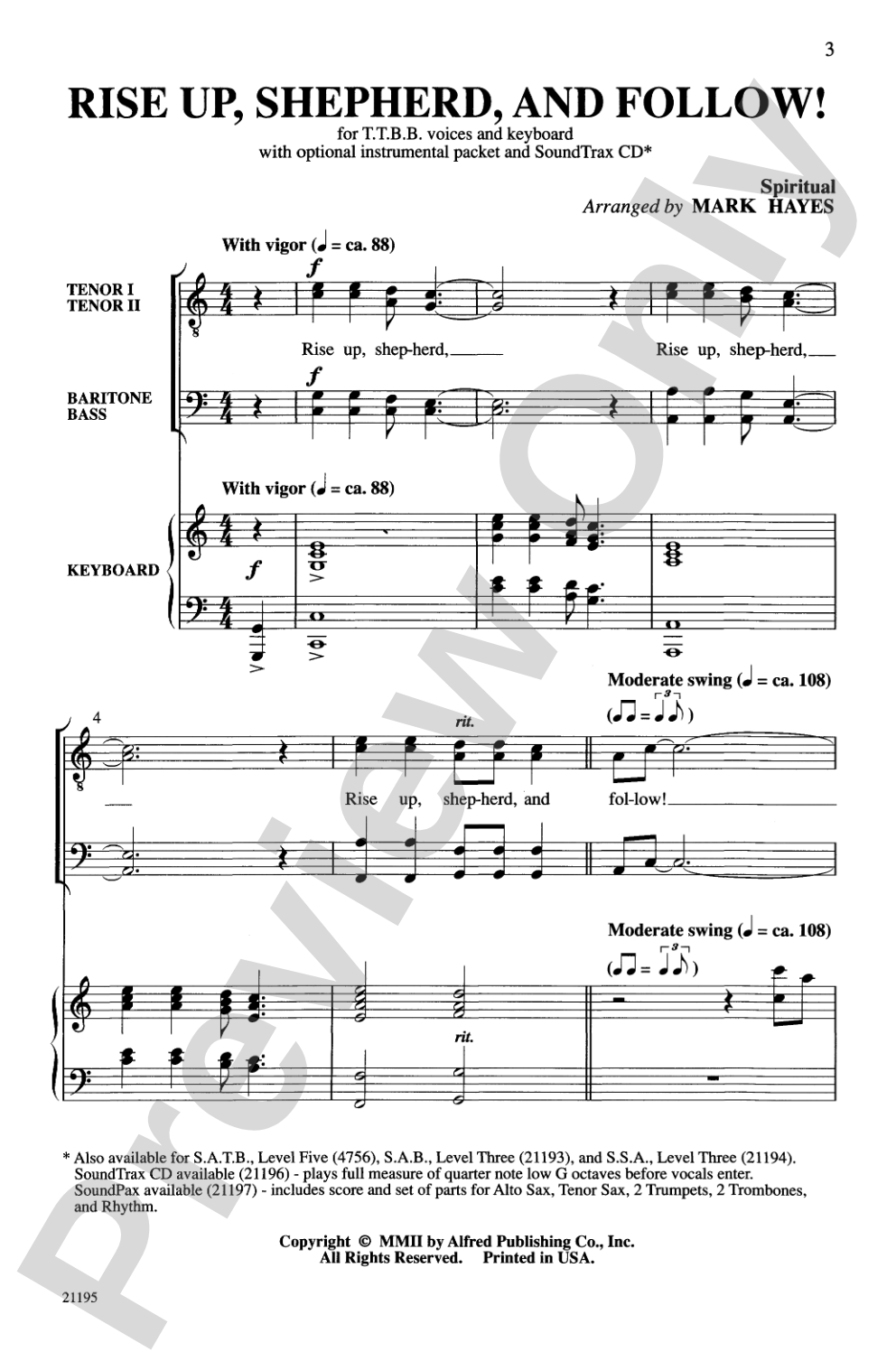
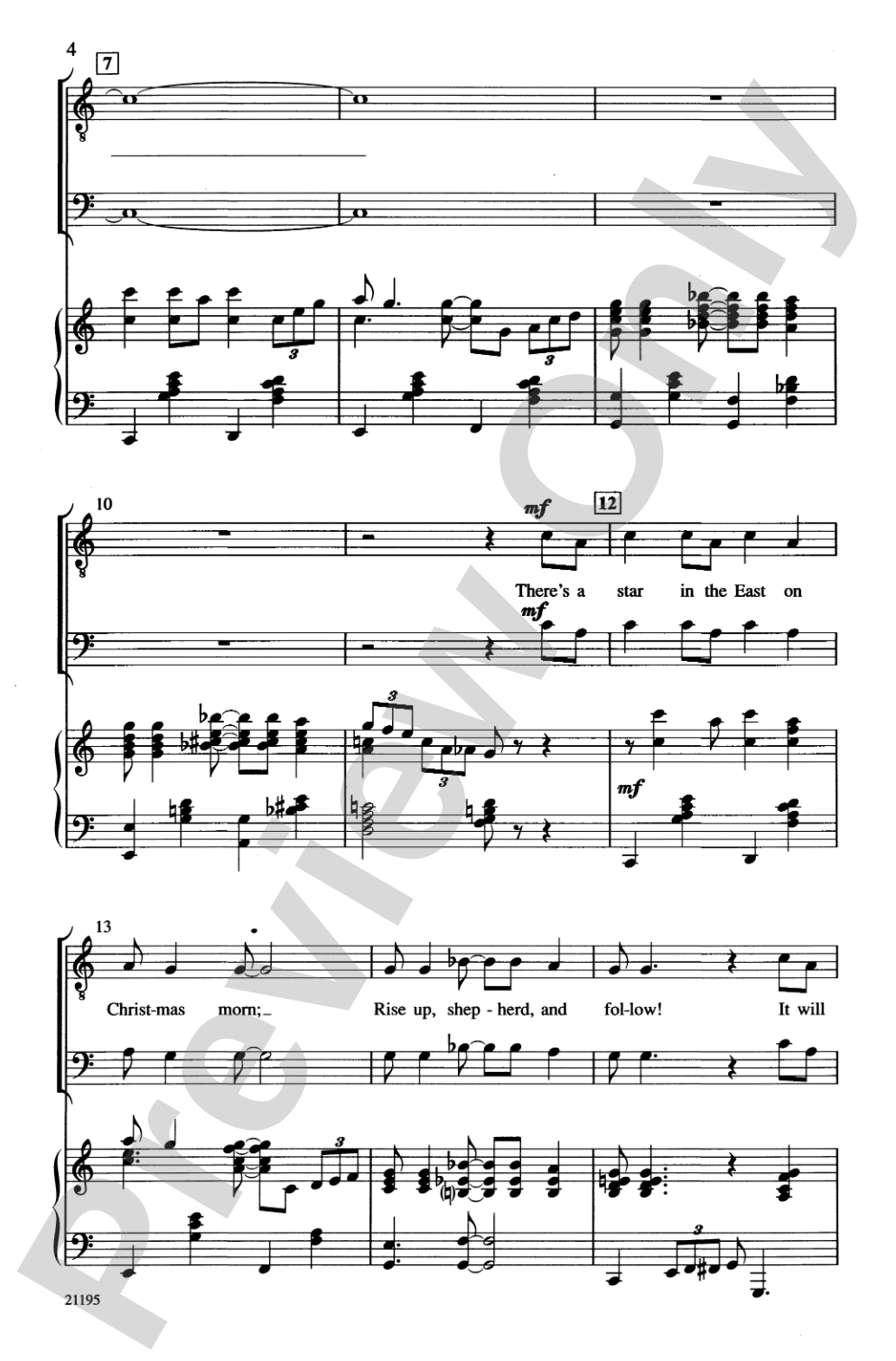

Rise Up, Shepherd, and Follow!: TTBB Choral Octavo
Arr. Mark Hayes
Item: 00-PO-0004267
$2.25
Minimum order quantity: 20 copies
Pickup currently not available
Related Items
Rise Up, Shepherd, and Follow!: SATB Choral Octavo |
$2.25
|
View | |
Rise Up, Shepherd, and Follow!: SAB Choral Octavo |
$2.25
|
View | |
Rise Up, Shepherd, and Follow!: SSA Choral Octavo |
$2.25
|
View | |
Rise Up, Shepherd, and Follow!: Choral SoundPax |
$30.00
|
View | |
Rise Up, Shepherd, and Follow!: SATB Choral Octavo |
$2.25
|
View | |
Rise Up, Shepherd, and Follow!: SAB Choral Octavo |
$2.25
|
View | |
Rise Up, Shepherd, and Follow!: SSA Choral Octavo |
$2.25
|
View | |
Rise Up, Shepherd, and Follow!: TTBB Choral Octavo |
$2.25
|
View | |
Rise Up, Shepherd, and Follow!: Choral Octavo SoundTrax CD |
$27.99
|
View | |
Rise Up, Shepherd, and Follow!: Choral SoundPax |
$30.00
|
View |
Description
Outstanding is the best word to describe this Mark Hayes spiritual arrangement. The challenging piano part will show off your accompanist. The voice parts, however, are logical, and feature lots of unison writing. Opens with a majestic fanfare, followed by a moderate swing, which builds to a powerful ending.


Rise Up, Shepherd, and Follow!: TTBB Choral Octavo isn't in MakeMusic Cloud just yet...but it could be. Let us know you'd like to see it, and you'll help shape what comes next. In the meantime, start a free trial and dive into thousands of interactive titles your students can play along with today.
Request This Title
Tell us you want it.
Start Your Free Trial
Explore everything that's ready to play right now.
Sample Audio
1
Audio File
--:--
0:00
0:00
Sample Video
No sample videos found.
Additional Details
Series:
Alfred Archive Edition: Alfred Choral Designs
Publisher:
Alfred Music
Page Count:
12
SKU:
00-PO-0004267
More about this title
About the Arranger: Mark Hayes
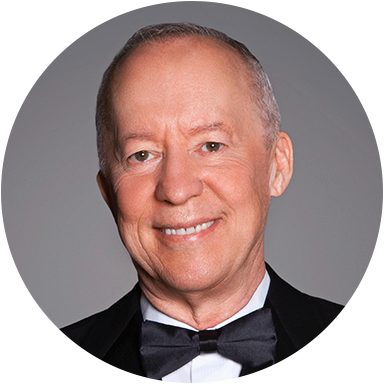
Mark Hayes brings three decades of experience as a composer, arranger, and conductor to his work across sacred and secular music. His catalog exceeds 1,750 published compositions spanning piano literature, choral works, orchestrations, and theatrical scores. He holds a Bachelor of Music degree in Piano Performance from Baylor University and has guest conducted at Lincoln Center, the National Cathedral, and Carnegie Hall, premiering major works including his Requiem at Lincoln Center in 2013 and again at St. Ignatius Basilica in Rome as part of the Vatican-sponsored Festival Pro Musica E Arte Sacra.
Based in Kansas City, Missouri, Hayes has earned recognition including the 2010 Award for Exemplary Leadership in Christian Music from Baylor University. His creative reach spans classical and sacred traditions alongside contemporary musical theater, with recent projects including orchestrations for theatrical productions and commissions for international institutions. Over 100 piano books in his name remain in print, reflecting his particular passion for writing idiomatically for the instrument across jazz, gospel, classical, and Broadway styles.
Why we love this
Hayes knows how to write for lower voices without sacrificing musicality or impact. The unison passages here give your singers breathing room while the majestic opening and swinging middle sections provide musical substance that lets a strong accompanist shine. This is an arrangement that respects both your singers and your audience.
What to expect
A spiritual that commands respect from the moment it opens. The majestic fanfare sets a solemn tone, then the moderate swing breathes with the ease and conviction of a timeless song. By the powerful final section, you've traveled from formal ceremony to joyful proclamation.
Who it's for
TTBB choirs with access to a capable pianist who can handle Hayes's sophisticated accompaniment work. This arrangement works well for choirs that want to perform spirituals with musical depth and aren't intimidated by a challenging piano part.
How to get the most out of it
- Let the opening fanfare establish the spiritual's dignity before settling into the moderate swing feel. Your pianists should approach the opening with ceremonial weight, then shift into a relaxed, grounded pulse for the main section.
- Shape the dynamic arc carefully through the moderate swing section. The unison writing means every voice is heard, so encourage singers to listen for when their line is carrying the melody and when they're providing foundation.
- Build the ending deliberately without rushing. Hayes has written this to grow in power, so maintain steady tempo and let each harmonic layer add weight as you approach the final statement.
How to use it
Program this as a centerpiece for a concert focused on American sacred music or as a standout selection in a mixed choral concert. The spiritual tradition and Hayes's substantial arrangement make it equally at home in a Christmas program or as part of a concert exploring African American musical heritage. Its length and moderate difficulty level fit well in the second half of a program, after voices are warmed up and audiences are settled.
Skills your students will build
- Reading and performing unison passages with rhythmic precision and unified tone
- Balancing TTBB voicing within a swing rhythmic context
- Responding to a complex piano accompaniment and using it as an anchor for ensemble cohesion
- Shaping longer phrases with dynamic control across a building harmonic structure