

Prayer, The: SAB Choral Octavo
Words and music by Carole Bayer Sager and David Foster / arr. Mark Hayes
Item: 00-PO-0001960

$2.10
Minimum order quantity: 10 copies
Please note: Under U.S. copyright law, you must purchase the exact number of copies needed for your ensemble. Printing, duplicating or sharing additional copies is strictly prohibited.
Pickup currently not available
Related Items
Prayer, The: SATB Choral Octavo |
$2.05
|
View | |
Prayer, The: SSA Choral Octavo |
$2.10
|
View | |
Prayer, The: TTBB Choral Octavo |
$2.25
|
View | |
The Prayer: SoundTrax Digital Audio Download |
$27.99
|
View | |
The Prayer: SATB Choral Octavo |
$2.05
|
View | |
The Prayer: SAB Choral Octavo |
$2.10
|
View | |
The Prayer: SSA Choral Octavo |
$2.10
|
View | |
The Prayer: TTBB Choral Octavo |
$2.25
|
View | |
The Prayer: Choral Octavo SoundTrax CD |
$27.99
|
View |
Description
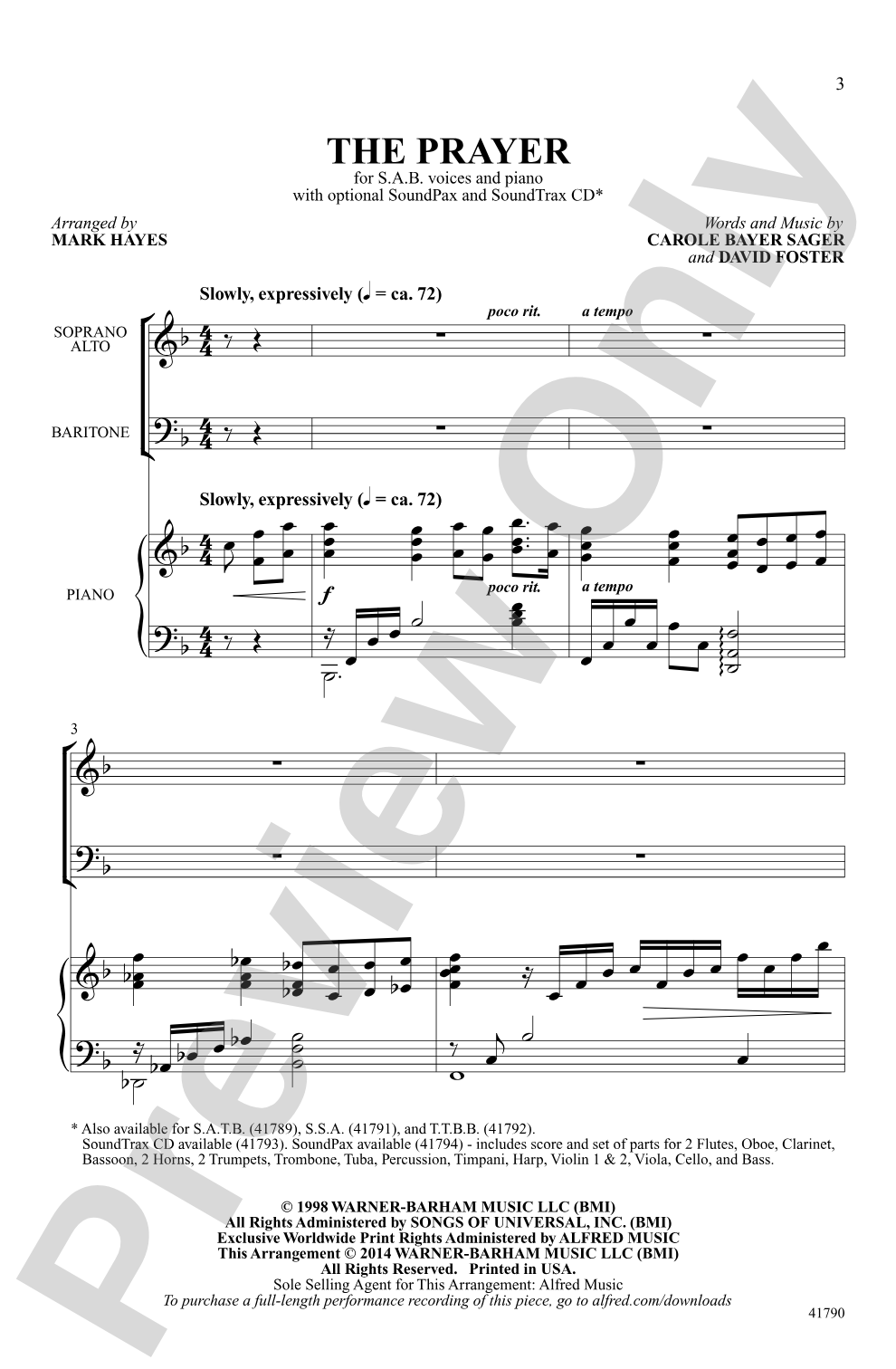
Originally recorded separately by both Celine Dion and Andrea Bocelli, the English and Italian versions were later combined to create this well-known duet. A beautiful, yet supportive, Mark Hayes' accompaniment makes this new arrangement soar.


Don't just read it, hear it, play along with it, and watch your students grow with it. In MakeMusic Cloud, Prayer, The: SAB Choral Octavo comes alive with professional accompaniment, adjustable tempo, and built-in practice tools that turn solo practice into real progress.
Open in the Player
Jump straight in and assign it today.
Start Your Free Trial
Open this title and explore the full library in minutes.
Sample Audio
1
Audio File
--:--
0:00
0:00
Sample Video
No sample videos found.
Additional Details
Series:
Alfred Pop Choral Series
Publisher:
Alfred Music
Page Count:
12
SKU:
00-PO-0001960
More about this title
About the Composer: Carole Bayer Sager
Carole Bayer Sager is a Grammy Award-winning songwriter whose catalog spans pop, film, and television music. She has written songs recorded by major artists across multiple genres, demonstrating versatility across both melody and lyric. Her work in film and television scoring has earned her recognition as a composer who understands how music serves emotional storytelling.
David Foster is a producer, composer, and arranger known for his work across pop, R&B, and classical crossover genres. His arrangements and productions have shaped the sound of contemporary vocal music, and his collaborations with artists like Celine Dion and Andrea Bocelli have become cultural touchstones. In music education contexts, his work demonstrates how sophisticated production techniques can enhance rather than overshadow the human voice.
Why we love this
This arrangement captures the emotional depth of the original duet while making it genuinely singable for a three-part choir. Mark Hayes' accompaniment respects the song's inherent beauty without overwhelming the singers, which means your choir can focus on the honest, contemplative character rather than fighting against dense orchestration. Programming sacred music that your singers and audience already know creates an immediate connection, and this piece delivers on that promise.
What to expect
The piece unfolds with quiet reverence, inviting singers and listeners into a moment of genuine reflection. There is warmth without sentimentality, and the arrangement maintains the tenderness of the original while giving the choir room to breathe and shape the melody. This is music that feels like a shared meditative experience rather than a performance.
Who it's for
This arrangement serves choirs seeking accessible sacred repertoire that resonates with both singers and audiences. It works well for groups with limited vocal ranges or mixed voice experience, since SAB voicing offers flexibility without requiring advanced sight-reading skills. Community choirs, school and church choirs, and programs focused on contemporary sacred music will find this piece both meaningful and manageable.
How to get the most out of it
- Balance the parts so that no single voice line overwhelms the others. The SAB voicing works best when sopranos, altos, and basses blend as equals rather than having sopranos carry all the melodic weight.
- Shape the phrasing by thinking of this as a prayer rather than a pop song. Longer musical lines and careful breath placement will deepen the spiritual quality.
- If using the recorded accompaniment, rehearse with it regularly so your singers develop confidence with the tempos and harmonic colors Foster originally envisioned.
- Pay attention to vowel consistency across the choir, especially in sustained passages. The intimacy of this piece requires precision in tuning.
How to use it
Include this in a sacred music concert or service that pairs traditional and contemporary repertoire, where its familiar melody can serve as a bridge between classic hymns and modern spiritual expression. It also functions well as a program closer that leaves the audience in a thoughtful, peaceful state. Spring and holiday concert programs often benefit from a piece like this that anchors emotional depth without requiring lengthy program notes.
Skills your students will build
- Balancing three independent voice parts within a single harmonic texture
- Sustaining tone quality and intonation over longer legato phrases
- Responding to the emotional intent of sacred music through interpretation
- Singing contemporary arrangements of well-known material