

Prayer, The: SATB Choral Octavo
Words and music by Carole Bayer Sager and David Foster / arr. Mark Hayes
Item: 00-PO-0001959

$2.05
Minimum order quantity: 10 copies
Please note: Under U.S. copyright law, you must purchase the exact number of copies needed for your ensemble. Printing, duplicating or sharing additional copies is strictly prohibited.
Pickup currently not available
Related Items
Prayer, The: SAB Choral Octavo |
$2.10
|
View | |
Prayer, The: SSA Choral Octavo |
$2.10
|
View | |
Prayer, The: TTBB Choral Octavo |
$2.25
|
View | |
The Prayer: SoundTrax Digital Audio Download |
$27.99
|
View | |
The Prayer: SATB Choral Octavo |
$2.05
|
View | |
The Prayer: SAB Choral Octavo |
$2.10
|
View | |
The Prayer: SSA Choral Octavo |
$2.10
|
View | |
The Prayer: TTBB Choral Octavo |
$2.25
|
View | |
The Prayer: Choral Octavo SoundTrax CD |
$27.99
|
View |
Description
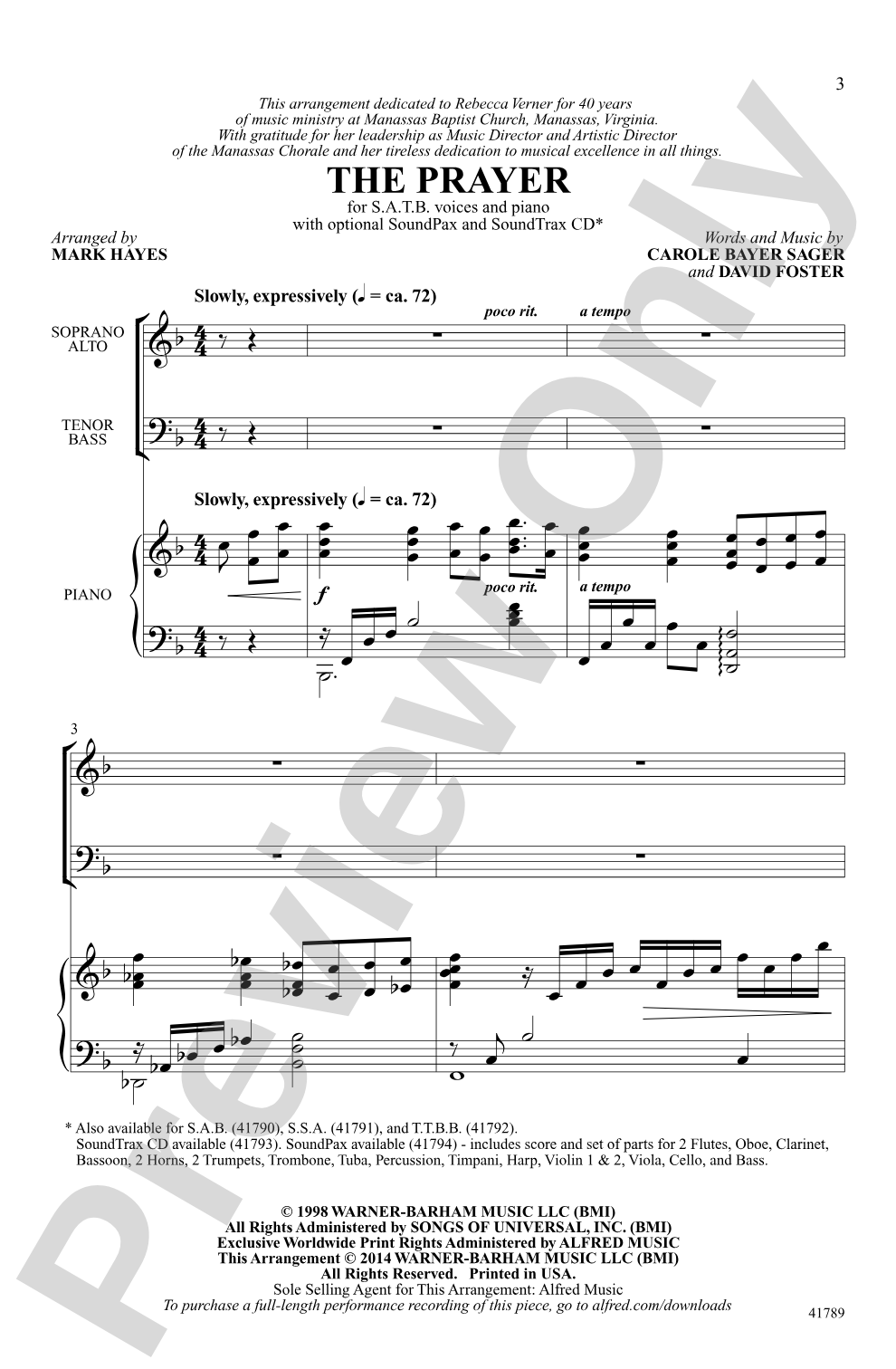
Originally recorded separately by both Celine Dion and Andrea Bocelli, the English and Italian versions were later combined to create this well-known duet. A beautiful, yet supportive, Mark Hayes' accompaniment makes this new arrangement soar.


Don't just read it, hear it, play along with it, and watch your students grow with it. In MakeMusic Cloud, Prayer, The: SATB Choral Octavo comes alive with professional accompaniment, adjustable tempo, and built-in practice tools that turn solo practice into real progress.
Open in the Player
Jump straight in and assign it today.
Start Your Free Trial
Open this title and explore the full library in minutes.
Sample Audio
1
Audio File
--:--
0:00
0:00
Sample Video
No sample videos found.
Additional Details
Series:
Alfred Pop Choral Series
Publisher:
Alfred Music
Page Count:
12
SKU:
00-PO-0001959
More about this title
About the Composer: Carole Bayer Sager
Carole Bayer Sager is a Grammy Award-winning songwriter and lyricist whose career spans five decades of popular music, film scores, and theatrical work. Her gift for crafting emotionally resonant melodies and deeply personal lyrics has resulted in countless hits across multiple genres, from pop and R&B to film soundtracks and Broadway productions.
Why we love this
Mark Hayes transforms this contemporary duet into an SATB arrangement that respects the song's intrinsic beauty while giving every voice part something meaningful to sing. The accompaniment supports rather than dominates, allowing the emotional core of Sager's composition to emerge naturally through four-part harmony.
What to expect
Reverent and intimate, yet never precious. The arrangement unfolds with quiet confidence, building from introspection toward genuine spiritual resonance without sentimentality. Singers often find themselves moved by the simplicity of the harmonic language and the way it amplifies rather than obscures the song's central message.
Who it's for
This octavo suits choral programs seeking literature that bridges classical reverence and contemporary accessibility. It works equally well for advanced high school choirs, collegiate ensembles, and community choirs with moderate reading ability.
How to get the most out of it
- Use the recorded accompaniment to establish the song's pacing and emotional arc, then gradually shift the choir toward independence so ensemble members own the phrasing.
- Balance the upper and lower voices carefully in the sustains; younger or less experienced singers often need reminders that the foundation they're providing is as important as the melody line.
- Shape phrases in longer phrases rather than by individual bars, letting the text and harmonic movement guide your conducting gesture.
- Pay attention to dynamic contrast between verse-like sections and fuller moments; resist the urge to belt throughout, as restraint in the middle sections heightens impact when the full choir enters.
How to use it
Pair this with other contemporary sacred works to create a concert segment that speaks to modern audiences while maintaining liturgical weight. It also serves as an accessible entry point for choirs exploring arranged popular music, or as a moving finale to a secular concert that needs a moment of reflection.
Skills your students will build
- Singing sustained tones with consistent tone quality across chord changes
- Balancing individual voice parts within a four-part texture
- Interpreting contemporary musical notation and phrasing marks
- Responding to emotional content through dynamic and tempo variation
- Listening across voice parts to create ensemble blend