
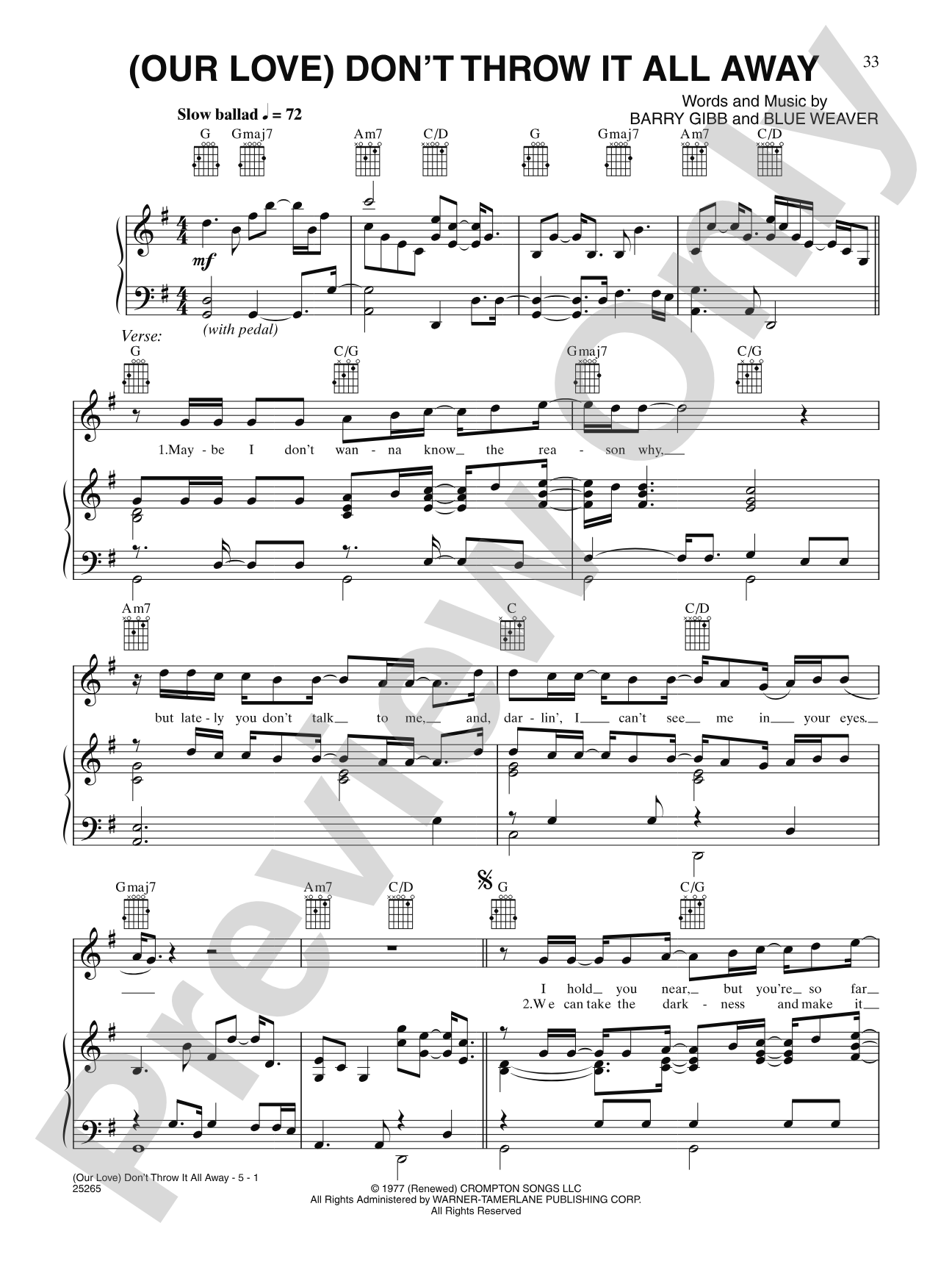

(Our Love) Don't Throw It All Away: Piano/Vocal/Chords
Bee Gees
Item: 00-PSP-000026
$4.99
One moment…
Related Items
Emotion: Piano/Vocal/Chords |
$4.99
|
View | |
First Of May: Piano/Vocal/Chords |
$4.99
|
View | |
Heartbreaker: Piano/Vocal/Chords |
$5.99
|
View | |
How Can You Mend A Broken Heart: Piano/Vocal/Chords |
$4.99
|
View | |
How Deep Is Your Love: Piano/Vocal/Chords |
$4.99
|
View | |
I Could Not Love You More: Piano/Vocal/Chords |
$4.99
|
View | |
Islands In The Stream: Piano/Vocal/Chords |
$4.99
|
View | |
Lonely Days: Piano/Vocal/Chords |
$5.99
|
View | |
More Than A Woman: Piano/Vocal/Chords |
$4.99
|
View | |
Secret Love: Piano/Vocal/Chords |
$5.99
|
View | |
To Love Somebody: Piano/Vocal/Chords |
$4.99
|
View | |
Too Much Heaven: Piano/Vocal/Chords |
$5.99
|
View | |
Words: Piano/Vocal/Chords |
$4.99
|
View |
Description
Titles: To Love Somebody * Words * First of May * Lonely Days * How Can You Mend a Broken Heart * How Deep Is Your Love * More Than a Woman * (Our Love) Don't Throw It All Away * Emotion * Too Much Heaven * Heartbreaker * Islands in the Stream * Juliet * Secret Love * For Whom the Bell Tolls * Closer Than Close * I Could Not Love You More * Wedding Day.


(Our Love) Don't Throw It All Away: Piano/Vocal/Chords isn't in MakeMusic Cloud just yet...but it could be. Let us know you'd like to see it, and you'll help shape what comes next. In the meantime, start a free trial and dive into thousands of interactive titles your students can play along with today.
Request This Title
Tell us you want it.
Start Your Free Trial
Explore everything that's ready to play right now.
Sample Audio
No sample audio found.
Sample Video
No sample videos found.
Additional Details
Publisher:
Alfred Music
Page Count:
100
SKU:
00-PSP-000026
More about this title
About the Artist: Bee Gees
The Bee Gees (Barry, Robin, and Maurice Gibb) shaped popular music across five decades, moving fluidly from baroque pop harmonies in the 1960s through disco production in the 1970s and into the sophisticated pop arrangements of the 1980s and beyond. Their catalog demonstrates mastery of melody, vocal harmony, and production technique, making their work foundational repertoire for understanding modern songwriting and arrangement.
Why we love this
This collection captures the full emotional range of the Bee Gees' songwriting: tender ballads like "How Deep Is Your Love" sit alongside passionate declarations and intricate vocal harmonies that demand careful voicing from singers. The piano-vocal arrangements preserve the sophistication of the originals while remaining accessible for performers working through popular repertoire in a classical or jazz-influenced context.
What to expect
These songs balance sincerity with sophistication. Whether it is the aching vulnerability of a broken heart ballad or the buoyant energy of "Emotion," each piece carries the distinctive Bee Gees signature: lush harmonic movement, soaring vocal lines that reward control and breath management, and arrangements that feel both intimate and expansive.
Who it's for
This collection serves singers exploring popular songwriting standards and pianists developing accompanying skills alongside solo repertoire. It is equally useful for music theater students, jazz-influenced vocalists, and anyone assembling a working set of contemporary classics with enduring melodic and harmonic merit.
How to get the most out of it
- Pay attention to the three-part vocal harmonies in tracks like "Words" and "How Can You Mend a Broken Heart." These signature Bee Gees arrangements require tight blend and precise intonation across all three lines.
- Let the piano accompaniment breathe on the ballads. Resist rushing through the introductions and transitions; they establish the emotional foundation for the vocal melody.
- Experiment with the recorded accompaniments to internalize phrasing and tempo before finalizing your interpretation. The Bee Gees' sense of timing is part of what makes these songs memorable.
- Treat the chord symbols as a starting point rather than a limitation. These arrangements support both straightforward interpretations and more inventive reharmonizations.
How to use it
Program individual selections as recital repertoire, mixing one or two into a classical or cabaret-style concert to demonstrate range and appeal across genre boundaries. These pieces work particularly well in a program exploring the evolution of songwriting from the 1970s onward, or as a bridge between traditional vocal standards and contemporary popular song.
Skills your students will build
- Reading and executing three-part vocal harmonies with independent line independence
- Interpreting chord symbols and understanding their harmonic function within popular song structures
- Coordinating vocal phrasing with piano accompaniment across ballad and uptempo contexts
- Understanding vocal production and breath management across extended melodic phrases
- Sight-reading piano-vocal score format with simultaneous melodic and harmonic awareness