
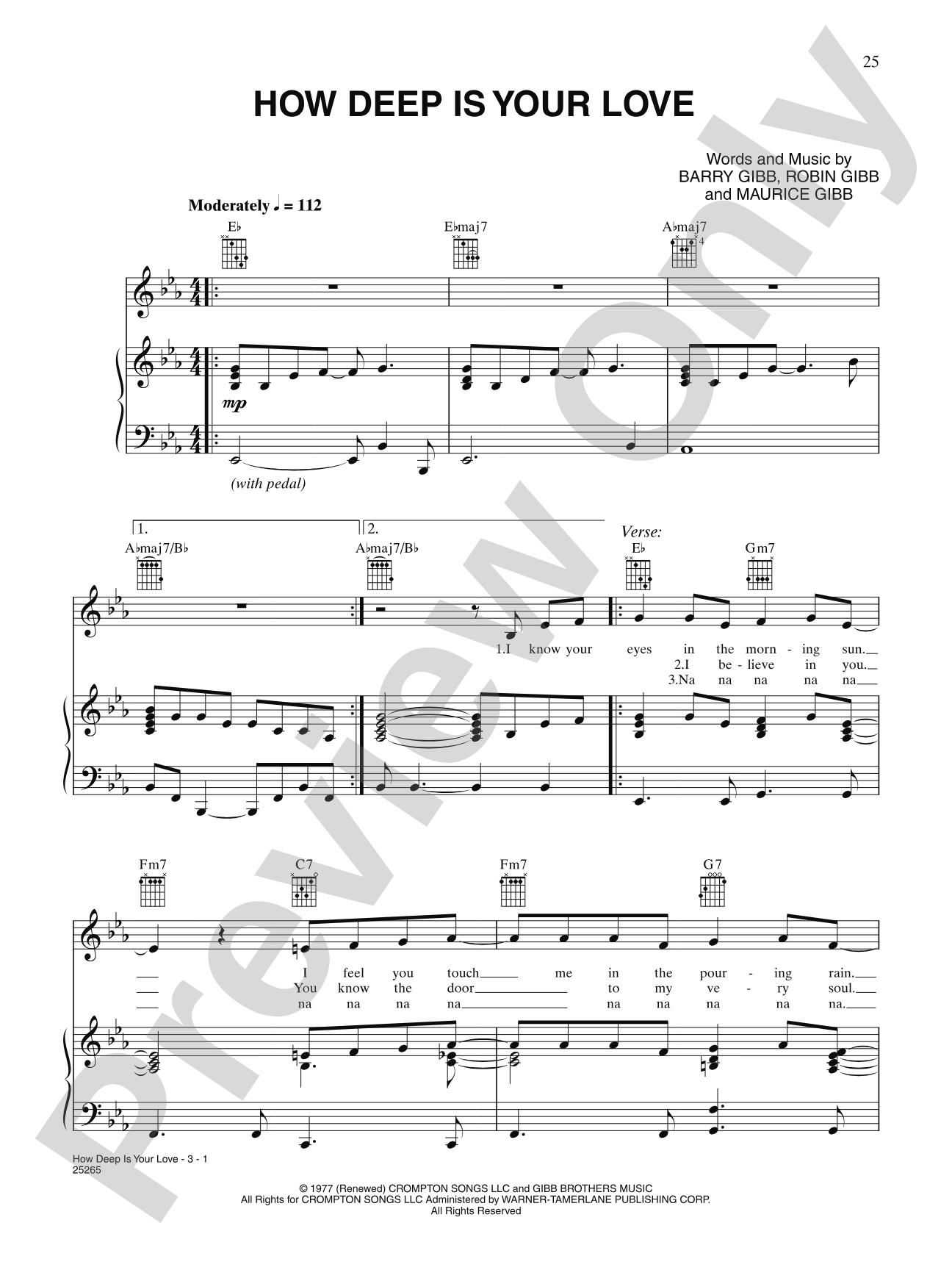

How Deep Is Your Love: Piano/Vocal/Chords
Bee Gees
Item: 00-PSP-000031
$4.99
One moment…
Related Items
(Our Love) Don't Throw It All Away: Piano/Vocal/Chords |
$4.99
|
View | |
Emotion: Piano/Vocal/Chords |
$4.99
|
View | |
First Of May: Piano/Vocal/Chords |
$4.99
|
View | |
Heartbreaker: Piano/Vocal/Chords |
$5.99
|
View | |
How Can You Mend A Broken Heart: Piano/Vocal/Chords |
$4.99
|
View | |
I Could Not Love You More: Piano/Vocal/Chords |
$4.99
|
View | |
Islands In The Stream: Piano/Vocal/Chords |
$4.99
|
View | |
Lonely Days: Piano/Vocal/Chords |
$5.99
|
View | |
More Than A Woman: Piano/Vocal/Chords |
$4.99
|
View | |
Secret Love: Piano/Vocal/Chords |
$5.99
|
View | |
To Love Somebody: Piano/Vocal/Chords |
$4.99
|
View | |
Too Much Heaven: Piano/Vocal/Chords |
$5.99
|
View | |
Words: Piano/Vocal/Chords |
$4.99
|
View |
Description
Titles: To Love Somebody * Words * First of May * Lonely Days * How Can You Mend a Broken Heart * How Deep Is Your Love * More Than a Woman * (Our Love) Don't Throw It All Away * Emotion * Too Much Heaven * Heartbreaker * Islands in the Stream * Juliet * Secret Love * For Whom the Bell Tolls * Closer Than Close * I Could Not Love You More * Wedding Day.


How Deep Is Your Love: Piano/Vocal/Chords isn't in MakeMusic Cloud just yet...but it could be. Let us know you'd like to see it, and you'll help shape what comes next. In the meantime, start a free trial and dive into thousands of interactive titles your students can play along with today.
Request This Title
Tell us you want it.
Start Your Free Trial
Explore everything that's ready to play right now.
Sample Audio
No sample audio found.
Sample Video
No sample videos found.
Additional Details
Publisher:
Alfred Music
Page Count:
100
SKU:
00-PSP-000031
More about this title
About the Artist: Bee Gees
The Bee Gees were a songwriting and performing trio whose influence on popular music spanned five decades. Barry, Robin, and Maurice Gibb crafted some of the most recognizable melodies in pop history, from 1960s ballads through 1970s disco to 1980s soul-influenced pop. Their compositions showcase sophisticated harmonic structures, memorable vocal arrangements, and emotionally direct storytelling that made them invaluable to singers across genres.
Their work appears in countless educational settings because their songs sit at the intersection of accessibility and musical substance. Teachers and pianists value Bee Gees material for its singable melodic lines, clear chord progressions suitable for sight-reading and transposition, and timeless relevance to students of all ages.
Why we love this
This collection gives pianists and singers immediate access to eighteen songs with genuine emotional range, from tender ballads to uptempo pop moments. The material works equally well for recital preparation, studio teaching, or ensemble performance, and each song reinforces basic to intermediate keyboard and vocal skills without requiring specialized instrumental knowledge. The chord charts make transposition and arrangement exploration straightforward, encouraging students to personalize interpretations.
What to expect
These songs carry an emotional sophistication that transcends their pop classification. The collection moves through vulnerability and longing in the ballads, celebration in the uptempo tracks, and genuine tenderness throughout. Playing this music invites singers and accompanists into conversations about how melodic shape, harmonic rhythm, and lyrical directness combine to create songs that resonate across generations.
Who it's for
This collection serves pianists who accompany singers in lessons or recitals, solo performers building a setlist of beloved standards, and classroom musicians exploring pop songwriting across different eras. Music teachers use it to engage students who connect with popular artists while building sight-reading and harmonic analysis skills.
How to get the most out of it
- Listen closely to the original recordings to internalize the phrasing and breath placements that made these songs distinctive; the Bee Gees' vocal timing often sits slightly ahead of or behind the beat in ways that require careful transcription.
- Use chord voicings suggested in the charts as a foundation, then experiment with inversions and extensions that fit your vocal range and hand position, especially in ballads where accompaniment color shapes the emotional arc.
- Mark breath points in the vocal line before your first full run-through; many of these melodies have longer phrases than contemporary pop, and planning your breathing prevents awkward truncation.
- Practice the piano part independently first, then layer the vocal line; this builds independence and keeps the accompaniment steady when navigating the melodic demands.
How to use it
Feature individual songs as recital openers or closer pieces, pairing them with classical standards to show students how songwriting craft exists across genres. Assign specific titles as ensemble warm-ups where singers and pianists practice sustaining lines, managing transitions between sections, and maintaining ensemble cohesion. Use the collection to teach transposition and chord substitution in a repertoire context where students immediately hear how adjustments affect musical color.
Skills your students will build
- reading chord charts and interpreting jazz-influenced voicings in a pop context
- sustaining long vocal phrases and planning breath placement for legit singing
- transposing melodies and harmonies to accommodate different voice types and ranges
- balancing vocal melody with harmonic accompaniment to support rather than overshadow the singer
- analyzing song structure (verse, chorus, bridge) to inform phrasing and emotional weight