
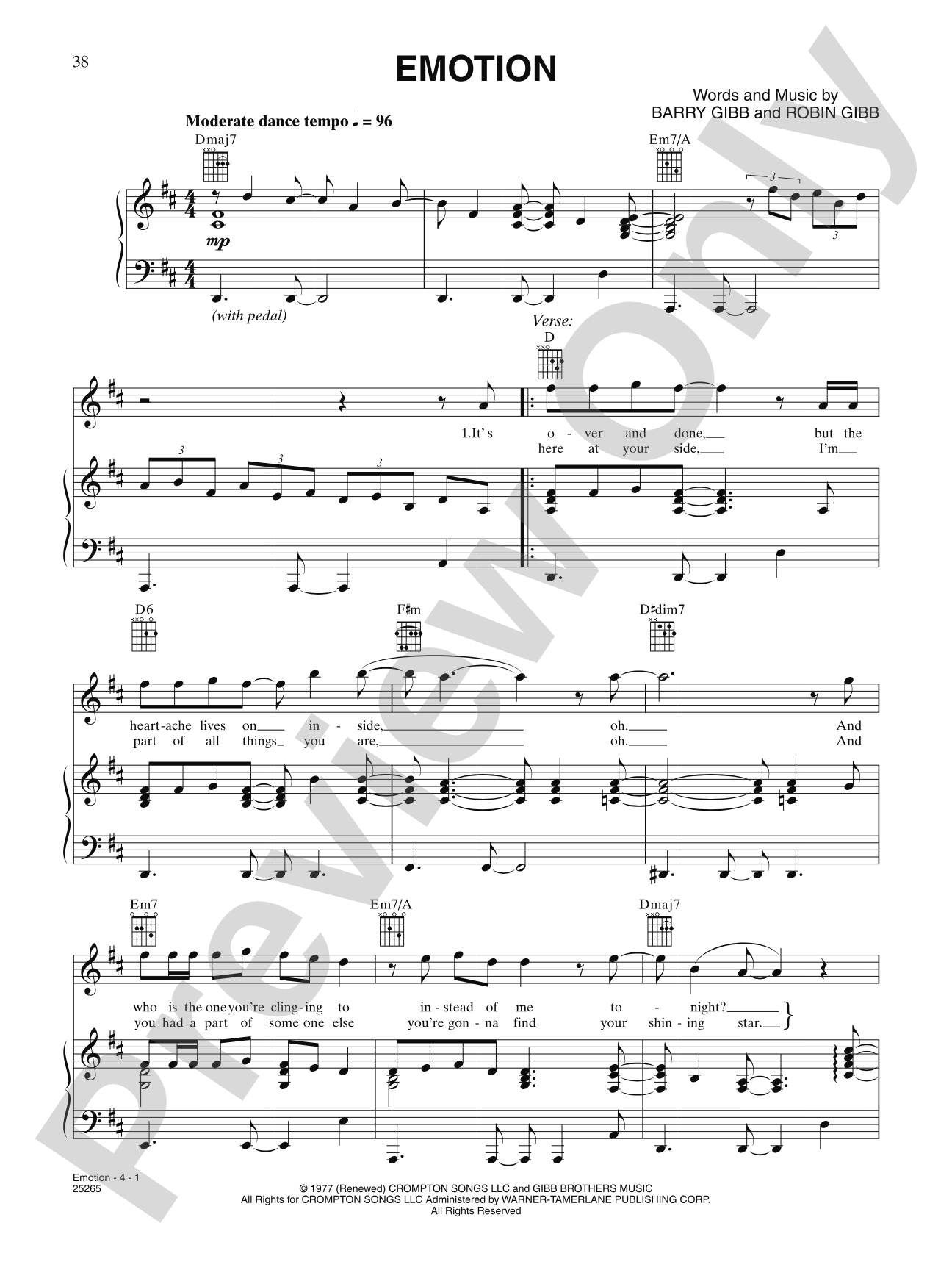

Emotion: Piano/Vocal/Chords
Bee Gees
Item: 00-PSP-000027
$4.99
One moment…
Related Items
(Our Love) Don't Throw It All Away: Piano/Vocal/Chords |
$4.99
|
View | |
First Of May: Piano/Vocal/Chords |
$4.99
|
View | |
Heartbreaker: Piano/Vocal/Chords |
$5.99
|
View | |
How Can You Mend A Broken Heart: Piano/Vocal/Chords |
$4.99
|
View | |
How Deep Is Your Love: Piano/Vocal/Chords |
$4.99
|
View | |
I Could Not Love You More: Piano/Vocal/Chords |
$4.99
|
View | |
Islands In The Stream: Piano/Vocal/Chords |
$4.99
|
View | |
Lonely Days: Piano/Vocal/Chords |
$5.99
|
View | |
More Than A Woman: Piano/Vocal/Chords |
$4.99
|
View | |
Secret Love: Piano/Vocal/Chords |
$5.99
|
View | |
To Love Somebody: Piano/Vocal/Chords |
$4.99
|
View | |
Too Much Heaven: Piano/Vocal/Chords |
$5.99
|
View | |
Words: Piano/Vocal/Chords |
$4.99
|
View |
Description
Titles: To Love Somebody * Words * First of May * Lonely Days * How Can You Mend a Broken Heart * How Deep Is Your Love * More Than a Woman * (Our Love) Don't Throw It All Away * Emotion * Too Much Heaven * Heartbreaker * Islands in the Stream * Juliet * Secret Love * For Whom the Bell Tolls * Closer Than Close * I Could Not Love You More * Wedding Day.


Emotion: Piano/Vocal/Chords isn't in MakeMusic Cloud just yet...but it could be. Let us know you'd like to see it, and you'll help shape what comes next. In the meantime, start a free trial and dive into thousands of interactive titles your students can play along with today.
Request This Title
Tell us you want it.
Start Your Free Trial
Explore everything that's ready to play right now.
Sample Audio
No sample audio found.
Sample Video
No sample videos found.
Additional Details
Publisher:
Alfred Music
Page Count:
100
SKU:
00-PSP-000027
More about this title
About the Artist: Bee Gees
The Bee Gees dominated popular music across five decades, crafting some of the most recognizable melodies in modern music history. Brothers Barry, Robin, and Maurice Gibb built their reputation on intricate vocal harmonies, sophisticated pop arrangements, and an ability to write songs that move both radio listeners and music students alike. Their catalog spans ballads, disco, and contemporary pop, making them essential listening for understanding how melody, harmony, and production shaped the second half of the twentieth century.
Why we love this
This collection captures the Bee Gees at their harmonic best, with songs that reward close attention to voice leading and chord movement. Every title here offers singers and pianists a chance to explore lush accompaniments and emotionally direct melodies without unnecessary complexity. The mix of uptempo and ballad material gives you flexibility in programming while keeping the emotional authenticity that makes these songs memorable.
What to expect
Lush, emotionally direct, and deeply singable. These melodies live in your memory from the first hearing, but the chord progressions and vocal layers reveal new details with each return. Whether the song celebrates love or mourns its loss, the Bee Gees' signature sound wraps every lyric in sophisticated warmth.
Who it's for
Vocalists preparing for recitals or auditions, pianists building a contemporary pop repertoire, and music students studying song structure and vocal harmony. This book works equally well for solo performance, classroom singing, and studio work.
How to get the most out of it
- Balance the vocal line with keyboard accompaniment by listening to how the chord voicings support (not compete with) the melody. The piano part often carries the harmonic conversation.
- Pay attention to the lyrical phrasing in ballads like "How Can You Mend a Broken Heart" and "Secret Love." These songs demand space and breath, not rushed tempos.
- Explore the alto and tenor lines in the chord charts to find countermelodies and inner voices that add depth when performing with backup singers or overdubbing.
- Use the chord symbols as a launching point for improvisation and reharmonization rather than playing exactly what's written. The Bee Gees' arrangements were often studio creations; your live version can be uniquely yours.
How to use it
Use these songs as standalone recital pieces, group them thematically for a concert focused on love songs across eras, or extract individual titles for voice lesson repertoire and piano studio performance days. The collection's 18 tracks give you enough material to build an entire program or to cherry-pick selections for variety within a larger concert.
Skills your students will build
- Reading and performing chord symbols with fluency
- Interpreting vocal phrasing and breath placement in pop ballads
- Analyzing four-part harmonic movement and voice leading
- Managing accompaniment texture to support (not overshadow) the melody
- Coordinating singing and playing simultaneously