

Of Grateful Praise: 2-Part Choral Octavo
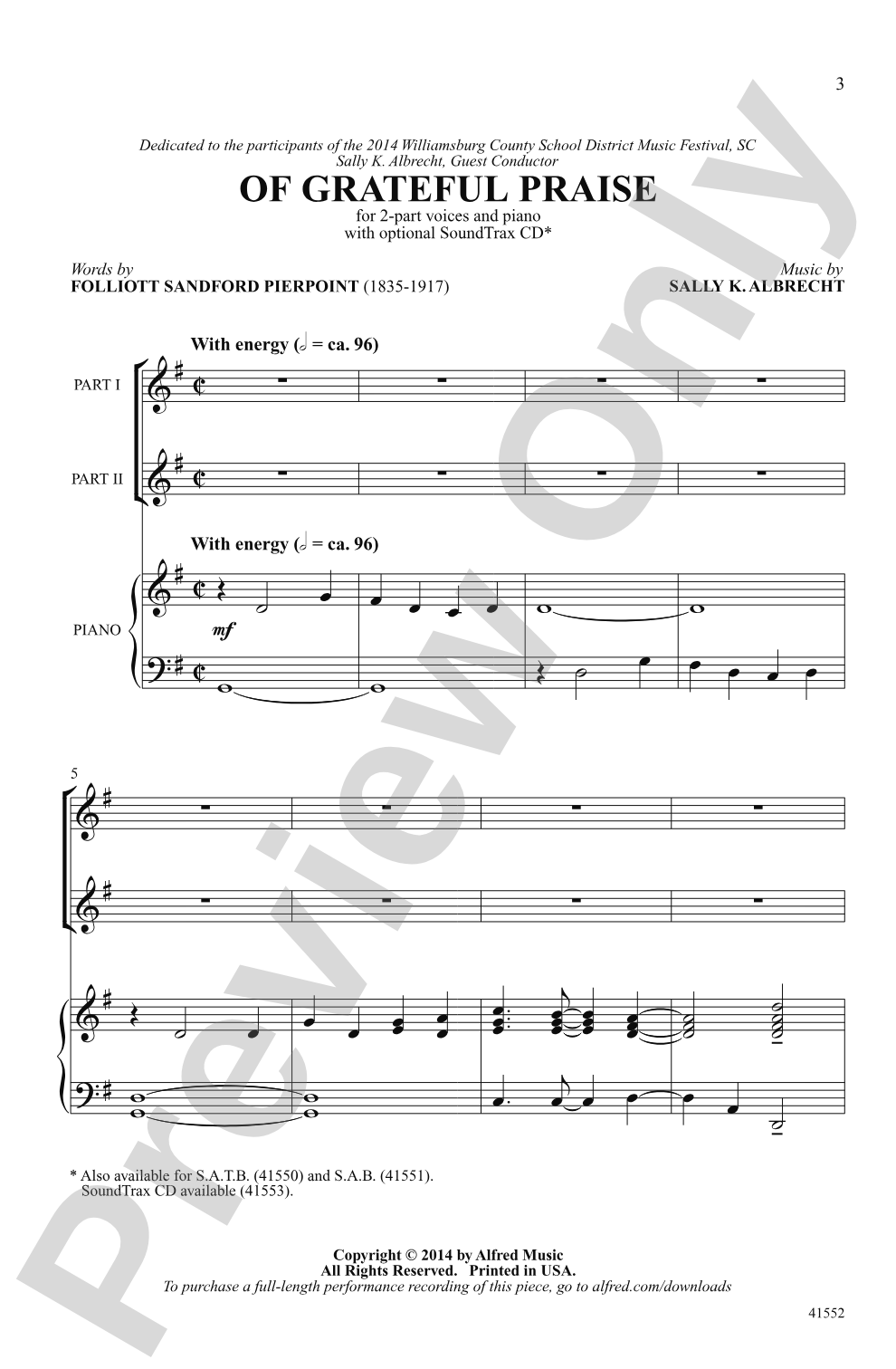
Words by Folliott Sandford Pierpoint, music by Sally K. Albrecht
Item: 00-PO-0001795
$1.85
Minimum order quantity: 20 copies
Pickup currently not available
Related Items
Of Grateful Praise: SoundTrax Digital Audio Download |
$27.99
|
View | |
Of Grateful Praise: SATB Choral Octavo |
$1.85
|
View | |
Of Grateful Praise: SAB Choral Octavo |
$1.85
|
View | |
Of Grateful Praise: SAB Choral Octavo |
$1.85
|
View | |
Of Grateful Praise: 2-Part Choral Octavo |
$1.85
|
View | |
Of Grateful Praise: Choral Octavo SoundTrax CD |
$27.99
|
View |
Description
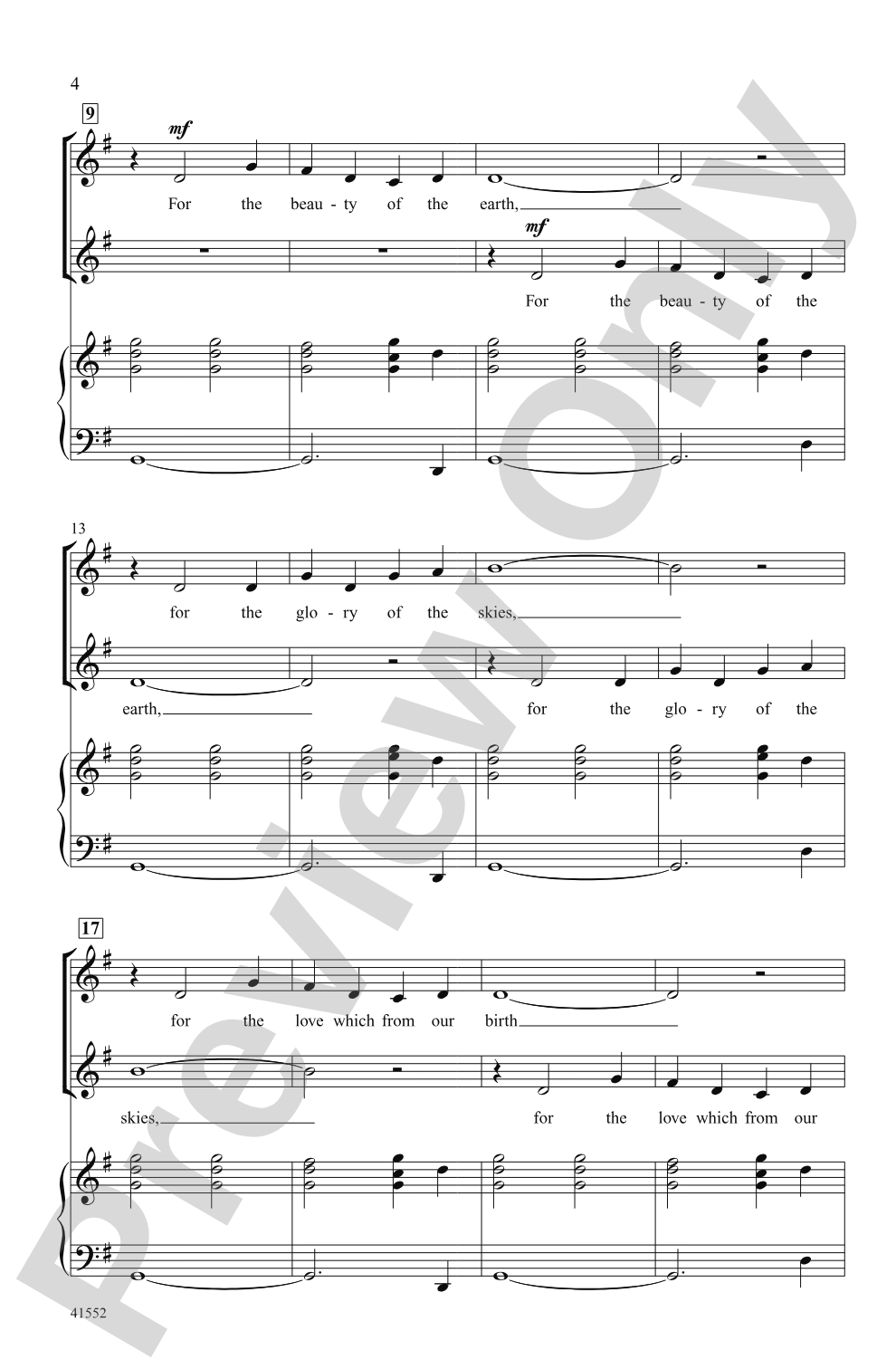
Pierpoint's famous "For the Beauty of the Earth" text is given new energy with a contemporary groove. Canonic verses and sensible repetition make for easy learning. An exciting song of praise for developing school and church choirs!


Of Grateful Praise: 2-Part Choral Octavo isn't in MakeMusic Cloud just yet...but it could be. Let us know you'd like to see it, and you'll help shape what comes next. In the meantime, start a free trial and dive into thousands of interactive titles your students can play along with today.
Request This Title
Tell us you want it.
Start Your Free Trial
Explore everything that's ready to play right now.
Sample Audio
1
Audio File
--:--
0:00
0:00
Sample Video
No sample videos found.
Additional Details
Series:
Alfred Choral Designs
Publisher:
Alfred Music
Page Count:
12
SKU:
00-PO-0001795
More about this title
About the Composer: Sally K. Albrecht

Sally K. Albrecht has spent over thirty years shaping choral music for school and church ensembles, first as Director of School Choral, Vocal, and Elementary Publications at Alfred Music and continuing as a prolific composer with more than 600 published works. Her catalog spans everything from accessible octavos to full-length musicals, and she has earned the ASCAP Special Music Award consistently since 1987 for her contributions to American music. Beyond the page, Albrecht conducts honor choirs nationwide and has led festival performances at Lincoln Center, Carnegie Hall, and The Kennedy Center.
Her educational background reflects a deep investment in both music and performance. She holds degrees from Rollins College (B.A. in Music and Theater, 1976), the University of Miami (M.A. in Drama, 1977, and M.M. in Accompanying, 1979), and has taught at Oakland University, Jersey City State College, and Meredith College. She is also known for her work integrating movement into choral singing, a signature approach that distinguishes her compositions. Albrecht currently resides in Wake Forest, North Carolina, with her husband, composer and arranger Jay Althouse.
Why we love this
Albrecht takes one of the most beloved hymn texts in American choral repertoire and reinvents it with a contemporary groove that feels fresh without losing reverence. The canonic structure and smart repetition mean your choir learns the piece quickly, freeing rehearsal time for musicality and interpretation rather than mechanics. This is the kind of piece that energizes a developing choir while still sounding substantial in concert.
What to expect
Bright and grateful, with a contemporary rhythmic vitality that makes the familiar text feel alive and present. The canonic writing creates a sense of conversation and building energy without demanding technical virtuosity.
Who it's for
Developing school and church choirs comfortable with 2-part voicing and ready for repertoire with both melodic accessibility and contemporary style. This works for middle school through adult community choirs, particularly those wanting to program something that bridges traditional sacred text with modern musical language.
How to get the most out of it
- Emphasize the rhythmic groove in the accompaniment; let your singers feel the pulse as an anchor rather than something rigid. The contemporary energy comes from relaxed confidence in the beat.
- Shape the canonic passages by having one voice part lead clearly while the other enters as a response. This creates dialogue rather than unison and keeps the texture interesting.
- Balance clarity of text with the musical flow. The familiar words deserve to land, so avoid rushing through phrases even as the energy moves forward.
How to use it
Program this as a centerpiece for a service of thanksgiving or as part of a concert celebrating gratitude and praise. Its contemporary groove pairs well alongside more traditional sacred music, offering contrast while maintaining thematic coherence. It also works effectively in spring concerts or year-end celebrations where an uplifting, accessible choral moment anchors the program.
Skills your students will build
- Reading and performing canonic structures with accurate entries
- Maintaining rhythmic precision in contemporary grooves
- Balancing two independent vocal lines while keeping unified phrasing
- Connecting lyrical text to modern musical idioms