
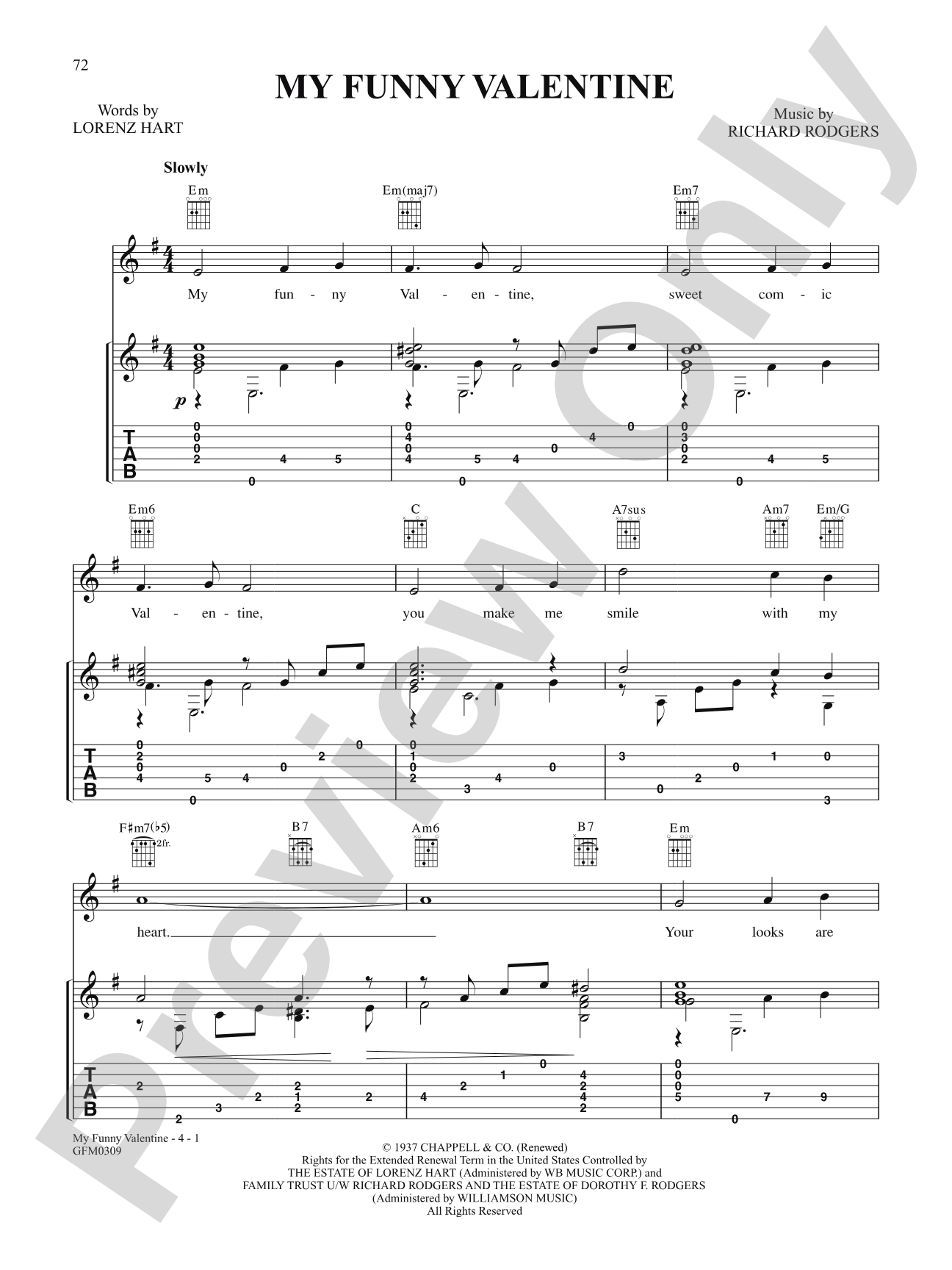

My Funny Valentine (From "Babes In Arms"): Solo Guitar
Eighteen Classic Standards Arranged As Easy-to-Play Guitar Solos
Arr. Jerry Silverman and Gregory Coleman
Item: 00-PSG-000448
$4.99
One moment…
Related Items
Laura: Solo Guitar |
$5.99
|
View | |
Over The Rainbow (From "The Wizard Of Oz"): Solo Guitar |
$5.99
|
View | |
Ain't Misbehavin': Solo Guitar |
$4.99
|
View | |
Summertime (From "Porgy And Bess"): Solo Guitar |
$4.99
|
View | |
Love For Sale: Solo Guitar |
$5.99
|
View | |
As Time Goes By (From "Casablanca"): Solo Guitar |
$4.99
|
View | |
What's New?: Solo Guitar |
$4.99
|
View | |
The Days Of Wine And Roses: Solo Guitar |
$4.99
|
View | |
I Got Rhythm: Solo Guitar |
$4.99
|
View | |
Someone To Watch Over Me (From "Oh, Kay!"): Solo Guitar |
$5.99
|
View | |
Satin Doll (Vocal Version): Solo Guitar |
$4.99
|
View |
Description
Eighteen classic standards in beautiful and playable solo guitar arrangements. Titles are: Ain't Misbehavin' * As Time Goes By * Bye Bye Blackbird * Days of Wine and Roses * Five Foot Two, Eyes of Blue * A Foggy Day * I Got Rhythm * It Had to Be You * Laura * Love for Sale * Misty * My Funny Valentine * Over the Rainbow * Satin Doll * Send in the Clowns * Someone to Watch Over Me * Summertime * What's New?


My Funny Valentine (From "Babes In Arms"): Solo Guitar isn't in MakeMusic Cloud just yet...but it could be. Let us know you'd like to see it, and you'll help shape what comes next. In the meantime, start a free trial and dive into thousands of interactive titles your students can play along with today.
Request This Title
Tell us you want it.
Start Your Free Trial
Explore everything that's ready to play right now.
Sample Audio
No sample audio found.
Sample Video
No sample videos found.
Additional Details
Series:
Guitar Solo
Publisher:
Alfred Music
Page Count:
84
SKU:
00-PSG-000448
More about this title
About the Composer: Richard Rodgers
Richard Rodgers (1902-1979) shaped American musical theater across five decades, creating melodies that have become inseparable from popular song standards. His gift for writing singable, memorable lines made his work accessible to both concert performers and casual listeners, establishing him as one of the most recorded composers in history.
Rodgers's collaboration with lyricist Lorenz Hart produced some of Broadway's most enduring songs, from intimate ballads to rollicking showstoppers. His music rewards musicians who focus on phrasing and nuance rather than technical display, making his works invaluable for developing interpretive maturity.
Why we love this
This collection captures Rodgers's genius for melody in a format that lets guitarists really explore how he balanced sophistication with singability. Each arrangement sits naturally on the fingerboard without sacrificing the harmonic richness these standards deserve, making them genuinely playable while sounding substantial.
What to expect
Stepping into a sophisticated supper club from another era. These arrangements invite you into the intimate space where melody takes center stage and harmony provides sophisticated support, letting the guitar sing with the warmth these standards deserve.
Who it's for
Guitar players with intermediate skills who want to move beyond simplified arrangements and develop interpretive musicianship through repertoire that rewards nuance. Solo performers preparing recital programs, and any guitarist seeking material that sounds elegant without demanding virtuosic technique.
How to get the most out of it
- Honor the vocal phrasing these melodies came from. Sing the line internally as you play, then listen back to confirm your rubato and breath points feel natural.
- Differentiate textures between verse and chorus by adjusting your dynamic range rather than tempo. A slight pull on the melody in a chorus can suggest emotional emphasis without losing the song's conversational quality.
- Let the harmony breathe in the accompaniment figures. These songs benefit from space between chord changes rather than continuous strumming.
How to use it
Build an entire recital around a thematic selection from this collection, or program individual standards alongside contemporary solo guitar work to demonstrate how classical training applies to repertoire beyond the traditional canon. Several pieces work beautifully as concert openers or elegant interludes.
Skills your students will build
- Reading single-line melodies with jazz-inflected harmony beneath
- Balancing melody projection with accompaniment texture
- Interpreting rubato and phrasing from vocal song traditions
- Managing chord substitutions and chromatic voice leading
- Developing arrangement awareness by comparing original sheet music to guitar adaptations