
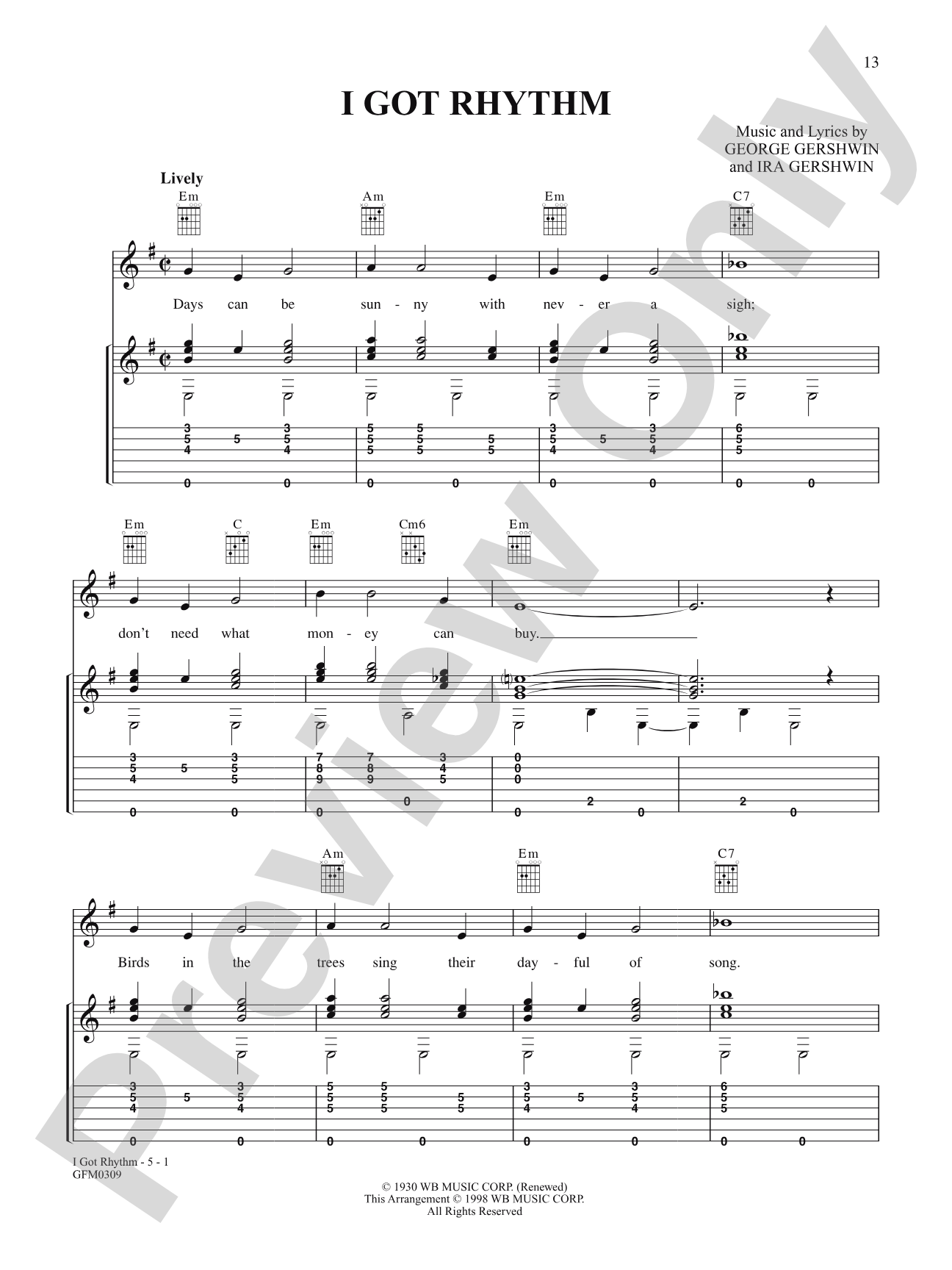

I Got Rhythm: Solo Guitar
Eighteen Classic Standards Arranged As Easy-to-Play Guitar Solos
Arr. Jerry Silverman and Gregory Coleman
Item: 00-PSG-000455
$4.99
One moment…
Related Items
Laura: Solo Guitar |
$5.99
|
View | |
Over The Rainbow (From "The Wizard Of Oz"): Solo Guitar |
$5.99
|
View | |
Ain't Misbehavin': Solo Guitar |
$4.99
|
View | |
My Funny Valentine (From "Babes In Arms"): Solo Guitar |
$4.99
|
View | |
Summertime (From "Porgy And Bess"): Solo Guitar |
$4.99
|
View | |
Love For Sale: Solo Guitar |
$5.99
|
View | |
As Time Goes By (From "Casablanca"): Solo Guitar |
$4.99
|
View | |
What's New?: Solo Guitar |
$4.99
|
View | |
The Days Of Wine And Roses: Solo Guitar |
$4.99
|
View | |
Someone To Watch Over Me (From "Oh, Kay!"): Solo Guitar |
$5.99
|
View | |
Satin Doll (Vocal Version): Solo Guitar |
$4.99
|
View |
Description
Eighteen classic standards in beautiful and playable solo guitar arrangements. Titles are: Ain't Misbehavin' * As Time Goes By * Bye Bye Blackbird * Days of Wine and Roses * Five Foot Two, Eyes of Blue * A Foggy Day * I Got Rhythm * It Had to Be You * Laura * Love for Sale * Misty * My Funny Valentine * Over the Rainbow * Satin Doll * Send in the Clowns * Someone to Watch Over Me * Summertime * What's New?


Discover MakeMusic Cloud: thousands of interactive titles your students can play along with today.
Sample Audio
No sample audio found.
Sample Video
No sample videos found.
Additional Details
Series:
Guitar Solo
Publisher:
Alfred Music
Page Count:
84
SKU:
00-PSG-000455
More about this title
About the Composer: George & Ira Gershwin
George Gershwin (1898-1937) bridged popular song and concert music with a fluency no American composer before him had achieved. His melodies became the soundtrack of the Jazz Age, and his harmonic language—drawing equally from tin pan alley and European modernism—shaped how American songwriting developed. Ira Gershwin (1896-1983) was the lyricist who matched his brother's sophistication with wit, precision, and an instinctive sense of how words sit on melody. Together they created standards that have outlasted the decade they wrote them in because the songs are simply built to last.
For guitar educators, the Gershwin catalog is essential repertoire. These melodies teach voice leading, harmonic movement, and the craft of song form. Solo guitarists find in this music an ideal bridge between classical technique and the American popular tradition, with arrangements that demand musicality as much as fingerboard facility.
Why we love this
These arrangements pack genuine musical substance into a single, practical volume. Rather than asking students to hunt through six different fake books or struggle with arrangements that oversimplify the harmonic richness of these songs, you get eighteen classics in settings that let the melody sing while remaining genuinely playable. The mix spans multiple moods and keys, giving you flexible programming options and repertoire that appeals to both the student looking for standards to master and the player seeking to build solo repertoire that audiences actually want to hear.
What to expect
Sophisticated, warm, and deeply familiar even on first encounter. These melodies carry the ease of songs that have lived in the culture for nearly a century, yet the arrangements reveal harmonic depth that invites repeated listening. There's romance here, wit, melancholy, and joy in measure.
Who it's for
Intermediate to advanced solo guitarists seeking a curated collection of standards. This book also serves teachers and ensembles who need flexible repertoire for recitals, studio performances, and programming that celebrates the American songbook on guitar.
How to get the most out of it
- Approach the phrasing as you would in vocal performance; these are songs, and the guitar should serve the melody rather than dominate it. Listen to recordings of the standards to internalize how the tune should breathe.
- Pay attention to the harmonic language underneath the melody. Gershwin's chord progressions often move in unexpected ways; let your left hand shape the harmony with clear voice leading rather than playing chords mechanically.
- Manage the dynamic range across the full arrangement. Many of these pieces sit comfortably on the guitar, but their beauty depends on contrast between moments of fullness and moments of restraint.
How to use it
Program these across a season as standalone recital pieces or as a thematic concert devoted to the American songbook. The variety of moods and keys makes it easy to pair contrasting selections in a single performance or to underscore a program arc from uptempo material through ballads and back again.
Skills your students will build
- Reading chord charts and harmonic notation in jazz and popular music contexts
- Phrasing vocal melodies idiomatically on guitar
- Executing single-line melody passages while maintaining harmonic accompaniment
- Voice leading through shell chords and suspended harmonies
- Interpreting standards notation and adapting performance tempo and dynamics to suit the song