
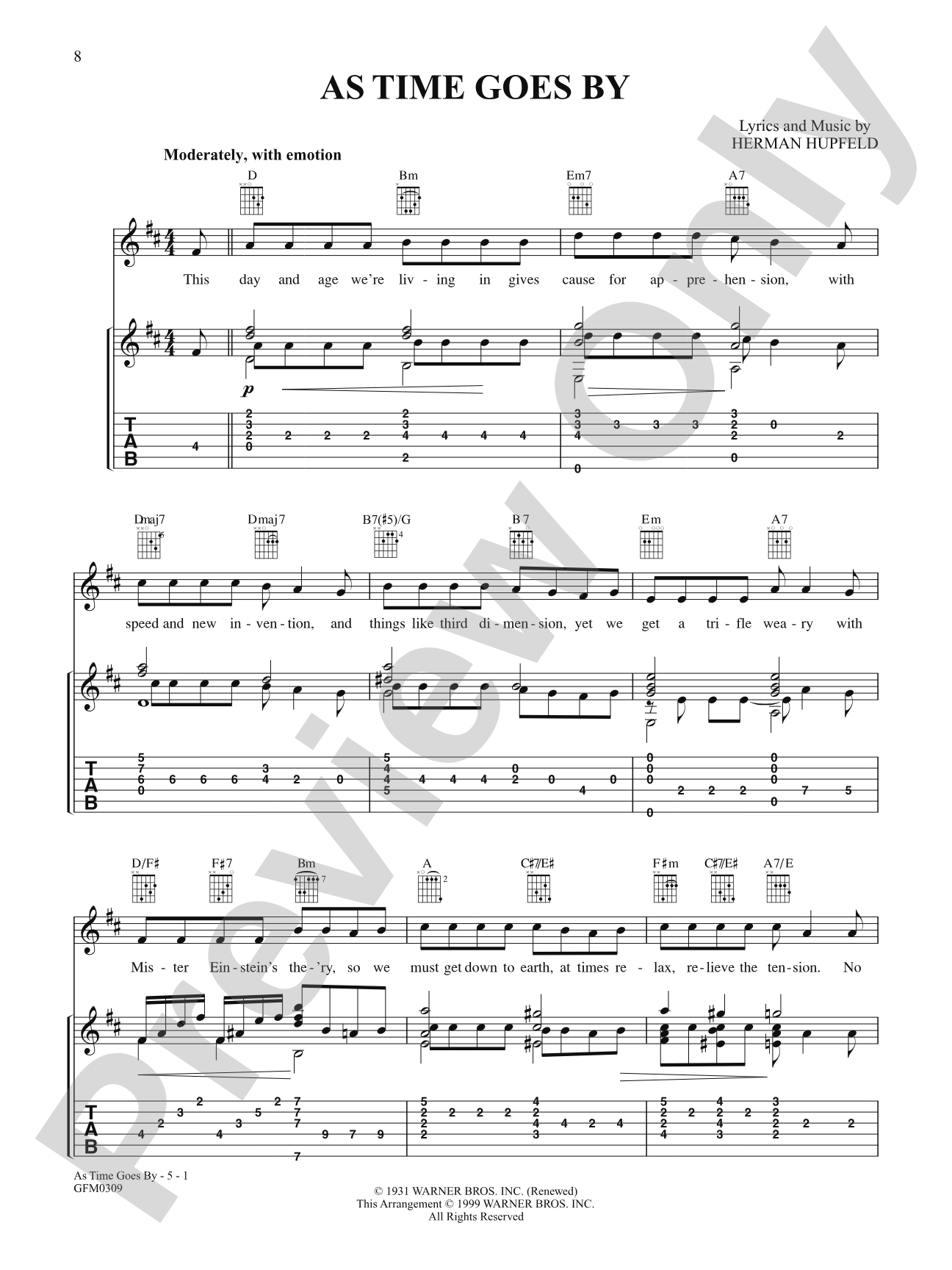

As Time Goes By (From "Casablanca"): Solo Guitar
Eighteen Classic Standards Arranged As Easy-to-Play Guitar Solos
Arr. Jerry Silverman and Gregory Coleman
Item: 00-PSG-000451
$4.99
One moment…
Related Items
Laura: Solo Guitar |
$5.99
|
View | |
Over The Rainbow (From "The Wizard Of Oz"): Solo Guitar |
$5.99
|
View | |
Ain't Misbehavin': Solo Guitar |
$4.99
|
View | |
My Funny Valentine (From "Babes In Arms"): Solo Guitar |
$4.99
|
View | |
Summertime (From "Porgy And Bess"): Solo Guitar |
$4.99
|
View | |
Love For Sale: Solo Guitar |
$5.99
|
View | |
What's New?: Solo Guitar |
$4.99
|
View | |
The Days Of Wine And Roses: Solo Guitar |
$4.99
|
View | |
I Got Rhythm: Solo Guitar |
$4.99
|
View | |
Someone To Watch Over Me (From "Oh, Kay!"): Solo Guitar |
$5.99
|
View | |
Satin Doll (Vocal Version): Solo Guitar |
$4.99
|
View |
Description
Eighteen classic standards in beautiful and playable solo guitar arrangements. Titles are: Ain't Misbehavin' * As Time Goes By * Bye Bye Blackbird * Days of Wine and Roses * Five Foot Two, Eyes of Blue * A Foggy Day * I Got Rhythm * It Had to Be You * Laura * Love for Sale * Misty * My Funny Valentine * Over the Rainbow * Satin Doll * Send in the Clowns * Someone to Watch Over Me * Summertime * What's New?


Discover MakeMusic Cloud: thousands of interactive titles your students can play along with today.
Sample Audio
No sample audio found.
Sample Video
No sample videos found.
Additional Details
Series:
Guitar Solo
Publisher:
Alfred Music
Page Count:
84
SKU:
00-PSG-000451
More about this title
About the Composer: Herman Hupfeld
Herman Hupfeld (1894-1951) was an American composer and lyricist who created some of the most enduring songs of the Great American Songbook. His gift for memorable melodies and sophisticated harmonic language made him a cornerstone of Broadway and film music during the 1920s and 1930s. "As Time Goes By," written for the 1931 operetta "Everybody's Welcome," became immortal through its use in the 1942 film "Casablanca," cementing Hupfeld's place in popular music history.
Hupfeld's compositions are prized by music educators and performers for their elegant balance of accessibility and harmonic depth. His melodic instincts translate beautifully to solo guitar arrangements, where each phrase can breathe and sing with the intimacy the songs deserve.
Why we love this
This collection pairs instantly recognizable standards with arrangements that feel natural on the guitar fingerboard, never fighting the instrument's voice or resorting to gimmickry. Whether a student is learning jazz voicings, developing interpretive maturity, or preparing repertoire for recitals and weddings, these 18 titles offer genuine musical substance without unnecessary technical barriers.
What to expect
These arrangements capture the elegance and wistful beauty that made these standards timeless. Each piece breathes with the warmth of a summer evening and the sophistication of a piano bar, inviting the player into intimate storytelling through the guitar's own voice. The harmonic richness draws you into the emotional world Hupfeld created nearly a century ago.
Who it's for
Intermediate to advanced guitarists working toward a recital repertoire, students exploring jazz harmony and voicing through written arrangements, and performers seeking reliable, well-crafted standards for weddings, restaurants, or private events. This collection suits anyone who wants to deepen their understanding of American songwriting while playing music that rewards careful listening.
How to get the most out of it
- Honor the song's lyrical content through phrasing and dynamics, even without words; allow rubato in the melody line to shape the emotional arc that these standards demand.
- Listen closely to how the written voicings move between chords; small shifts in voice leading often suggest natural crescendos and diminuendos that don't require notation.
- Break tempos into sections and identify the harmonic turning points; this approach helps you avoid rushing through changes and maintains the reflective quality these ballads require.
- Experiment with fingering choices that keep common tones under the same fingers across chord changes, reducing unnecessary position shifts and allowing the listener to hear continuity.
How to use it
Use individual selections as opening or closing numbers for recitals, particularly when programming alongside 20th-century classical or contemporary works that benefit from the contrasting lyricism of jazz standards. These titles also serve as excellent supplementary repertoire for students studying jazz history, music theory through songbook analysis, or developing sight-reading fluency with extended harmonies.
Skills your students will build
- Reading and interpreting jazz voicings and extended chord symbols
- Navigating position shifts while maintaining legato phrasing
- Understanding harmonic function and voice leading in standard song forms
- Balancing melody projection with accompaniment texture on a single instrument
- Shaping phrasing and tempo flexibility to serve a song's emotional narrative
- Transcribing and adapting melodic lines across different fingerboard positions