
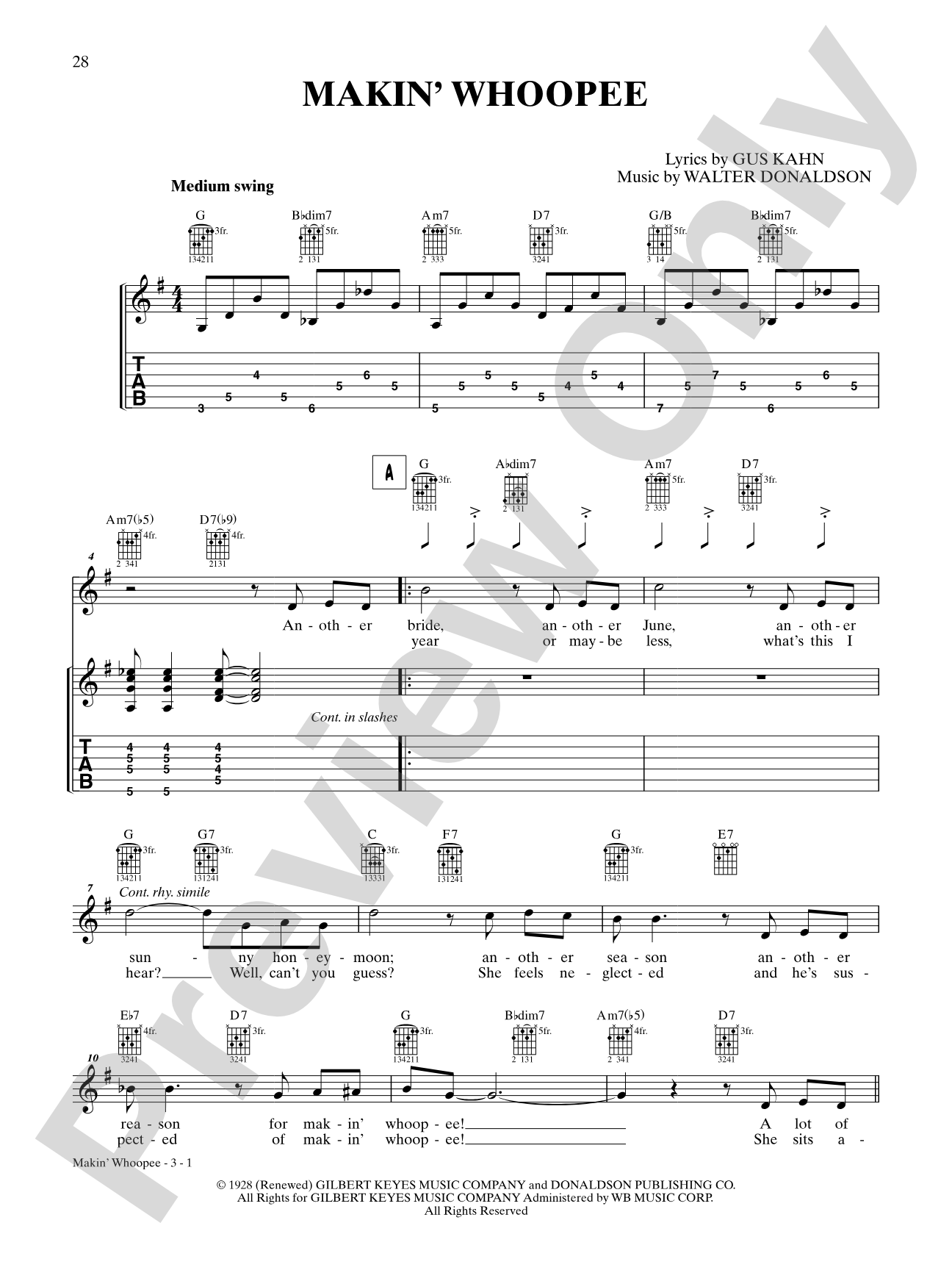

Makin' Whoopee: Interm./Easy Guitar TAB
12 Great Songs of the '20s & '30s
Item: 00-PS-0011774
$4.99
One moment…
Related Items
Five Foot Two, Eyes of Blue: Interm./Easy Guitar TAB |
$4.99
|
View | |
Ain't Misbehavin': Interm./Easy Guitar TAB |
$4.99
|
View | |
It Don't Mean a Thing: Interm./Easy Guitar TAB |
$4.99
|
View | |
Tonight You Belong to Me: Interm./Easy Guitar TAB |
$4.99
|
View | |
As Time Goes By: Interm./Easy Guitar TAB |
$4.99
|
View | |
It Had to Be You: Interm./Easy Guitar TAB |
$4.99
|
View | |
Sweet Georgia Brown: Interm./Easy Guitar TAB |
$4.99
|
View | |
Ain't She Sweet: Interm./Easy Guitar TAB |
$4.99
|
View | |
I'll See You in My Dreams: Interm./Easy Guitar TAB |
$4.99
|
View | |
Dream a Little Dream of Me: Interm./Easy Guitar TAB |
$4.99
|
View |
Description
Swingin' Jazz Guitar is designed for your total enjoyment. Each song is arranged in a fun and lively way with a strum-and-sing approach. The chords are simple, yet entirely appropriate to the jazz-age style of the '20s and '30s. We've also included classic intros, endings, and turnarounds that will make you sound like an authentic early jazzer. Titles: Ain't Misbehavin' * Ain't She Sweet * As Time Goes By * Bye Bye Blackbird * Dream a Little Dream of Me * Five Foot Two, Eyes of Blue * I'll See You in My Dreams * It Don't Mean a Thing (If It Ain't Got That Swing) * It Had to Be You * Makin' Whoopee * Sweet Georgia Brown * Tonight You Belong to Me.


Makin' Whoopee: Interm./Easy Guitar TAB isn't in MakeMusic Cloud just yet...but it could be. Let us know you'd like to see it, and you'll help shape what comes next. In the meantime, start a free trial and dive into thousands of interactive titles your students can play along with today.
Request This Title
Tell us you want it.
Start Your Free Trial
Explore everything that's ready to play right now.
Sample Audio
No sample audio found.
Sample Video
No sample videos found.
Additional Details
Series:
Just for Fun
Publisher:
Alfred Music
Page Count:
44
SKU:
00-PS-0011774
More about this title
About the Composer: Gus Kahn
Gus Kahn (1886-1941) was one of the most prolific lyricists of the Jazz Age, crafting witty, singable words for some of the era's most enduring standards. His partnership with composer Walter Donaldson produced "Makin' Whoopee" and many other songs that defined the sound and sensibility of 1920s popular music.
Kahn's gift was making lyrics that worked equally well for singers and instrumentalists. His words fit naturally into melodies, and his sense of humor and romantic sentiment captured the spirit of the era in ways that still resonate today. For music educators, his catalog represents essential American songwriting and a gateway into authentic jazz repertoire.
Why we love this
This folio captures the genuine swagger of early jazz without requiring complicated fingerings or obscure chord voicings. The strum-and-sing approach with period-appropriate intros, endings, and turnarounds teaches authentic jazz guitar style at a level intermediate and easy players can actually execute. You get twelve standards that sound sophisticated because they are, not because they're technically out of reach.
What to expect
Stepping into a speakeasy full of good humor and romance. The melodies are instantly memorable, the rhythms snap with a relaxed confidence, and the overall mood balances elegance with playfulness. These twelve songs feel like they belong together, a snapshot of American popular music at its most charming.
Who it's for
Guitar students at the intermediate and easy levels who want to play authentic jazz standards without years of theory or advanced technique. This is ideal for singers who play guitar and want a repertoire that works for both instruments, and for guitarists exploring jazz style and voicing for the first time.
How to get the most out of it
- Treat the rhythm section parts (strumming patterns) as essential to the groove rather than accompaniment. The swing feel depends on your phrasing, not just note accuracy.
- Study the classic intros and turnarounds included in the book separately before integrating them into full arrangements. These figures are what distinguish jazz guitar from folk or pop playing.
- Listen to early jazz guitar recordings of these songs (Django Reinhardt, Eddie Lang) to absorb the articulation and timing that written TAB alone cannot capture.
- Keep the tempo relaxed and conversational, especially on ballads. Jazz-age tempos often feel slower than modern recordings suggest.
How to use it
Program individual songs as solo recital pieces or as part of a vintage jazz-themed concert. The collection works beautifully in a casual performance setting (coffeehouse, informal community event) or as the anchor repertoire for a unit on American songwriting and jazz history. These titles are recognizable enough to audiences that even modest performances feel substantial.
Skills your students will build
- Swing rhythms and jazz phrasing on guitar
- Simple jazz chord voicings and progressions characteristic of the 1920s-1930s
- Reading TAB notation for specific chord shapes and intros/turnarounds
- Authentic jazz accompaniment patterns and strumming techniques
- Listening and intonation in the context of jazz melody and harmony