
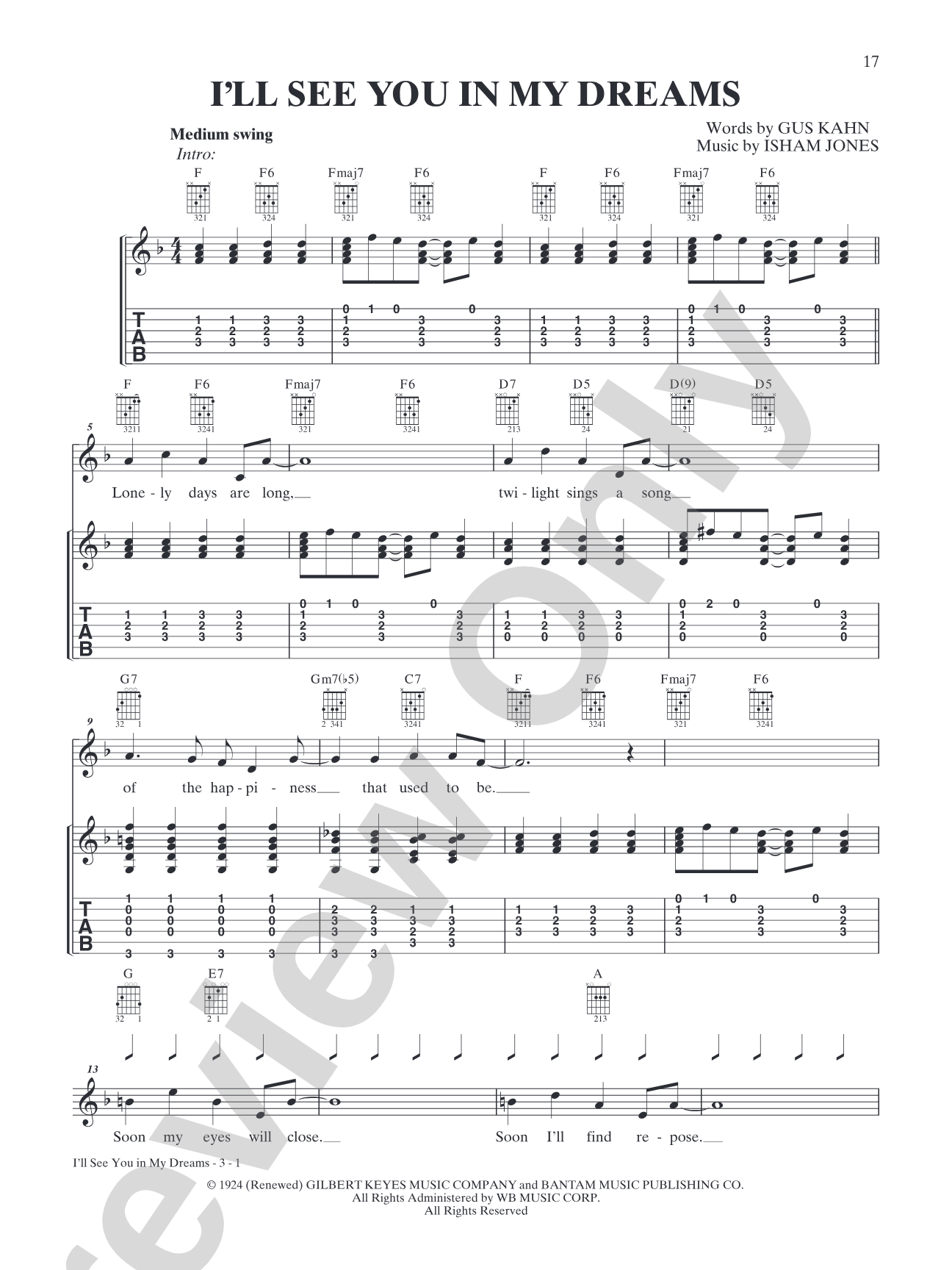

I'll See You in My Dreams: Interm./Easy Guitar TAB
12 Great Songs of the '20s & '30s
Item: 00-PS-0011938
$4.99
Pickup currently not available
Related Items
Makin' Whoopee: Interm./Easy Guitar TAB |
$4.99
|
View | |
Five Foot Two, Eyes of Blue: Interm./Easy Guitar TAB |
$4.99
|
View | |
Ain't Misbehavin': Interm./Easy Guitar TAB |
$4.99
|
View | |
It Don't Mean a Thing: Interm./Easy Guitar TAB |
$4.99
|
View | |
Tonight You Belong to Me: Interm./Easy Guitar TAB |
$4.99
|
View | |
As Time Goes By: Interm./Easy Guitar TAB |
$4.99
|
View | |
It Had to Be You: Interm./Easy Guitar TAB |
$4.99
|
View | |
Sweet Georgia Brown: Interm./Easy Guitar TAB |
$4.99
|
View | |
Ain't She Sweet: Interm./Easy Guitar TAB |
$4.99
|
View | |
Dream a Little Dream of Me: Interm./Easy Guitar TAB |
$4.99
|
View |
Description
Swingin' Jazz Guitar is designed for your total enjoyment. Each song is arranged in a fun and lively way with a strum-and-sing approach. The chords are simple, yet entirely appropriate to the jazz-age style of the '20s and '30s. We've also included classic intros, endings, and turnarounds that will make you sound like an authentic early jazzer. Titles: Ain't Misbehavin' * Ain't She Sweet * As Time Goes By * Bye Bye Blackbird * Dream a Little Dream of Me * Five Foot Two, Eyes of Blue * I'll See You in My Dreams * It Don't Mean a Thing (If It Ain't Got That Swing) * It Had to Be You * Makin' Whoopee * Sweet Georgia Brown * Tonight You Belong to Me.


I'll See You in My Dreams: Interm./Easy Guitar TAB isn't in MakeMusic Cloud just yet...but it could be. Let us know you'd like to see it, and you'll help shape what comes next. In the meantime, start a free trial and dive into thousands of interactive titles your students can play along with today.
Request This Title
Tell us you want it.
Start Your Free Trial
Explore everything that's ready to play right now.
Sample Audio
No sample audio found.
Sample Video
No sample videos found.
Additional Details
Series:
Just for Fun
Publisher:
Alfred Music
Page Count:
44
SKU:
00-PS-0011938
More about this title
About the Composer: Gus Kahn
Gus Kahn (1886-1941) was one of the most prolific lyricists of the jazz age, writing words for hundreds of popular songs that defined the sound of the 1920s and 1930s. Though technically a lyricist rather than a composer, Kahn's collaborations with composers like Isham Jones produced some of the era's most enduring standards, many of which appear in this collection. His gift for singable, memorable phrases and his ability to capture the spirit of early jazz made him an essential voice in American popular music.
Why we love this
These twelve standards feel completely at home on guitar, and the tab notation makes the jazz-age vocabulary accessible without requiring years of classical training. The inclusion of period-appropriate intros, endings, and turnarounds moves students beyond simple strumming into authentic jazz phrasing, all at a pace intermediate players can actually manage.
What to expect
Relaxed and sophisticated, with the warmth of early jazz standards that feel both familiar and timeless. Every tune invites you to lean back, swing the rhythm just slightly, and enjoy the simplicity of good melody and period-perfect harmony.
Who it's for
Intermediate and early intermediate guitarists who want to move beyond folk and pop strumming into the jazz repertoire without needing to read standard notation. Solo players preparing material for casual performance or studio musicians building familiarity with jazz-age standards will find the tab format and singable melodies especially useful.
How to get the most out of it
- Study the turnarounds and intros as separate practice units; they're the details that transform a tune from competent to convincing, and they reward focused attention before you assemble them into full arrangements.
- Keep the tempo relaxed and conversational rather than metronomically rigid; these songs from the 1920s and 1930s breathe and swing rather than march.
- Use the chord symbols as a guide to improvisation once you've mastered the written lines; jazz guitar lives in the space between the page and your ear.
- Pay attention to the strum patterns notated in the arrangements; they carry the rhythm style of each tune and should feel like part of the melody, not separate from it.
How to use it
These arrangements work beautifully as intermission material or as a standalone set for a casual performance focused on American popular standards. They also suit a curriculum unit on jazz history, where students can explore how guitar fits into the ensemble sound of the 1920s and 1930s.
Skills your students will build
- Chord progression reading and recognition across jazz standards
- Jazz-era strum patterns and rhythm articulation
- Melodic phrasing and swing feel in a soloing context
- Understanding jazz turnarounds, intros, and endings as structural elements
- Tab reading for intermediate fretboard navigation