
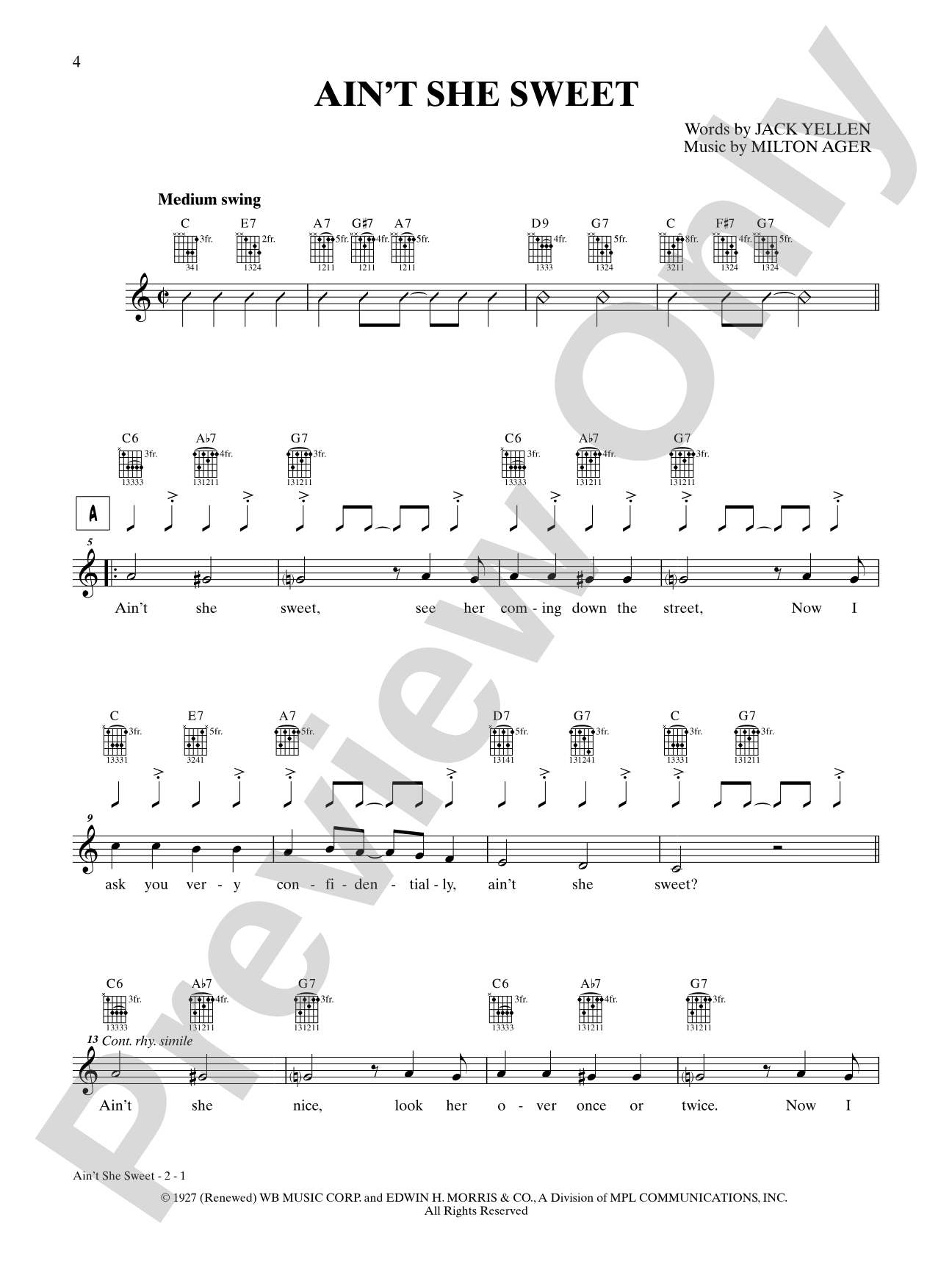

Ain't She Sweet: Interm./Easy Guitar TAB
12 Great Songs of the '20s & '30s
Item: 00-PS-0011859
$4.99
One moment…
Related Items
Makin' Whoopee: Interm./Easy Guitar TAB |
$4.99
|
View | |
Five Foot Two, Eyes of Blue: Interm./Easy Guitar TAB |
$4.99
|
View | |
Ain't Misbehavin': Interm./Easy Guitar TAB |
$4.99
|
View | |
It Don't Mean a Thing: Interm./Easy Guitar TAB |
$4.99
|
View | |
Tonight You Belong to Me: Interm./Easy Guitar TAB |
$4.99
|
View | |
As Time Goes By: Interm./Easy Guitar TAB |
$4.99
|
View | |
It Had to Be You: Interm./Easy Guitar TAB |
$4.99
|
View | |
Sweet Georgia Brown: Interm./Easy Guitar TAB |
$4.99
|
View | |
I'll See You in My Dreams: Interm./Easy Guitar TAB |
$4.99
|
View | |
Dream a Little Dream of Me: Interm./Easy Guitar TAB |
$4.99
|
View |
Description
Swingin' Jazz Guitar is designed for your total enjoyment. Each song is arranged in a fun and lively way with a strum-and-sing approach. The chords are simple, yet entirely appropriate to the jazz-age style of the '20s and '30s. We've also included classic intros, endings, and turnarounds that will make you sound like an authentic early jazzer. Titles: Ain't Misbehavin' * Ain't She Sweet * As Time Goes By * Bye Bye Blackbird * Dream a Little Dream of Me * Five Foot Two, Eyes of Blue * I'll See You in My Dreams * It Don't Mean a Thing (If It Ain't Got That Swing) * It Had to Be You * Makin' Whoopee * Sweet Georgia Brown * Tonight You Belong to Me.


Ain't She Sweet: Interm./Easy Guitar TAB isn't in MakeMusic Cloud just yet...but it could be. Let us know you'd like to see it, and you'll help shape what comes next. In the meantime, start a free trial and dive into thousands of interactive titles your students can play along with today.
Request This Title
Tell us you want it.
Start Your Free Trial
Explore everything that's ready to play right now.
Sample Audio
No sample audio found.
Sample Video
No sample videos found.
Additional Details
Series:
Just for Fun
Publisher:
Alfred Music
Page Count:
44
SKU:
00-PS-0011859
More about this title
About the Composer: Milton Ager
Milton Ager (1893-1979) was a prolific composer of popular songs during the Jazz Age and beyond, with a gift for writing melodies that stayed in the public ear. His collaborations with lyricist Jack Yellen produced some of the era's most enduring standards, including "Ain't Misbehavin'" and "Ain't She Sweet." Ager's understanding of what made a song singable and memorable made him a natural fit for the Broadway and Tin Pan Alley scenes of the 1920s and 1930s.
For guitarists, Ager's songs offer straightforward harmonic frameworks that accommodate both melody and improvisation. His melodies are clever without being fussy, and his chord progressions sit naturally under the fingers. These qualities make his work ideal for learning the vocabulary of jazz-era songwriting.
Why we love this
This collection captures the essence of early jazz guitar in a format that actually sounds authentic without requiring advanced technique. The inclusion of classic intros, endings, and turnarounds teaches you how early jazz guitarists actually voiced these standards, giving you the harmonic and stylistic building blocks to eventually improvise over these changes yourself. It's a rare intermediate book that feels like you're learning from the era itself, not just learning songs that happen to be old.
What to expect
Opening these pages feels like stepping into a 1920s speakeasy with a guitar in your hands. The melodies are immediately singable and the chords sit comfortably under your fingers, but there's enough stylistic character in the suggested voicings and turnarounds to make you sound like you belong there. The music swings without pretension, offering genuine jazz flavor at a level where you can actually focus on phrasing and feel rather than struggling with the mechanics.
Who it's for
Intermediate to easy-level guitarists who want to explore jazz-age standards without the theoretical demands of advanced jazz harmony. This works equally well for self-taught players developing their own sound and for ensemble members who need accessible jazz repertoire to complement band or orchestra concerts. Singers looking for tasteful accompaniment will also find this collection straightforward to learn and fun to interpret.
How to get the most out of it
- Listen to recordings of Wes Montgomery or Joe Pass playing jazz standards from this era; their approach to phrasing and dynamic control will inform how you shape these melodies.
- Practice the provided intros and turnarounds separately until they become muscle memory, then integrate them into full run-throughs so they feel organic rather than tacked on.
- Let the syncopation breathe by resisting the urge to play metronomically; the jazz-age style rewards slight rhythmic flexibility and swing feel, especially on the offbeats.
How to use it
Pair this collection with a school jazz assembly or informal performance event where a solo guitarist or small ensemble can entertain without heavy amplification. These standards work beautifully as interludes between larger ensemble pieces or as part of a social music event celebrating American songwriting. Because the arrangements are self-contained and the songs are recognizable, you can program one or two pieces strategically without needing a full jazz band context.
Skills your students will build
- jazz-era chord voicings and voice leading
- reading and executing guitar-specific notation (TAB with standard notation)
- interpreting swing feel and syncopation in context
- building fluency with classic turnarounds and reharmonization techniques
- adapting arrangement elements (intros/endings) across multiple songs