
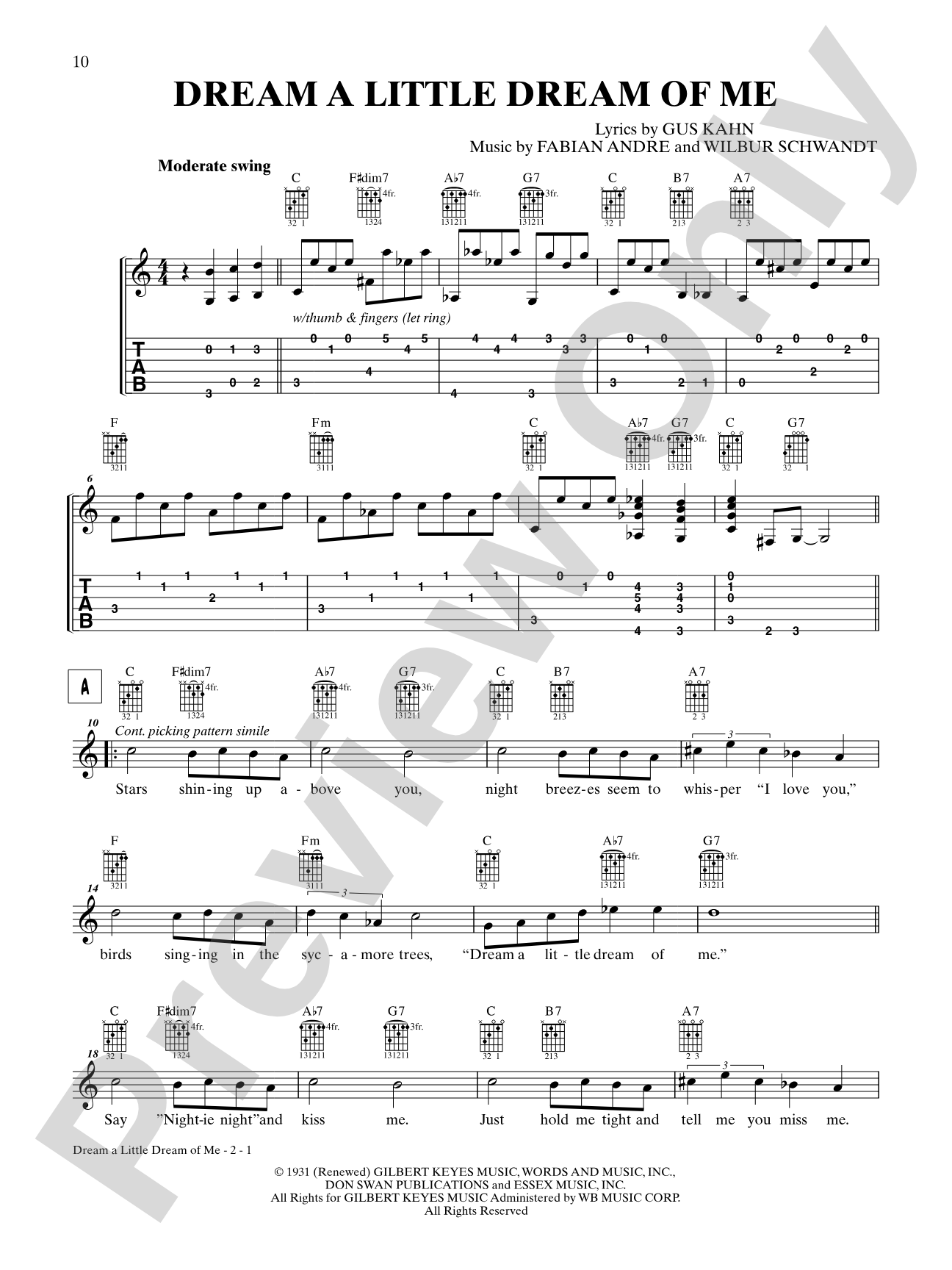

Dream a Little Dream of Me: Interm./Easy Guitar TAB
12 Great Songs of the '20s & '30s
Item: 00-PS-0011952
$4.99
One moment…
Related Items
Makin' Whoopee: Interm./Easy Guitar TAB |
$4.99
|
View | |
Five Foot Two, Eyes of Blue: Interm./Easy Guitar TAB |
$4.99
|
View | |
Ain't Misbehavin': Interm./Easy Guitar TAB |
$4.99
|
View | |
It Don't Mean a Thing: Interm./Easy Guitar TAB |
$4.99
|
View | |
Tonight You Belong to Me: Interm./Easy Guitar TAB |
$4.99
|
View | |
As Time Goes By: Interm./Easy Guitar TAB |
$4.99
|
View | |
It Had to Be You: Interm./Easy Guitar TAB |
$4.99
|
View | |
Sweet Georgia Brown: Interm./Easy Guitar TAB |
$4.99
|
View | |
Ain't She Sweet: Interm./Easy Guitar TAB |
$4.99
|
View | |
I'll See You in My Dreams: Interm./Easy Guitar TAB |
$4.99
|
View |
Description
Swingin' Jazz Guitar is designed for your total enjoyment. Each song is arranged in a fun and lively way with a strum-and-sing approach. The chords are simple, yet entirely appropriate to the jazz-age style of the '20s and '30s. We've also included classic intros, endings, and turnarounds that will make you sound like an authentic early jazzer. Titles: Ain't Misbehavin' * Ain't She Sweet * As Time Goes By * Bye Bye Blackbird * Dream a Little Dream of Me * Five Foot Two, Eyes of Blue * I'll See You in My Dreams * It Don't Mean a Thing (If It Ain't Got That Swing) * It Had to Be You * Makin' Whoopee * Sweet Georgia Brown * Tonight You Belong to Me.


Dream a Little Dream of Me: Interm./Easy Guitar TAB isn't in MakeMusic Cloud just yet...but it could be. Let us know you'd like to see it, and you'll help shape what comes next. In the meantime, start a free trial and dive into thousands of interactive titles your students can play along with today.
Request This Title
Tell us you want it.
Start Your Free Trial
Explore everything that's ready to play right now.
Sample Audio
No sample audio found.
Sample Video
No sample videos found.
Additional Details
Series:
Just for Fun
Publisher:
Alfred Music
Page Count:
44
SKU:
00-PS-0011952
More about this title
About the Composer: Fabian Andre
Fabian Andre was a prolific composer and lyricist of the Jazz Age, working extensively during the 1920s and 1930s when jazz standards were being codified into the Great American Songbook. His gift for memorable melodies and his understanding of what made a song singable made him a sought-after collaborator for both theatrical and popular music. Andre's compositions remain central to jazz repertoire because they capture the harmonic sophistication and rhythmic ease that defined early jazz songwriting.
As a composer working alongside lyricists like Gus Kahn and Wilbur Schwandt, Andre created songs built on clear harmonic structures and melodies that sit naturally on the voice and guitar alike. His work continues to serve as foundational material for jazz musicians learning the language of standards and swing.
Why we love this
This collection captures the spirit of early jazz with arrangements that honor the era without getting bogged down in complexity. The strum-and-sing approach means guitarists can focus on the essential feel of swing rather than wrestling with dense voicings, and the inclusion of period-authentic intros, endings, and turnarounds teaches genuine jazz guitar vocabulary. Twelve standards from a single songwriting perspective give students a cohesive musical statement they can actually absorb and internalize.
What to expect
Swinging, nostalgic, and surprisingly warm. These twelve songs transport you to smoky rooms and dimly lit jazz clubs of the 1920s and '30s, where the music moved with ease and humor. The arrangements sit naturally under the fingers, allowing you to feel the rhythmic pocket and harmonic sophistication without strain.
Who it's for
Intermediate to easy-level guitarists ready to move beyond pop and folk into jazz standards repertoire. Solo performers preparing recital material, and ensemble guitarists looking for sing-along pieces that sit comfortably between accompaniment and featured playing.
How to get the most out of it
- Anchor the swing feel through steady bass notes and syncopated chord strums rather than trying to rush the rhythm. The written tab will guide your strum pattern, but the space between notes matters as much as the notes themselves.
- Listen to classic recordings of these songs to absorb how the melodies sit and breathe. Your interpretation should honor the melody line while letting the guitar's natural timbre shine through.
- Practice the intros and turnarounds in isolation before weaving them into full performances. These figures are the connective tissue of authentic jazz guitar and deserve dedicated attention.
- Shape the dynamics across a verse and chorus to build interest. Early jazz arrangements thrive on contrast, not uniform volume.
How to use it
Program several of these standards in a themed jazz recital or coffeehouse setting where the audience can hear the evolution of early swing style across a single evening. Solo performers can build a five to seven song set from this folio for a recital focused on American songbook standards. In an ensemble or mixed-instruments context, select one or two arrangements as feature pieces featuring a guitarist vocalist.
Skills your students will build
- Reading and executing swing rhythms and syncopation in TAB
- Executing period-appropriate jazz guitar intros, endings, and turnarounds
- Understanding chord melody relationships within early jazz compositions
- Building interpretation and phrasing skills for jazz standards
- Accompanying a vocal melody while maintaining rhythmic integrity