
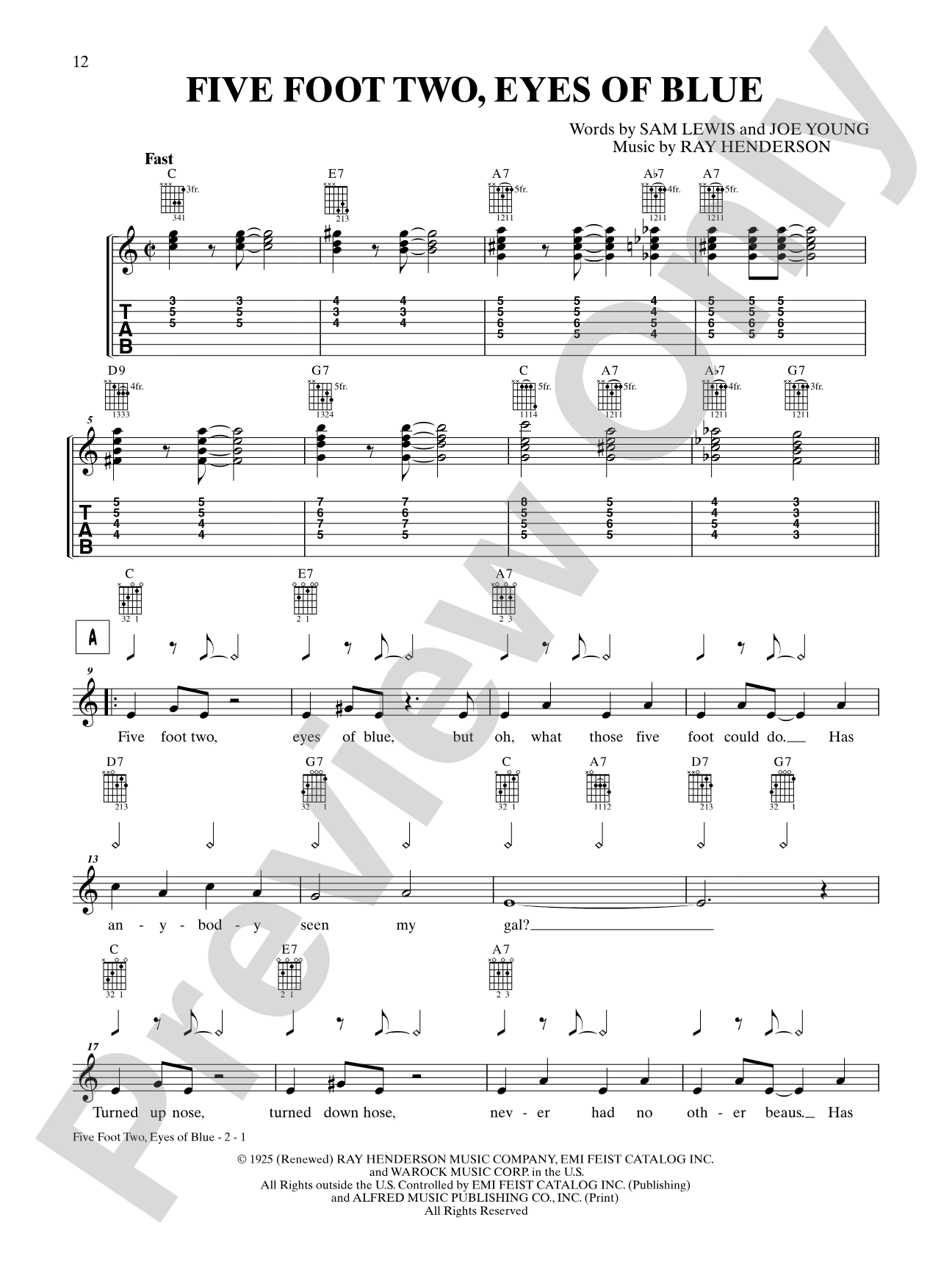

Five Foot Two, Eyes of Blue: Interm./Easy Guitar TAB
12 Great Songs of the '20s & '30s
Item: 00-PS-0011782
$4.99
One moment…
Related Items
Makin' Whoopee: Interm./Easy Guitar TAB |
$4.99
|
View | |
Ain't Misbehavin': Interm./Easy Guitar TAB |
$4.99
|
View | |
It Don't Mean a Thing: Interm./Easy Guitar TAB |
$4.99
|
View | |
Tonight You Belong to Me: Interm./Easy Guitar TAB |
$4.99
|
View | |
As Time Goes By: Interm./Easy Guitar TAB |
$4.99
|
View | |
It Had to Be You: Interm./Easy Guitar TAB |
$4.99
|
View | |
Sweet Georgia Brown: Interm./Easy Guitar TAB |
$4.99
|
View | |
Ain't She Sweet: Interm./Easy Guitar TAB |
$4.99
|
View | |
I'll See You in My Dreams: Interm./Easy Guitar TAB |
$4.99
|
View | |
Dream a Little Dream of Me: Interm./Easy Guitar TAB |
$4.99
|
View |
Description
Swingin' Jazz Guitar is designed for your total enjoyment. Each song is arranged in a fun and lively way with a strum-and-sing approach. The chords are simple, yet entirely appropriate to the jazz-age style of the '20s and '30s. We've also included classic intros, endings, and turnarounds that will make you sound like an authentic early jazzer. Titles: Ain't Misbehavin' * Ain't She Sweet * As Time Goes By * Bye Bye Blackbird * Dream a Little Dream of Me * Five Foot Two, Eyes of Blue * I'll See You in My Dreams * It Don't Mean a Thing (If It Ain't Got That Swing) * It Had to Be You * Makin' Whoopee * Sweet Georgia Brown * Tonight You Belong to Me.


Five Foot Two, Eyes of Blue: Interm./Easy Guitar TAB isn't in MakeMusic Cloud just yet...but it could be. Let us know you'd like to see it, and you'll help shape what comes next. In the meantime, start a free trial and dive into thousands of interactive titles your students can play along with today.
Request This Title
Tell us you want it.
Start Your Free Trial
Explore everything that's ready to play right now.
Sample Audio
No sample audio found.
Sample Video
No sample videos found.
Additional Details
Series:
Just for Fun
Publisher:
Alfred Music
Page Count:
44
SKU:
00-PS-0011782
More about this title
About the Composer: Ray Henderson
Ray Henderson (1896-1970) was a prolific songwriter whose melodies defined the jazz age and early American musical theater. His gift for crafting instantly memorable tunes made him a cornerstone of 1920s-1930s popular music, collaborating with lyricists like Lew Brown and B.G. DeSylva on standards that remain central to jazz repertoire.
For guitarists, Henderson's work offers straightforward harmonic language paired with infectious rhythm and swing. His songs reward players who focus on feel and phrasing over technical complexity, making them ideal for developing interpretive musicianship at the intermediate level.
Why we love this
This collection captures the essential vocabulary of early jazz guitar without overwhelming players with complex chord substitutions or fast-moving changes. Each arrangement includes period-appropriate intros, endings, and turnarounds that teach authentic style and give guitarists immediate tools for sounding polished from the first rehearsal.
What to expect
Stepping into a 1920s speakeasy with a guitar in hand. The tunes swing with a breezy confidence, and the arrangements give you just enough harmonic color to feel like an ensemble player without demanding virtuosity. This is music made for playing with friends, for finding groove, and for discovering how much personality you can coax from straightforward chords.
Who it's for
Intermediate and early-intermediate guitarists ready to move beyond basic strumming patterns into jazz-age repertoire. Players who sing or perform with others will find immediate, accessible material that sounds sophisticated and intentional from day one.
How to get the most out of it
- Shape the melody around the swing feel rather than playing it metronomically; let the rhythm section breathe with you.
- Study how the turnarounds function as connectors between sections; they're your bridge into the next phrase.
- Experiment with the dynamics of your strumming hand to distinguish verse from chorus, even when the chords stay simple.
- Use the intros and endings as listening guides; they show you how to frame a song and set the mood for bandmates.
How to use it
These arrangements work beautifully as a full set for a jazz-themed recital or as individual pieces sprinkled throughout a season. They're equally at home in a guitar ensemble, as solo recital warmers, or paired with full-band arrangements when you need a guitar-featured moment that won't stop the energy.
Skills your students will build
- Reading guitar TAB with jazz chord symbols
- Swing phrasing and rhythmic interpretation
- Jazz-era harmonic vocabulary (7th chords, common progressions of the 1920s-1930s)
- Ensemble listening and groove awareness
- Arranging decisions: intro, turnaround, and ending construction