
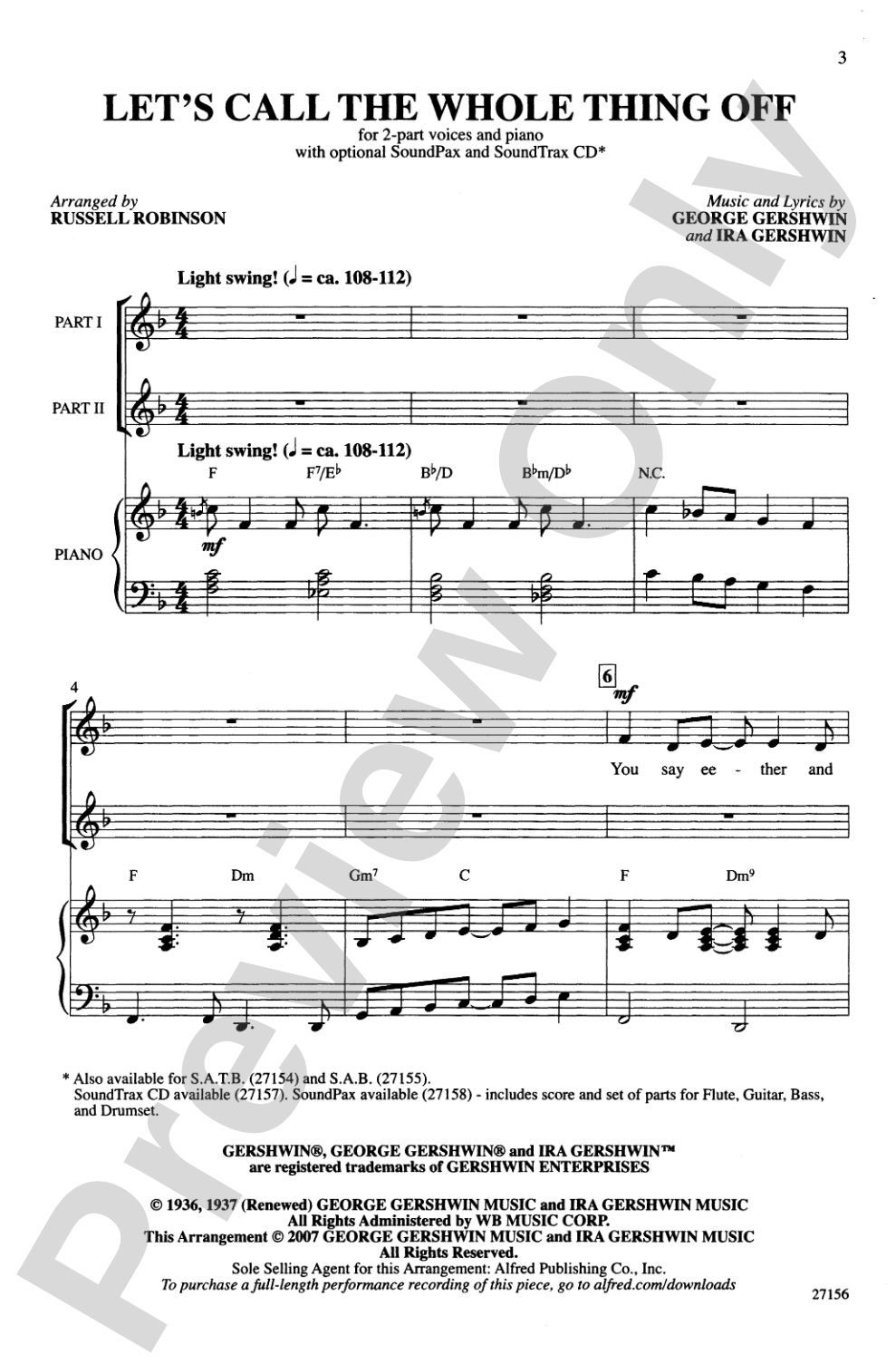

Let's Call the Whole Thing Off: 2-Part Choral Octavo
Music and lyrics by George Gershwin and Ira Gershwin / arr. Russell Robinson
Item: 00-PO-0002259
$2.25
Minimum order quantity: 20 copies
One moment…
Related Items
Let's Call the Whole Thing Off: SoundTrax Digital Audio Download |
$27.99
|
View | |
Let's Call the Whole Thing Off: SATB Choral Octavo |
$2.25
|
View | |
Let's Call the Whole Thing Off: SAB Choral Octavo |
$2.25
|
View | |
Let's Call the Whole Thing Off: Choral SoundPax |
$25.00
|
View | |
Let's Call the Whole Thing Off: SATB Choral Octavo |
$2.25
|
View | |
Let's Call the Whole Thing Off: SAB Choral Octavo |
$2.25
|
View | |
Let's Call the Whole Thing Off: 2-Part Choral Octavo |
$2.25
|
View | |
Let's Call the Whole Thing Off: Choral Octavo SoundTrax CD |
$27.99
|
View | |
Let's Call the Whole Thing Off: Choral SoundPax |
$25.00
|
View |
Description
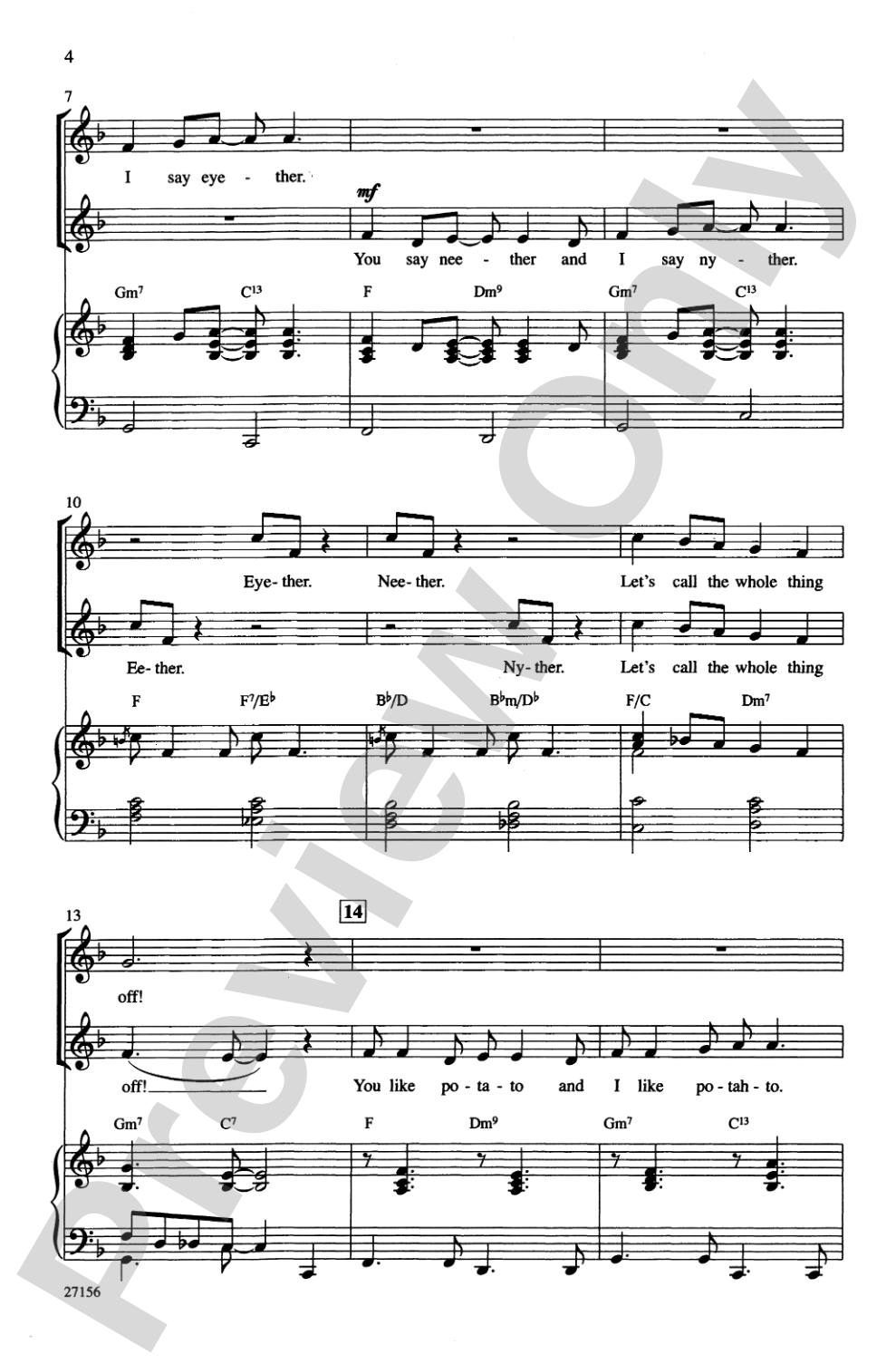
Here's a light, swinging arrangement of a cute George and Ira Gershwin song that's ideal for any age choir. High school groups can sink their teeth into it, middle school groups can really make music with it, and elementary groups can just have fun with it. The clever lyrics ("you say ee-ther and I say eye-ther") are the focus of this piece. Great for jazz/pop groups, too.


Let's Call the Whole Thing Off: 2-Part Choral Octavo isn't in MakeMusic Cloud just yet...but it could be. Let us know you'd like to see it, and you'll help shape what comes next. In the meantime, start a free trial and dive into thousands of interactive titles your students can play along with today.
Request This Title
Tell us you want it.
Start Your Free Trial
Explore everything that's ready to play right now.
Sample Audio
1
Audio File
--:--
0:00
0:00
Sample Video
No sample videos found.
Additional Details
Series:
Alfred Archive Edition: Alfred Pop Choral Series
Publisher:
Alfred Music
Page Count:
12
SKU:
00-PO-0002259
More about this title
About the Composer: George Gershwin
George Gershwin (1898-1937) bridged the concert hall and Broadway stage, composing works that synthesized classical forms with jazz and popular idioms. His collaborations with lyricist brother Ira produced some of the American musical theater's most enduring songs, including the standards that appear in this arrangement. Gershwin's harmonic language and rhythmic vitality made him a defining voice of 20th-century American music, and his works remain central to both classical and popular music education.
Ira Gershwin (1896-1983) was a lyricist of exceptional wit and craft, known for lyrics that matched the sophistication of his brother's melodies while remaining singable and dramatically apt. His collaborations with George, and later with other composers, shaped the Great American Songbook. For music educators, Gershwin's lyrics serve as models of how text and melody work together to create memorable, meaningful performances.
Why we love this
Russell L. Robinson's arrangement captures the playful charm of the original while giving every voice part something engaging to sing. The clever pronunciation differences in the lyrics (ee-ther/eye-ther, po-tay-to/po-tah-to) create natural humor that lands every time, and the swinging rhythm keeps the energy light without sacrificing musicality. This is a piece that works across age levels because the fun is built into the song itself, not manufactured.
What to expect
This is a song built on affectionate disagreement, and the performance should feel like a friendly debate set to music. The melody swings with ease, the harmony is warm and consonant, and the overall effect is conversational, witty, and buoyant. You'll hear smiles in the room from the first rehearsal.
Who it's for
Elementary, middle, and high school choirs all find something rewarding here, though the approach differs by age. Younger singers enjoy the humor and accessibility; older singers discover the harmonic sophistication and can explore stylistic nuance. Jazz and pop ensembles can use this as a gateway into jazz-influenced vocal phrasing and improvisation.
How to get the most out of it
- Lean into the rhythmic swing of the accompaniment; the lilt of the phrase dictates a relaxed, not rigid, approach to the beat.
- Emphasize the lyrical contrasts by making the opposing vowels in each couplet feel genuinely different. The comedy lives in clarity.
- Use the recorded accompaniment to establish the groove, especially for younger or less experienced singers who benefit from anchoring their phrasing to the jazz inflection.
- Balance the two parts so neither dominates; both voice lines carry melodic interest and should be audible throughout.
How to use it
Program this as a palate cleanser between more demanding classical or contemporary pieces, or use it to open a concert with immediate audience warmth and engagement. For middle and high school choirs studying the Great American Songbook or jazz history, it's a repertoire anchor that teaches style through performance. It also pairs naturally with other Gershwin standards or works that explore American vernacular music.
Skills your students will build
- Jazz phrasing and swing articulation
- Lyric clarity and expressive diction
- Two-part blend and balance
- Rhythmic independence from the accompaniment
- Stylistic awareness of American vernacular song