
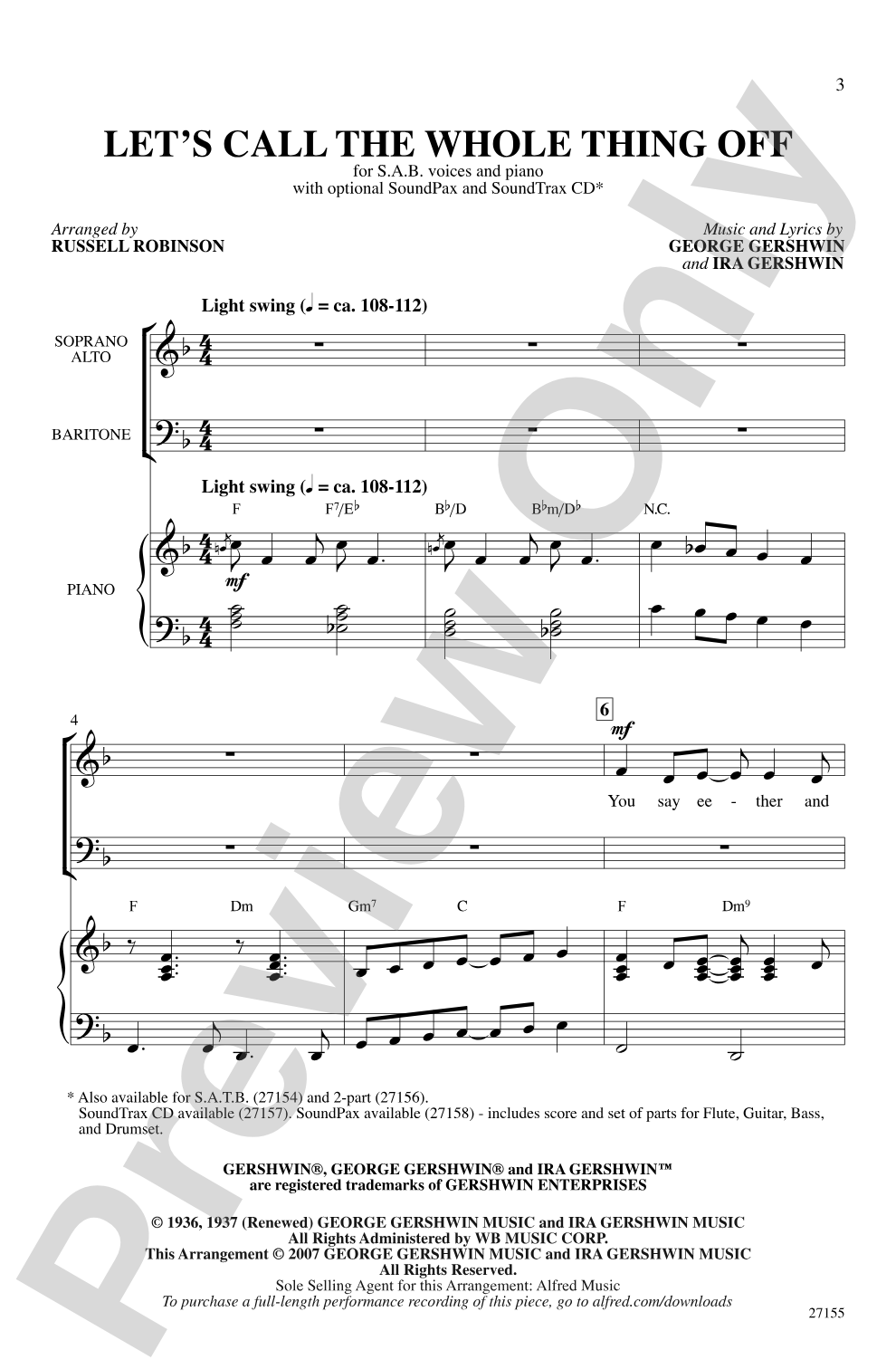

Let's Call the Whole Thing Off: SAB Choral Octavo
Music and lyrics by George Gershwin and Ira Gershwin / arr. Russell Robinson
Item: 00-PO-0002258
$2.25
Minimum order quantity: 20 copies
One moment…
Related Items
Let's Call the Whole Thing Off: SoundTrax Digital Audio Download |
$27.99
|
View | |
Let's Call the Whole Thing Off: SATB Choral Octavo |
$2.25
|
View | |
Let's Call the Whole Thing Off: 2-Part Choral Octavo |
$2.25
|
View | |
Let's Call the Whole Thing Off: Choral SoundPax |
$25.00
|
View | |
Let's Call the Whole Thing Off: SATB Choral Octavo |
$2.25
|
View | |
Let's Call the Whole Thing Off: SAB Choral Octavo |
$2.25
|
View | |
Let's Call the Whole Thing Off: 2-Part Choral Octavo |
$2.25
|
View | |
Let's Call the Whole Thing Off: Choral Octavo SoundTrax CD |
$27.99
|
View | |
Let's Call the Whole Thing Off: Choral SoundPax |
$25.00
|
View |
Description
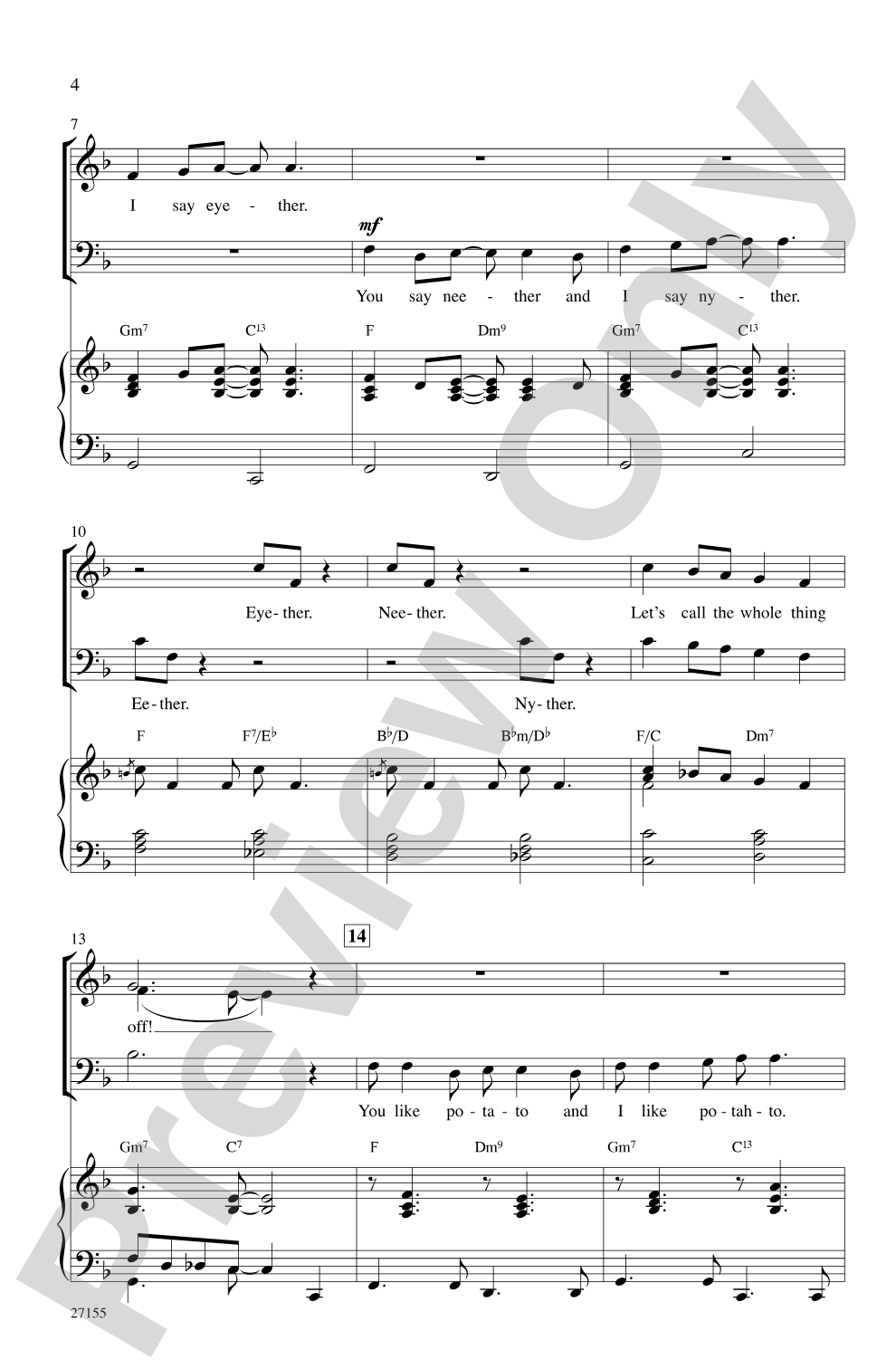
Here's a light, swinging arrangement of a cute George and Ira Gershwin song that's ideal for any age choir. High school groups can sink their teeth into it, middle school groups can really make music with it, and elementary groups can just have fun with it. The clever lyrics ("you say ee-ther and I say eye-ther") are the focus of this piece. Great for jazz/pop groups, too.


Let's Call the Whole Thing Off: SAB Choral Octavo isn't in MakeMusic Cloud just yet...but it could be. Let us know you'd like to see it, and you'll help shape what comes next. In the meantime, start a free trial and dive into thousands of interactive titles your students can play along with today.
Request This Title
Tell us you want it.
Start Your Free Trial
Explore everything that's ready to play right now.
Sample Audio
1
Audio File
--:--
0:00
0:00
Sample Video
No sample videos found.
Additional Details
Series:
Alfred Archive Edition: Alfred Pop Choral Series
Publisher:
Alfred Music
Page Count:
12
SKU:
00-PO-0002258
More about this title
About the Composer: George Gershwin
George Gershwin (1898-1937) bridged popular song and concert music at a moment when American composers were still finding their voice. A prolific songwriter for Broadway and film, Gershwin possessed an instinctive gift for melody and rhythm that made his work both immediately appealing and genuinely sophisticated. His partnership with his brother Ira produced some of the 20th century's most enduring standards, songs that remain central to American musical culture and continue to teach singers about phrasing, swing, and storytelling.
Ira Gershwin (1896-1983) was a master lyricist whose witty, conversational texts shaped the character of American song. His ability to match clever wordplay with natural vocal contours set a standard for musical theater writing that still influences composers today. The Gershwin brothers' collaboration demonstrated that popular music could be both commercially successful and artistically significant.
Why we love this
Robinson's arrangement captures the playful charm of this Gershwin classic while keeping the focus squarely on the lyrics and their comic interplay. The SAB voicing sits naturally, making it accessible for developing choirs without sacrificing the swing feel that makes the song memorable. It's the kind of piece that gets audiences smiling the moment the ensemble enters, which matters as much in choral music as technical precision does.
What to expect
Light and conversational, with the warmth of a classic song sung by friends rather than strangers. The swing rhythm and lyrical wit create an atmosphere of good humor; singers feel the lift of the groove while enjoying the wordplay, and audiences recognize the familiar tune immediately. There's an ease to the piece that invites the ensemble to relax into the music rather than strain toward it.
Who it's for
This arrangement works for high school choirs looking for repertoire that combines musical substance with immediate appeal, middle school ensembles ready to explore swing style and part-singing, and elementary choirs seeking an engaging performance that builds confidence through fun. Jazz and pop choirs will find it equally valuable as a bridge between contemporary styles and the Great American Songbook.
How to get the most out of it
- Emphasize the rhythmic precision of the pronunciation differences (ee-ther versus eye-ther, toe-may-toe versus toe-mah-toe). Have singers speak these pairs rhythmically before singing to internalize the comedic timing.
- Treat the harmonic movement with light articulation in the SAB sections; Robinson's voicing likely contains moments where the parts move together and moments where they diverge. Mark these transitions clearly so singers know when to lock in as a unit versus when to shine individually.
- Use the recorded accompaniment to establish the swing tempo and feel early in rehearsal. This piece lives or dies by its rhythmic groove, and the recording gives singers an authentic reference for the pocket.
- Shape the dynamics to support the humor. The clever lyrics deserve moments of emphasis and moments of pull-back; avoid singing the whole arrangement at one volume level.
How to use it
Program this as a standalone piece on a mixed concert, or pair it with other standards from the Great American Songbook to build a focused set. It works particularly well as a closer or as a palate cleanser between heavier choral works, since the familiarity and humor reset audience energy. Consider it also for spring pops concerts, cabaret settings, or any program that celebrates American musical theater.
Skills your students will build
- Swing rhythm and jazz articulation
- Lyrical clarity and comedic timing in ensemble singing
- Part independence in SAB voicing
- Ensemble balance across three parts
- Phrasing and shape in popular music style