
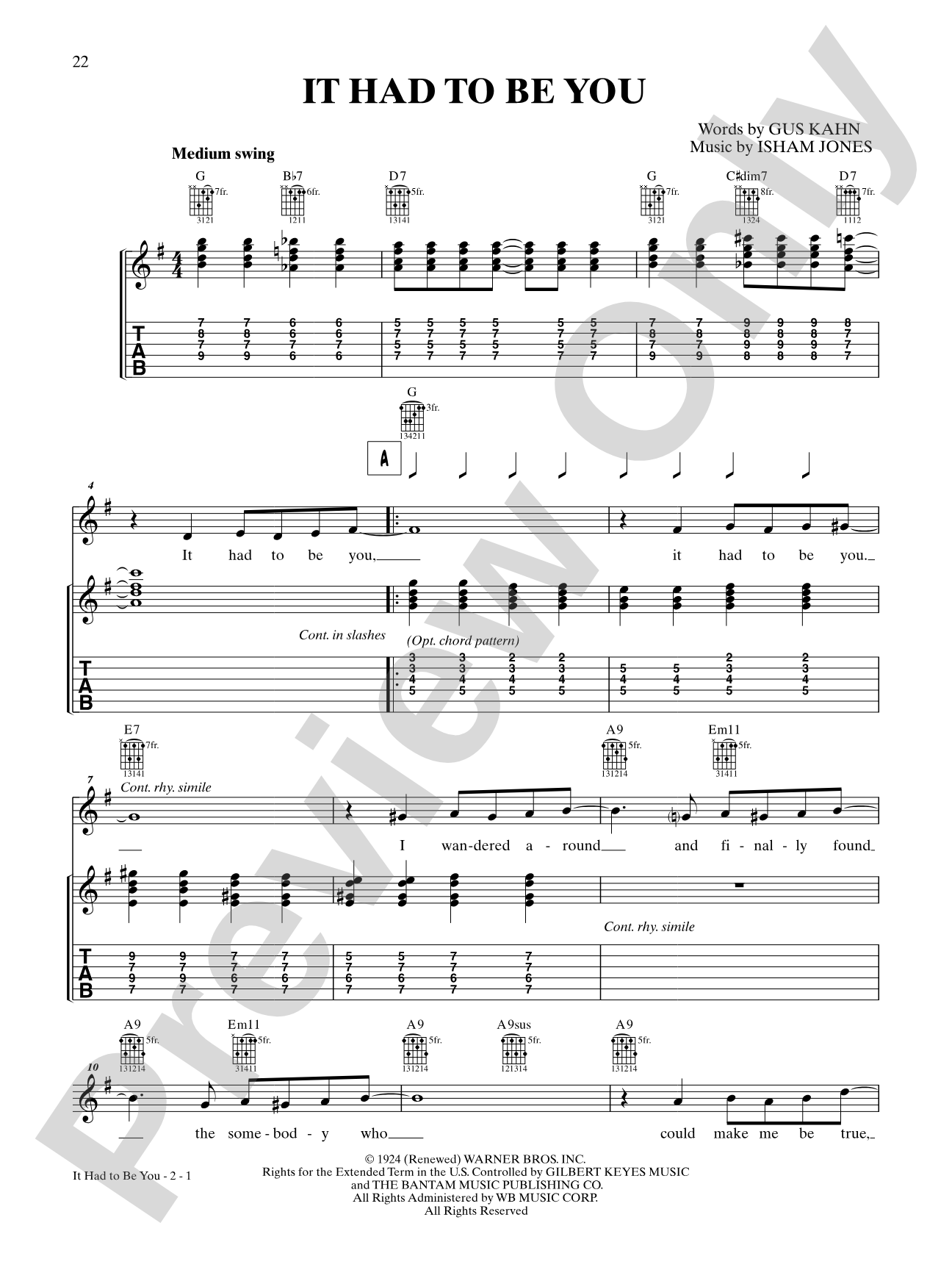

It Had to Be You: Interm./Easy Guitar TAB
12 Great Songs of the '20s & '30s
Item: 00-PS-0011846
$4.99
One moment…
Related Items
Makin' Whoopee: Interm./Easy Guitar TAB |
$4.99
|
View | |
Five Foot Two, Eyes of Blue: Interm./Easy Guitar TAB |
$4.99
|
View | |
Ain't Misbehavin': Interm./Easy Guitar TAB |
$4.99
|
View | |
It Don't Mean a Thing: Interm./Easy Guitar TAB |
$4.99
|
View | |
Tonight You Belong to Me: Interm./Easy Guitar TAB |
$4.99
|
View | |
As Time Goes By: Interm./Easy Guitar TAB |
$4.99
|
View | |
Sweet Georgia Brown: Interm./Easy Guitar TAB |
$4.99
|
View | |
Ain't She Sweet: Interm./Easy Guitar TAB |
$4.99
|
View | |
I'll See You in My Dreams: Interm./Easy Guitar TAB |
$4.99
|
View | |
Dream a Little Dream of Me: Interm./Easy Guitar TAB |
$4.99
|
View |
Description
Swingin' Jazz Guitar is designed for your total enjoyment. Each song is arranged in a fun and lively way with a strum-and-sing approach. The chords are simple, yet entirely appropriate to the jazz-age style of the '20s and '30s. We've also included classic intros, endings, and turnarounds that will make you sound like an authentic early jazzer. Titles: Ain't Misbehavin' * Ain't She Sweet * As Time Goes By * Bye Bye Blackbird * Dream a Little Dream of Me * Five Foot Two, Eyes of Blue * I'll See You in My Dreams * It Don't Mean a Thing (If It Ain't Got That Swing) * It Had to Be You * Makin' Whoopee * Sweet Georgia Brown * Tonight You Belong to Me.


It Had to Be You: Interm./Easy Guitar TAB isn't in MakeMusic Cloud just yet...but it could be. Let us know you'd like to see it, and you'll help shape what comes next. In the meantime, start a free trial and dive into thousands of interactive titles your students can play along with today.
Request This Title
Tell us you want it.
Start Your Free Trial
Explore everything that's ready to play right now.
Sample Audio
No sample audio found.
Sample Video
No sample videos found.
Additional Details
Series:
Just for Fun
Publisher:
Alfred Music
Page Count:
44
SKU:
00-PS-0011846
More about this title
About the Composer: Gus Kahn
Gus Kahn (1886-1941) was one of the most prolific lyricists of the Jazz Age, crafting witty, singable words for hundreds of standards. Though primarily known for his lyrics, Kahn collaborated closely with composers like Isham Jones to shape the melodic and harmonic identity of the Great American Songbook; his influence on how these songs sit in the voice and guitar remains fundamental to jazz performance today.
Kahn's gift was matching sophisticated rhyme schemes to accessible melodies, making complex emotions feel effortless to sing. His catalog dominates early jazz repertoire and continues to define the sound of the 1920s and 1930s for musicians and audiences alike.
Why we love this
This collection captures the spirit of early jazz in a format that respects both the era's harmonic character and the player's current ability level. The arrangement choices—simple chord voicings paired with authentic jazz-age turnarounds and introductions—let guitarists inhabit the style without getting lost in complex chord substitutions, making it genuine rather than diluted.
What to expect
These arrangements radiate the easy confidence of a smoky jazz club: unfussy, conversational, full of unexpected little melodic flourishes and rhythmic pivots that make the familiar feel fresh. Playing through the collection feels like flipping through a vinyl jukebox of the best dance numbers and romantic ballads from an era when guitar was just beginning to claim its place in jazz.
Who it's for
Guitarists with intermediate to easy-intermediate reading skills who want to explore authentic jazz repertoire without wrestling with advanced theory or complex voicings. This book works equally well for solo practice, informal jam sessions, or singers needing a straightforward guitar partner.
How to get the most out of it
- Treat the chord changes as guide tones rather than metronomic changes; ease into them slightly ahead of or behind the beat to create that laid-back swing feel characteristic of '20s and '30s jazz.
- Use the classic intros and endings provided as study material for learning idiomatic jazz-guitar language you can apply beyond these arrangements.
- Pay attention to dynamics across the form; these songs often shift between verse and chorus in mood, so color your strumming patterns accordingly rather than maintaining one texture throughout.
- Experiment with the tempo; many of these standards swing better at conversational speeds than at strict quarter-note metros, allowing the rhythm to breathe.
How to use it
Build a Jazz Age set for a casual concert or coffeehouse performance by selecting three to five pieces from this collection; the variety of tempos and moods creates natural programming momentum. Alternatively, assign individual pieces to guitarists studying jazz harmony and rhythm as a bridge between folk and bebop-era approaches.
Skills your students will build
- Comping with period-appropriate chord voicings (1920s-1930s jazz idiom)
- Reading and executing jazz-age turnarounds and introductions
- Understanding swing rhythm and how to lay behind or ahead of the beat intentionally
- Navigating chord changes fluidly in tunes with varied harmonic rhythms
- Adapting strumming patterns to support melody and create textural variety