
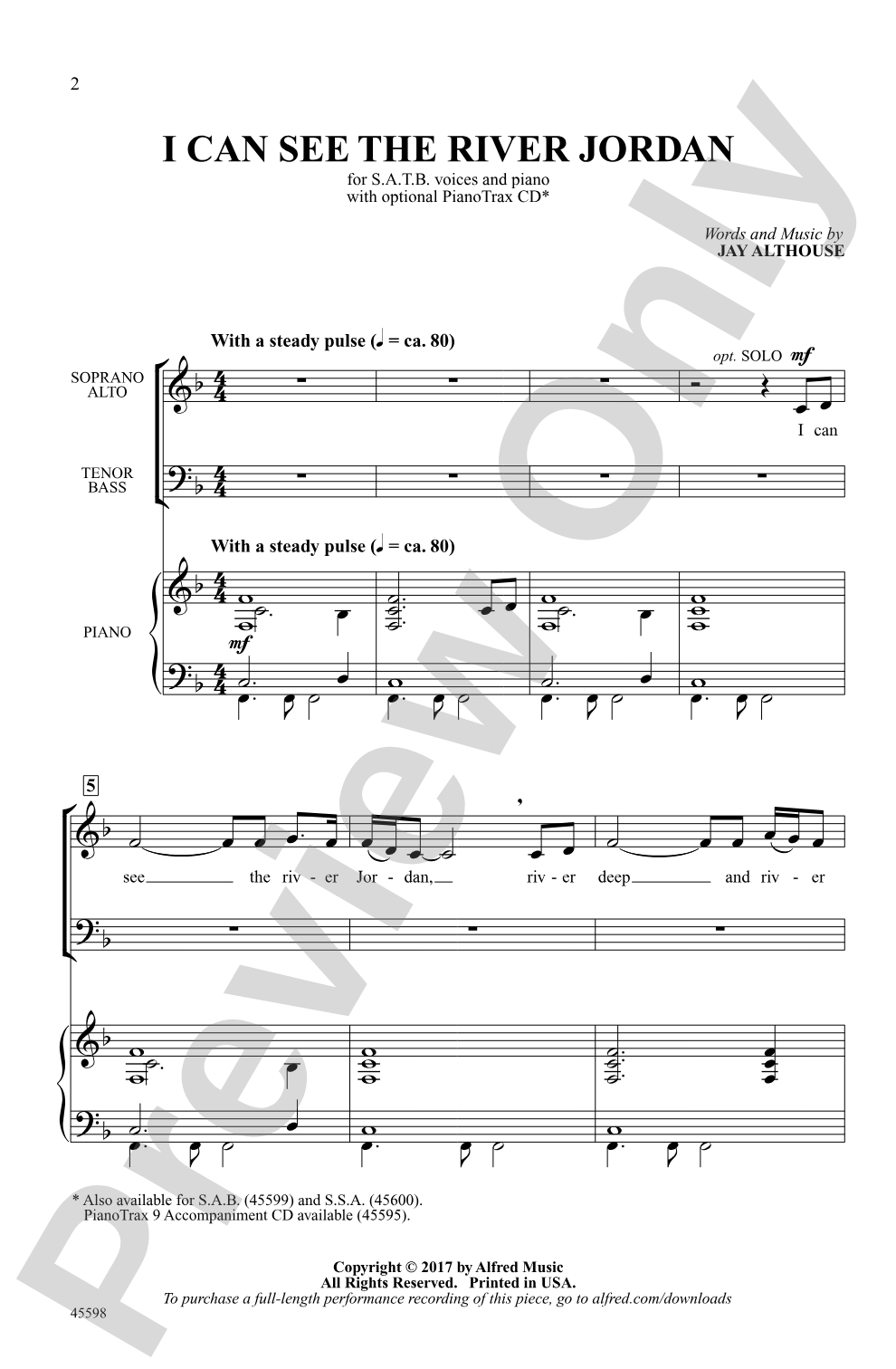
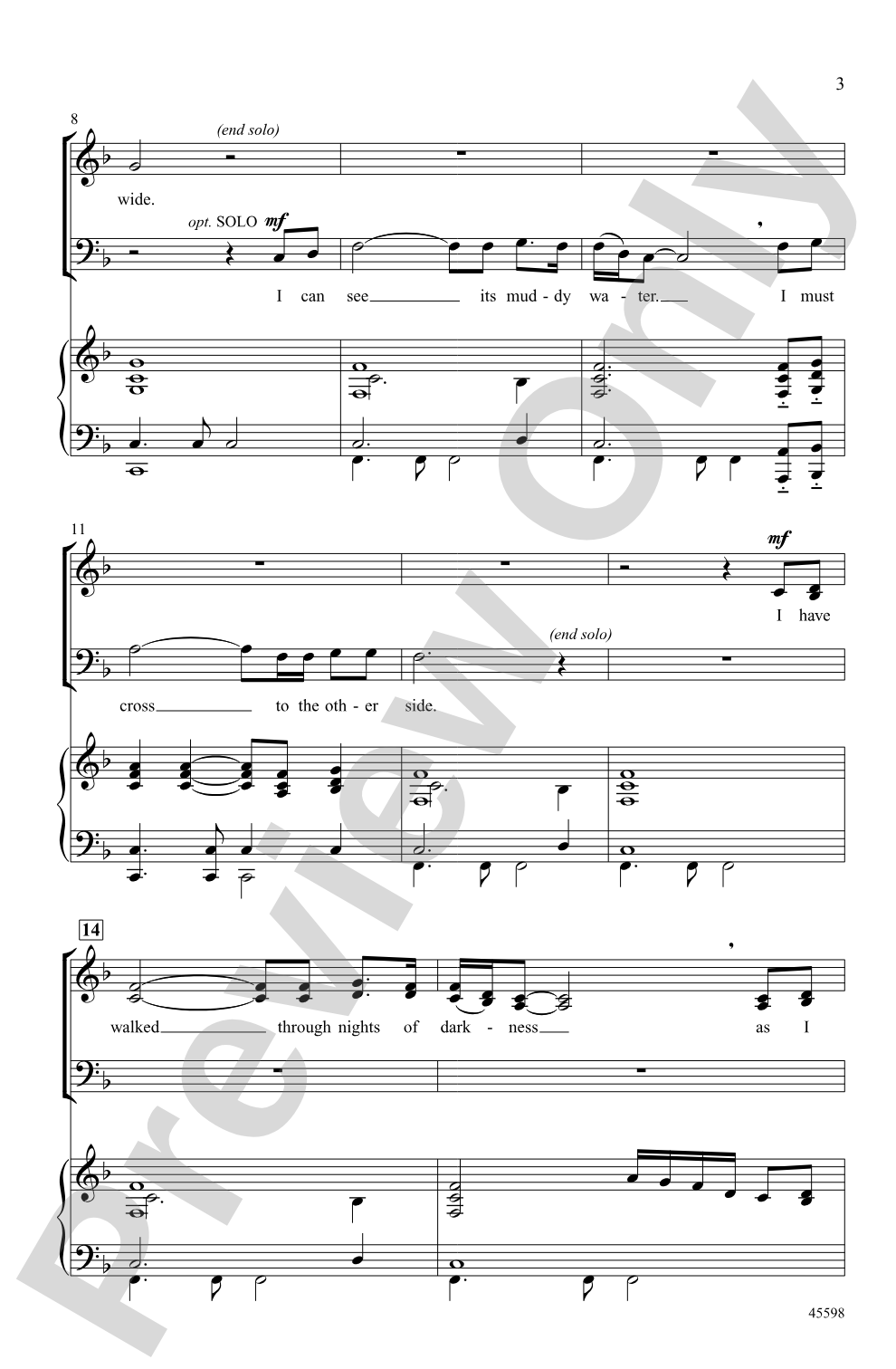

I Can See the River Jordan: SATB Choral Octavo
Words and music by Jay Althouse
Item: 00-PO-0005493
$1.90
Minimum order quantity: 20 copies
Pickup currently not available
Related Items
I Can See the River Jordan: PianoTrax Digital Download |
$9.99
|
View | |
I Can See the River Jordan: SAB Choral Octavo |
$1.90
|
View | |
I Can See the River Jordan: SSA Choral Octavo |
$1.90
|
View | |
I Can See the River Jordan: SATB Choral Octavo |
$1.90
|
View | |
I Can See the River Jordan: SAB Choral Octavo |
$1.90
|
View | |
I Can See the River Jordan: SSA Choral Octavo |
$1.90
|
View |
Description
This sturdy original is composed in the style of a traditional spiritual. A symbolic text leads to crossing metaphoric River Jordan as the music recalls songs from early America. Opens with brief solos, builds to a hand clapping, almost a cappella bridge, and concludes only after full choral harmonies fade and voices unite on a single pitch.


I Can See the River Jordan: SATB Choral Octavo isn't in MakeMusic Cloud just yet...but it could be. Let us know you'd like to see it, and you'll help shape what comes next. In the meantime, start a free trial and dive into thousands of interactive titles your students can play along with today.
Request This Title
Tell us you want it.
Start Your Free Trial
Explore everything that's ready to play right now.
Sample Audio
1
Audio File
--:--
0:00
0:00
Sample Video
Additional Details
Series:
Alfred Choral Designs
Publisher:
Alfred Music
Page Count:
8
SKU:
00-PO-0005493
More about this title
About the Composer: Jay Althouse

Jay Althouse holds degrees in Music Education and Music from Indiana University of Pennsylvania, where he was recognized as a Distinguished Alumnus. Early in his career, he spent eight years managing rights and licenses for a major educational music publisher and served on the Executive Board of the Music Publishers Association of America. His work as a composer has resulted in more than 800 published choral compositions performed regularly across the English-speaking world.
Althouse is a writer member of ASCAP and a consistent recipient of the ASCAP Special Award for his contributions to standard music composition. Beyond his choral output, he has collaborated with his wife Sally K. Albrecht on children's musicals, compiled respected vocal solo anthologies, and authored instructional resources including The Complete Choral Warm-up Book, Accent on Composers, and several reproducible classroom materials. He and Albrecht co-wrote I Hear America Singing, performed by the San Francisco Girls and Boys Choirs at President Obama's 2009 Inauguration. Althouse resides in Wake Forest, North Carolina, and has served on the board of the North Carolina Master Chorale as well as the National Advisory Board of the Folk Art Society of America.
Why we love this
Althouse crafts a spiritual that feels genuinely rooted in American choral tradition rather than imitative. The structural arc from intimate solos through a hand clapping, near-a cappella bridge to unified final tones gives your ensemble a genuine journey to sing, making this piece rewarding in rehearsal and compelling in performance. The symbolic text resonates with both sacred and secular audiences, making it a natural fit for festivals, competitions, and concerts seeking repertoire with depth.
What to expect
Hymn-like and hopeful, yet intimate in its opening moments. The music recalls the spiritual tradition while remaining unmistakably contemporary in its craft, building from quiet reflection through kinetic energy and finally to a transcendent unison resolution. Singers experience both accessibility and artistic substance throughout.
Who it's for
SATB choirs of intermediate to advanced ability seeking sacred repertoire with strong programming potential. The piece works equally well for school choirs, community ensembles, and festival-bound groups who want material with authentic spiritual roots and clean, singable harmonies.
How to get the most out of it
- Shape the opening solos with clarity and warmth. These establish the piece's reflective character and deserve individual attention even within group rehearsal.
- Approach the hand clapping bridge as a rhythmic and textural pivot point. Precision here, combined with controlled dynamics, creates the almost-a cappella effect Althouse intends.
- Allow the final unified pitch to sustain without rushing. This moment rewards patience and concentration from your singers and creates a powerful closure.
How to use it
Place this as a centerpiece of a sacred concert or as the closer to a set featuring American choral traditions. It pairs naturally with other spirituals or art song settings and has sufficient festival-contest appeal to anchor a competition program. The piece's length and accessible vocal writing also make it suitable for community performances where you want to showcase both your ensemble's skill and meaningful repertoire.
Skills your students will build
- Blending and balance in SATB voicing while maintaining individual solo clarity
- Rhythmic precision in hand clapping patterns within choral texture
- Dynamic control and sustaining long, unified pitches
- Interpretation of spiritual and folk song idioms in a composed context
- Transition between a cappella-style sections and full harmonic textures