
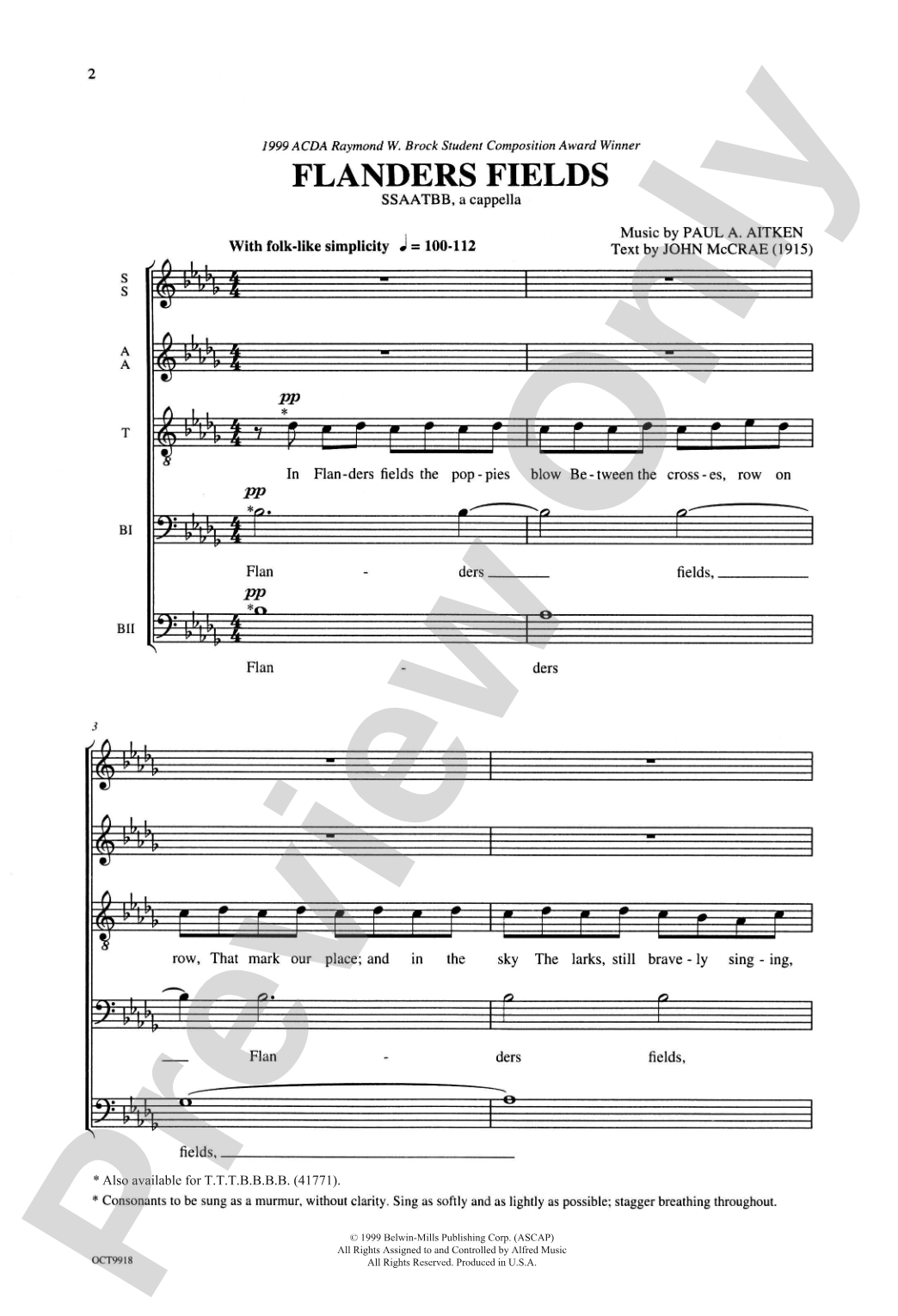
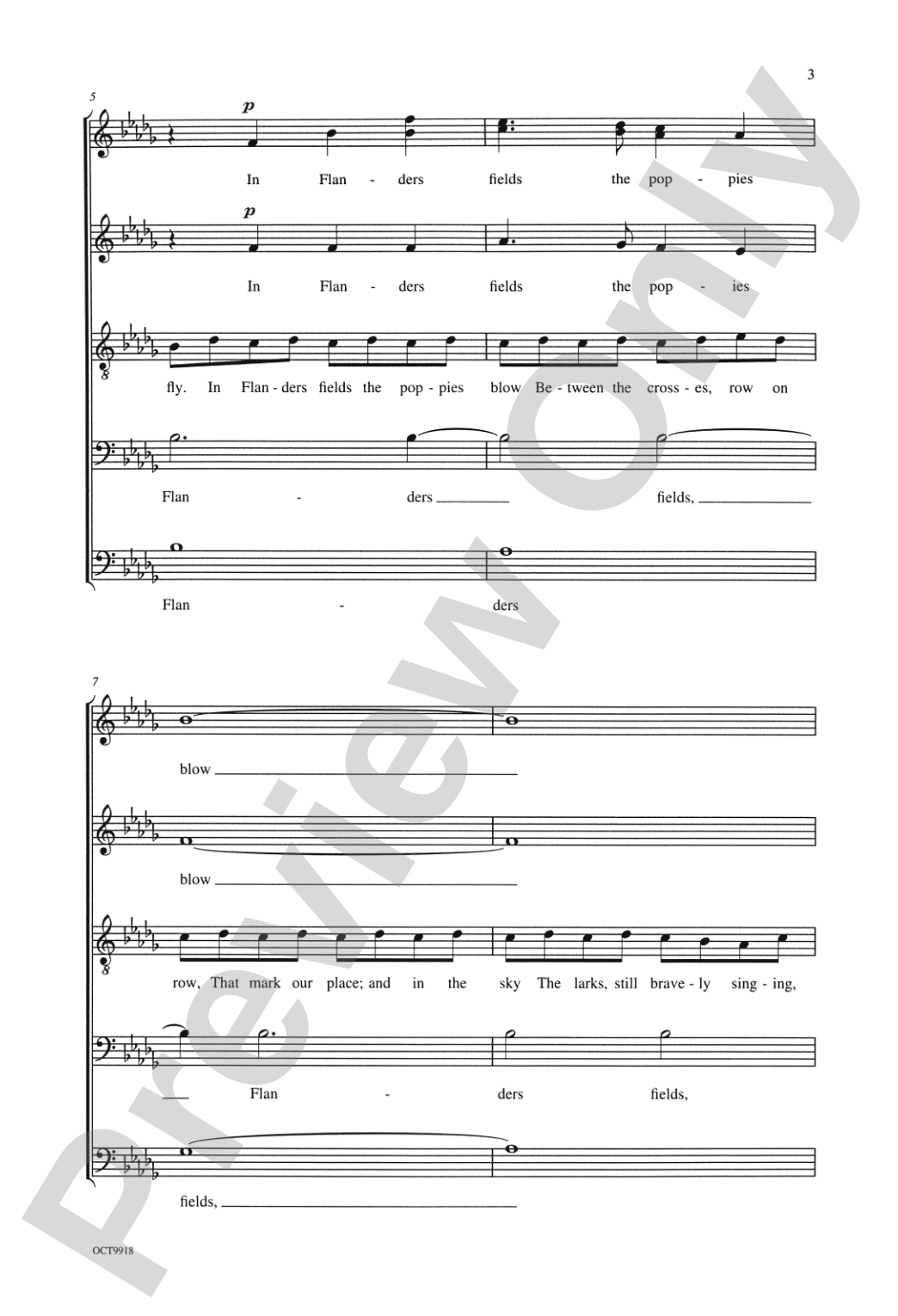
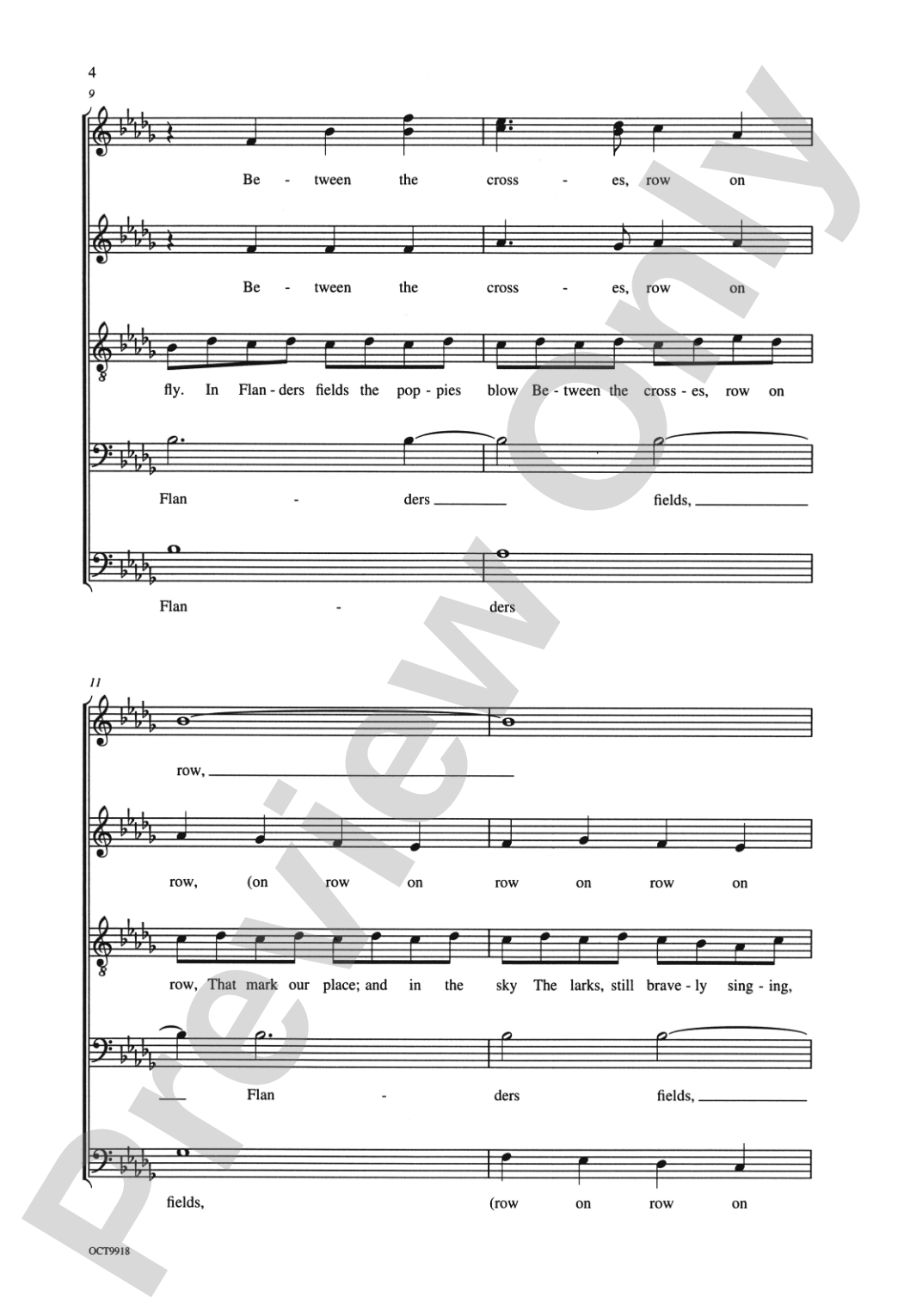

Flanders Fields: SSAATTBB Choral Octavo
Words by John McCrae, music by Paul A. Aitken
Item: 00-PO-0002706

$2.20
Minimum order quantity: 20 copies
Pickup currently not available
Description
This distinguished setting of the John McCrae text was originally published for mixed choirs soon after being named the first winner of the ACDA Brock Memorial composition contest. Aitken's more recent voicings for women's and men's choirs are just as inspiring as the original.


Don't just read it, hear it, play along with it, and watch your students grow with it. In MakeMusic Cloud, Flanders Fields: SSAATTBB Choral Octavo comes alive with professional accompaniment, adjustable tempo, and built-in practice tools that turn solo practice into real progress.
Open in the Player
Jump straight in and assign it today.
Start Your Free Trial
Open this title and explore the full library in minutes.
Sample Audio
No sample audio found.
Sample Video
No sample videos found.
Additional Details
Series:
Lawson-Gould
Publisher:
Alfred Music
Page Count:
16
SKU:
00-PO-0002706
More about this title
About the Composer: Paul A. Aitken

Paul A. Aitken grew up in Canada and has established himself as a composer, conductor, and church musician. He currently serves as Director of Music and Worship Arts and Composer-in-Residence at the Cathedral of the Rockies in Boise, Idaho, where he manages over twenty ensembles across two campuses. His early success came through winning the inaugural ACDA Brock Student Composition Competition for "Flanders Fields," a recognition that launched his career as a sought-after clinician and guest conductor.
With more than forty compositions spanning two decades, Aitken has received commissions from major organizations including the American Guild of Organists, the State of Idaho, and the Boise Philharmonic Master Chorale. His 2010 Carnegie Hall debut conducting "And None Shall Be Afraid" with two hundred singers and the New England Symphonic Ensemble marked a significant milestone in his professional trajectory. Aitken holds degrees from the University of Western Ontario, Southern Illinois University at Carbondale, and the University of Oklahoma, and has served in leadership roles at state, divisional, and national levels within ACDA.
Why we love this
This setting honors McCrae's profound text with compositional restraint and emotional clarity; Aitken's musical language serves the poetry rather than competing with it. The SSAATTBB voicing opens doors for expanded women's and men's choirs to tackle a powerful piece that carries genuine historical weight without requiring technical virtuosity.
What to expect
Solemn yet human, this setting captures the quiet dignity of McCrae's meditation on sacrifice and remembrance. The expanded voicing creates warmth and depth without ever becoming grandiose.
Who it's for
Women's and men's choirs looking for a serious a cappella work grounded in literary merit and historical significance. This piece suits ensembles ready to grapple with both the emotional and technical demands of eight-part writing.
How to get the most out of it
- Balance the harmonic voicing carefully in the SSAATTBB texture; the divisi writing expands the palette but demands precise intonation from all eight parts working together.
- Let the text's meaning guide your phrasing rather than imposing a strict metrical grid; McCrae's language breathes, and your choir should follow.
- Since this is a cappella, mark a clear, comfortable pitch reference in rehearsal and ensure your singers can maintain that pitch independently throughout.
How to use it
Program this during Veterans Day or Memorial Day observances, or pair it with other contest-winning or ACDA-commissioned works to build a thematic concert around American choral achievement. It also serves as a centerpiece for spring competitions and festivals where literary text and musical substance carry equal weight.
Skills your students will build
- Sustaining tone quality and blend across eight independent voice parts
- Reading and executing SSAATTBB divisi notation
- Interpreting textual phrasing and emotional arc in a cappella singing
- Understanding the relationship between poetic meter and musical phrasing
- Maintaining pitch accuracy without instrumental support