
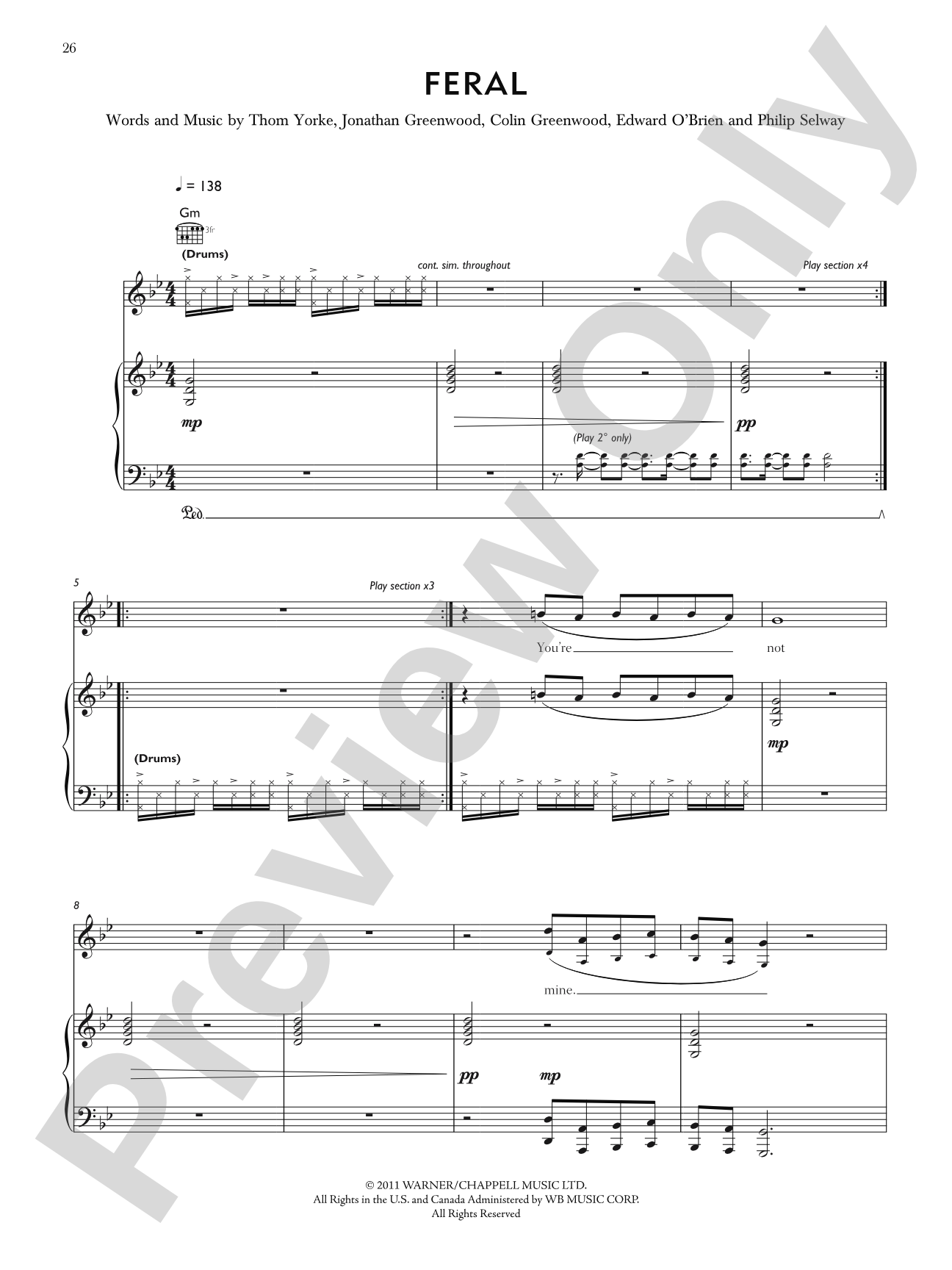

Feral: Piano/Vocal/Chords
Radiohead
Item: 00-PS-0013272
$4.99
One moment…
Related Items
Bloom: Piano/Vocal/Chords |
$5.99
|
View | |
Morning Mr. Magpie: Piano/Vocal/Chords |
$5.99
|
View | |
Little By Little: Piano/Vocal/Chords |
$5.99
|
View | |
Lotus Flower: Piano/Vocal/Chords |
$5.99
|
View | |
Codex: Piano/Vocal/Chords |
$4.99
|
View | |
Give Up the Ghost: Piano/Vocal/Chords |
$5.99
|
View | |
Separator: Piano/Vocal/Chords |
$5.99
|
View |
Description
This is the officially licensed matching songbook to Radiohead's February 2011 album, which met with widespread critical acclaim and a No. 3 peak on the Billboard 200. In this folio, each song from the album is arranged for piano and voice, with guitar chord grids also included. Titles: Bloom * Morning Mr. Magpie * Little by Little * Feral * Lotus Flower * Codex * Give Up the Ghost * Separator.


Feral: Piano/Vocal/Chords isn't in MakeMusic Cloud just yet...but it could be. Let us know you'd like to see it, and you'll help shape what comes next. In the meantime, start a free trial and dive into thousands of interactive titles your students can play along with today.
Request This Title
Tell us you want it.
Start Your Free Trial
Explore everything that's ready to play right now.
Sample Audio
No sample audio found.
Sample Video
No sample videos found.
Additional Details
Publisher:
Alfred Music
Page Count:
56
SKU:
00-PS-0013272
More about this title
About the Composer: Thom Yorke
Thom Yorke is the lead vocalist and primary songwriter of Radiohead, the British rock band that emerged from Oxford in the 1990s. His compositional voice is marked by complex harmonic progressions, unconventional song structures, and a willingness to blend electronic, orchestral, and traditional rock elements. Yorke's work across five decades of Radiohead albums has consistently pushed the boundaries of what rock music can express, earning him recognition as one of contemporary music's most inventive and intellectually rigorous voices.
Why we love this
This folio captures eight carefully crafted tracks that reward close study at the keyboard. The chord voicings and melodic writing reveal themselves more fully when played on piano, giving pianists and singers access to music that typically exists in a more electronic or orchestral context. Having the guitar chords included makes this accessible to multiinstrumentalists and ensemble settings without sacrificing the compositional integrity of the original arrangements.
What to expect
These songs occupy a reflective, introspective space that feels more intimate when translated to piano and voice. The arrangements preserve the original album's emotional restraint while bringing the harmonic architecture into sharper focus. There's an elegant melancholy running through the material, supported by sophisticated chord work that rewards both careful listening and repeated playing.
Who it's for
This book serves pianists and singer-pianists who want to explore contemporary songwriting with real compositional depth. It's equally valuable for music students analyzing modern rock harmony and structure, and for performers preparing recitals or cabaret-style programming that reaches beyond traditional classical or jazz standards.
How to get the most out of it
- Pay attention to the chord voicings on piano; they often create the harmonic color that defines each song. Resist the urge to simplify them, as the extensions and alterations are deliberate.
- Approach the vocal line as a conversation between the melody and the harmonic foundation. These songs often have the voice moving through unexpected harmonic territory, so nail your harmonic awareness first.
- Use the guitar chords as a reference for understanding voice leading and structure, even if you're performing on piano alone. They clarify harmonic function in a different way than the piano part might.
- Build the emotional arc slowly across a song. These pieces are not about driving forward at all costs; they reward restraint and space.
How to use it
Include individual songs in a recital to contrast with other contemporary repertoire or classical pieces, or perform several tracks together to create a thematic set about uncertainty and transformation. This folio also works well in educational settings where students are learning to analyze and perform modern songwriting, or in jazz/popular music courses exploring harmonic language beyond traditional pop structures.
Skills your students will build
- reading and voicing seventh chords, suspensions, and extended harmonies
- interpreting chord grids alongside staff notation
- connecting vocal melody to underlying harmonic structure
- balancing song interpretation with compositional fidelity
- understanding contemporary harmonic language in rock contexts