
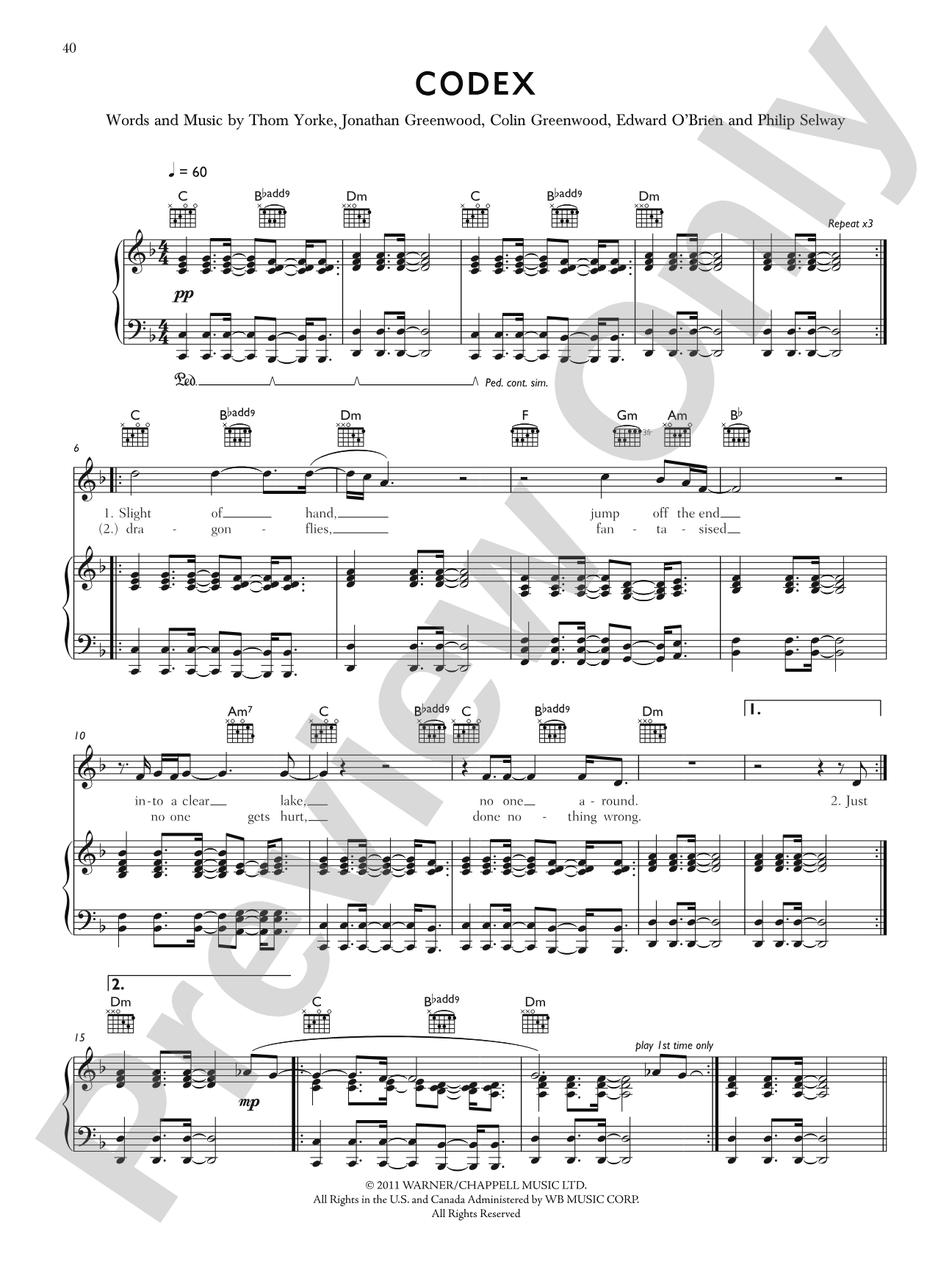

Codex: Piano/Vocal/Chords
Radiohead
Item: 00-PS-0013274
$4.99
One moment…
Related Items
Bloom: Piano/Vocal/Chords |
$5.99
|
View | |
Morning Mr. Magpie: Piano/Vocal/Chords |
$5.99
|
View | |
Little By Little: Piano/Vocal/Chords |
$5.99
|
View | |
Feral: Piano/Vocal/Chords |
$4.99
|
View | |
Lotus Flower: Piano/Vocal/Chords |
$5.99
|
View | |
Give Up the Ghost: Piano/Vocal/Chords |
$5.99
|
View | |
Separator: Piano/Vocal/Chords |
$5.99
|
View |
Description
This is the officially licensed matching songbook to Radiohead's February 2011 album, which met with widespread critical acclaim and a No. 3 peak on the Billboard 200. In this folio, each song from the album is arranged for piano and voice, with guitar chord grids also included. Titles: Bloom * Morning Mr. Magpie * Little by Little * Feral * Lotus Flower * Codex * Give Up the Ghost * Separator.


Codex: Piano/Vocal/Chords isn't in MakeMusic Cloud just yet...but it could be. Let us know you'd like to see it, and you'll help shape what comes next. In the meantime, start a free trial and dive into thousands of interactive titles your students can play along with today.
Request This Title
Tell us you want it.
Start Your Free Trial
Explore everything that's ready to play right now.
Sample Audio
No sample audio found.
Sample Video
No sample videos found.
Additional Details
Publisher:
Alfred Music
Page Count:
56
SKU:
00-PS-0013274
More about this title
About the Composer: Thom Yorke
Thom Yorke is the lead vocalist and primary songwriter of Radiohead, the British rock band that emerged in the 1990s and fundamentally reshaped alternative and experimental rock. His compositions span from accessible melodies to complex, layered arrangements that challenge conventional song structures. Yorke's work as a composer demonstrates sophisticated harmonic thinking, unconventional rhythmic patterns, and a willingness to integrate electronic and acoustic elements in ways that have influenced generations of musicians and songwriters.
Why we love this
This folio captures one of the most sonically ambitious rock albums of the 2010s in a format that reveals the compositional architecture beneath the studio production. Singers and pianists gain direct access to the melodic and harmonic core of songs that reward close listening, while the inclusion of guitar chords opens these arrangements to ensemble and accompaniment work. The 56-page collection offers enough substance to sustain serious study without overwhelming players approaching contemporary rock repertoire for the first time.
What to expect
These songs inhabit spaces between introspection and movement, balancing moments of quiet restraint with subtle intensity. The arrangements preserve the album's production ethos while presenting the songs as singable, playable pieces that reveal layers through performance rather than production wizardry.
Who it's for
This collection serves singers preparing contemporary repertoire, pianists seeking substantial arrangements beyond traditional classical or standard repertoire, and guitarists building chord-based accompaniment skills. It's equally valuable for ensemble directors assembling programs that bridge classical training and modern music, and for serious musicians developing fluency with 21st-century rock composition.
How to get the most out of it
- Pay attention to dynamic control in the vocal line; these songs often build tension through subtle shifts in intensity rather than dramatic jumps, so shape phrases with restraint and precision.
- The piano arrangements vary significantly from the album versions. Spend time with the recorded album alongside the score to understand which elements are essential to the song's identity and which can be adapted to your ensemble.
- Work chord changes carefully if you're accompanying with guitar; some progressions use unexpected voice leading that requires clean transitions to sound intentional rather than awkward.
- Treat rhythmic precision as essential, especially in songs where the piano or guitar rhythm drives the groove. These aren't swing tunes; locked timing communicates the song's forward momentum.
How to use it
Consider pairing this folio with contemporary or crossover concert programming where rock repertoire needs equal standing with other genres. A recital of songs from this album can anchor a program exploring how rock composers approach melody, harmony, and form, or these pieces can anchor a mixed-genre concert that reflects your singers' and pianists' musical lives beyond traditional classical training.
Skills your students will build
- Reading and performing non-standard song structures and harmonic progressions
- Interpreting chord symbols and translating them across instruments
- Balancing lyrical phrasing with rhythmic precision in contemporary rock idiom
- Ensemble coordination between voice, piano, and guitar parts
- Understanding production choices and how they inform arrangement decisions