
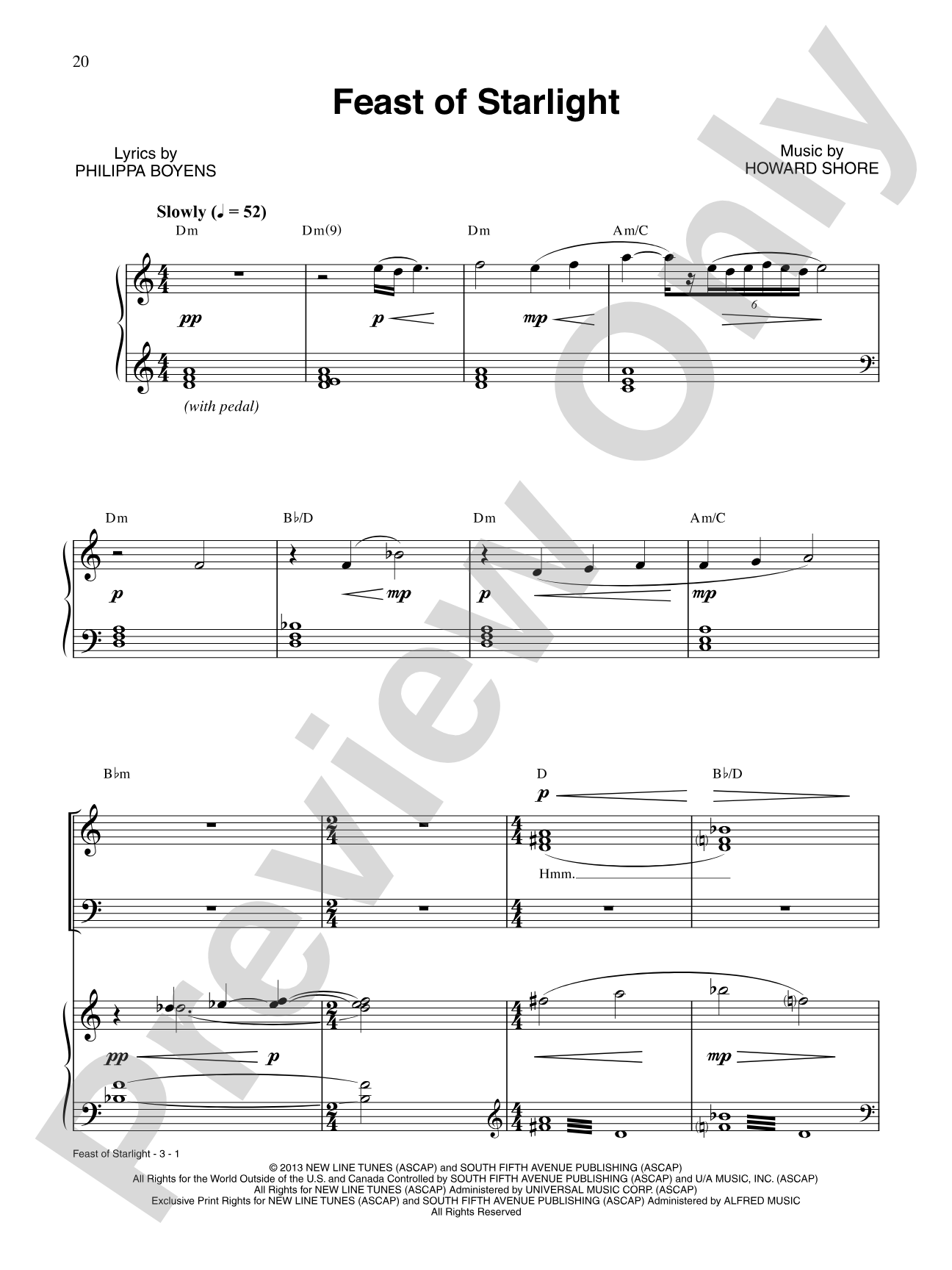

Feast of Starlight (from The Hobbit: The Desolation of Smaug): Piano/Vocal/Chords
Sheet Music Selections from the Original Motion Picture Soundtrack
Music composed by Howard Shore
Item: 00-PS-0015915
$4.99
Pickup currently not available
Related Items
The Quest for Erebor (from The Hobbit: The Desolation of Smaug): Piano |
$4.99
|
View | |
Erebor (from The Hobbit: The Desolation of Smaug): Piano |
$4.99
|
View | |
Bree (from The Hobbit: The Desolation of Smaug): Piano |
$4.99
|
View | |
Beorn (from The Hobbit: The Desolation of Smaug): Piano |
$4.99
|
View | |
A Necromancer (from The Hobbit: The Desolation of Smaug): Piano |
$4.99
|
View | |
The Woodland Realm (from The Hobbit: The Desolation of Smaug): Piano |
$4.99
|
View | |
Bard A Man of Lake-town (from The Hobbit: The Desolation of Smaug): Piano |
$4.99
|
View | |
Thrice Welcome (from The Hobbit: The Desolation of Smaug): Piano |
$4.99
|
View | |
Bard and Family (from The Hobbit: The Desolation of Smaug): Piano |
$4.99
|
View | |
Lake-town (from The Hobbit: The Desolation of Smaug): Piano |
$4.99
|
View | |
Girion Lord of Dale (from The Hobbit: The Desolation of Smaug): Piano |
$4.99
|
View | |
Girion and Bard (from The Hobbit: The Desolation of Smaug): Piano |
$4.99
|
View | |
Lake-town Bard (from The Hobbit: The Desolation of Smaug): Piano |
$4.99
|
View | |
House of Durin (from The Hobbit: The Desolation of Smaug): Piano |
$4.99
|
View | |
Smaug (from The Hobbit: The Desolation of Smaug): Piano |
$4.99
|
View | |
I See Fire (from The Hobbit: The Desolation of Smaug): Piano/Vocal/Chords |
$4.99
|
View | |
Tauriel and Kili (from The Hobbit: The Desolation of Smaug): Piano/Vocal/Chords |
$9.99
|
View | |
Beyond the Forest (from The Hobbit: The Desolation of Smaug): Piano/Vocal/Chords |
$4.99
|
View | |
The Hobbit: The Desolation of Smaug: Piano/Vocal Book |
$19.99
|
View |
Description
With The Hobbit: The Desolation of Smaug, audiences worldwide were transported back to Middle-earth for more thrills and adventure. This officially licensed sheet music collection features 19 piano renditions of Howard Shore's masterful score. Pianists will have both classic and new themes from the epic journey right at their fingertips as they play. In addition to the piano arrangements, this beautifully produced souvenir folio features an array of colorful photos from the film. Titles: The Quest for Erebor * Erebor * Bree * Beorn * A Necromancer * Woodland Realm * Feast of Starlight * Bard, A Man of Lake-town * Thrice Welcome * Bard and Family * Lake-town * Girion, Lord of Dale * Girion and Bard * Lake-town Bard * House of Durin * Smaug * I See Fire * Tauriel and Kili * Beyond the Forest.


Feast of Starlight (from The Hobbit: The Desolation of Smaug): Piano/Vocal/Chords isn't in MakeMusic Cloud just yet...but it could be. Let us know you'd like to see it, and you'll help shape what comes next. In the meantime, start a free trial and dive into thousands of interactive titles your students can play along with today.
Request This Title
Tell us you want it.
Start Your Free Trial
Explore everything that's ready to play right now.
Sample Audio
No sample audio found.
Sample Video
No sample videos found.
Additional Details
Publisher:
Alfred Music
Page Count:
64
SKU:
00-PS-0015915
More about this title
About the Composer: Howard Shore
Howard Shore is an Academy Award-winning composer whose orchestral scores have defined epic cinema for three decades. His work on The Lord of the Rings trilogy established him as a master of large-scale thematic composition, weaving intricate leitmotifs that carry narrative weight across hours of music. Shore's meticulous approach to film scoring combines classical orchestration with contemporary sensibility, making his arrangements accessible to pianists while preserving the grandeur of his original vision.
Why we love this
These piano arrangements capture Shore's gift for memorable, singable melodies without losing the harmonic sophistication that makes his orchestrations work in context. The folio balances 19 distinct themes, giving pianists material for everything from recital encores to sight-reading practice, and the film photos add visual engagement that appeals to students who grew up with these movies.
What to expect
These themes evoke the sweep of Middle-earth itself: moments of wonder and fellowship alternate with darker, more introspective passages. Shore's harmonic language moves between diatonic warmth and chromatic ambiguity, reflecting the story's tension between heroism and danger. Playing through this collection feels like a musical journey through mountains, forests, and fire.
Who it's for
Intermediate to advanced pianists who appreciate film music and want to expand their repertoire with sophisticated, recognizable material. Vocalists may also use these arrangements as accompaniment for performing the themes with sung melody lines. Students preparing for recitals will find instantly gratifying pieces with strong emotional content.
How to get the most out of it
- Honor the legato phrasing characteristic of Shore's themes; these melodies are built for sustained singing lines even on keyboard, so avoid percussive attack.
- Pay attention to the harmonic rhythm in slower passages like 'Feast of Starlight,' where subtle rubato can enhance the reflective quality without disrupting underlying pulse.
- Bring out inner voices and countermelodies that support the main theme, particularly in ensemble passages that suggest the full orchestration.
- Approach dynamic contrasts with restraint; Shore's scoring favors gradual swell and recede over sudden peaks, mirroring the narrative pacing of the film.
How to use it
Build a recital segment around complementary themes (pairing 'Woodland Realm' with 'Bard, A Man of Lake-town' creates dialogue between light and shadow). These pieces work well as contemporary bookends for a classical recital, or program them thematically by character or location for a cohesive thematic concert. They also serve as accessible sightreading material for student accompanists preparing to support vocalists.
Skills your students will build
- Reading and executing film music harmonic language (functional harmony with chromatic extension)
- Pedal control in lyrical passages to sustain resonance without muddying clarity
- Phrasing sustained melodies across multiple phrases without obvious seams
- Sight-reading stamina across varied styles and tempos within a single collection
- Interpreting dynamic and rubato cues from vocal/orchestral phrasing implied in the score