
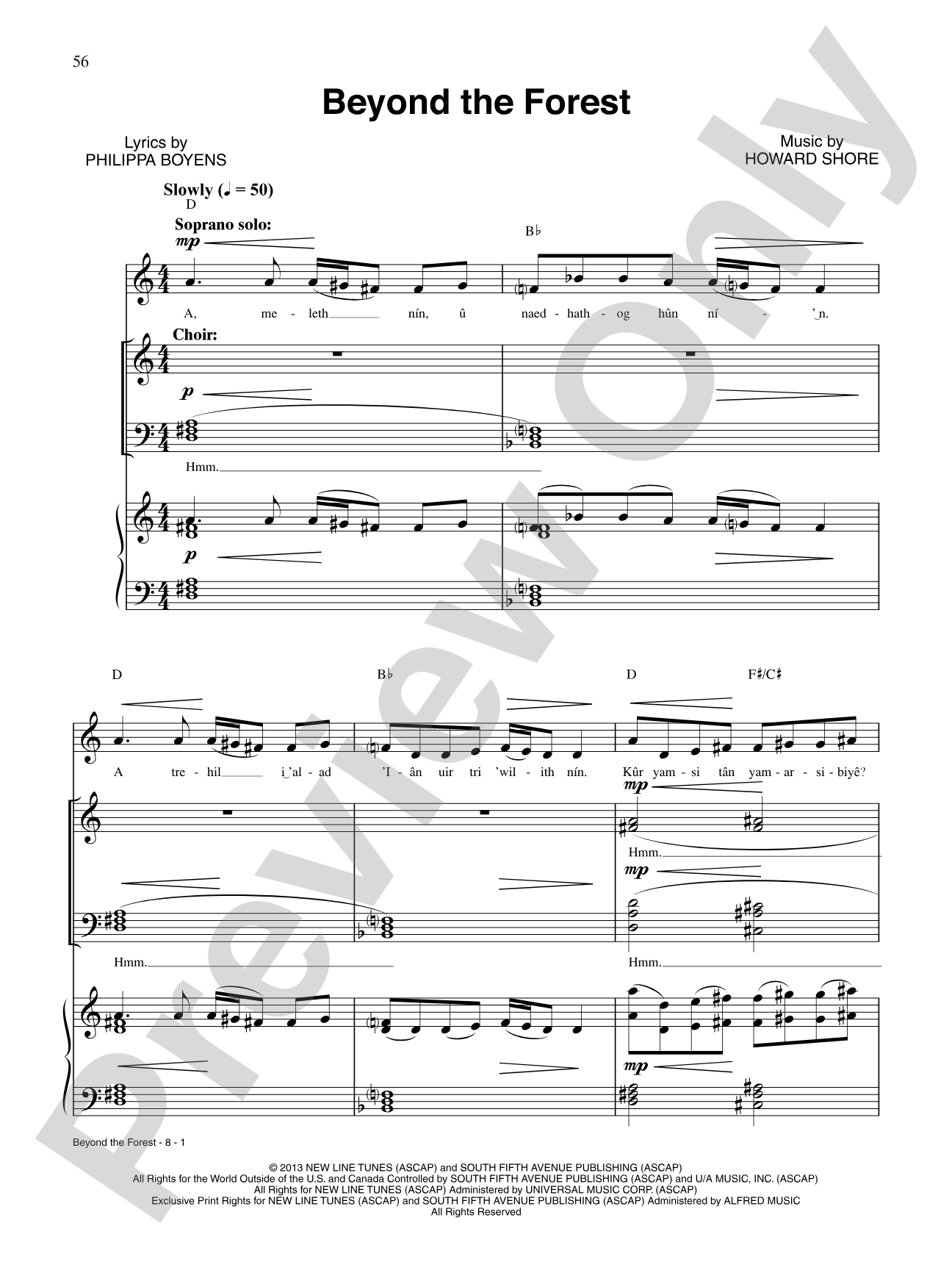

Beyond the Forest (from The Hobbit: The Desolation of Smaug): Piano/Vocal/Chords
Sheet Music Selections from the Original Motion Picture Soundtrack
Music composed by Howard Shore
Item: 00-PS-0015927
$4.99
Pickup currently not available
Related Items
The Quest for Erebor (from The Hobbit: The Desolation of Smaug): Piano |
$4.99
|
View | |
Erebor (from The Hobbit: The Desolation of Smaug): Piano |
$4.99
|
View | |
Bree (from The Hobbit: The Desolation of Smaug): Piano |
$4.99
|
View | |
Beorn (from The Hobbit: The Desolation of Smaug): Piano |
$4.99
|
View | |
A Necromancer (from The Hobbit: The Desolation of Smaug): Piano |
$4.99
|
View | |
The Woodland Realm (from The Hobbit: The Desolation of Smaug): Piano |
$4.99
|
View | |
Feast of Starlight (from The Hobbit: The Desolation of Smaug): Piano/Vocal/Chords |
$4.99
|
View | |
Bard A Man of Lake-town (from The Hobbit: The Desolation of Smaug): Piano |
$4.99
|
View | |
Thrice Welcome (from The Hobbit: The Desolation of Smaug): Piano |
$4.99
|
View | |
Bard and Family (from The Hobbit: The Desolation of Smaug): Piano |
$4.99
|
View | |
Lake-town (from The Hobbit: The Desolation of Smaug): Piano |
$4.99
|
View | |
Girion Lord of Dale (from The Hobbit: The Desolation of Smaug): Piano |
$4.99
|
View | |
Girion and Bard (from The Hobbit: The Desolation of Smaug): Piano |
$4.99
|
View | |
Lake-town Bard (from The Hobbit: The Desolation of Smaug): Piano |
$4.99
|
View | |
House of Durin (from The Hobbit: The Desolation of Smaug): Piano |
$4.99
|
View | |
Smaug (from The Hobbit: The Desolation of Smaug): Piano |
$4.99
|
View | |
I See Fire (from The Hobbit: The Desolation of Smaug): Piano/Vocal/Chords |
$4.99
|
View | |
Tauriel and Kili (from The Hobbit: The Desolation of Smaug): Piano/Vocal/Chords |
$9.99
|
View | |
The Hobbit: The Desolation of Smaug: Piano/Vocal Book |
$19.99
|
View |
Description
With The Hobbit: The Desolation of Smaug, audiences worldwide were transported back to Middle-earth for more thrills and adventure. This officially licensed sheet music collection features 19 piano renditions of Howard Shore's masterful score. Pianists will have both classic and new themes from the epic journey right at their fingertips as they play. In addition to the piano arrangements, this beautifully produced souvenir folio features an array of colorful photos from the film. Titles: The Quest for Erebor * Erebor * Bree * Beorn * A Necromancer * Woodland Realm * Feast of Starlight * Bard, A Man of Lake-town * Thrice Welcome * Bard and Family * Lake-town * Girion, Lord of Dale * Girion and Bard * Lake-town Bard * House of Durin * Smaug * I See Fire * Tauriel and Kili * Beyond the Forest.


Beyond the Forest (from The Hobbit: The Desolation of Smaug): Piano/Vocal/Chords isn't in MakeMusic Cloud just yet...but it could be. Let us know you'd like to see it, and you'll help shape what comes next. In the meantime, start a free trial and dive into thousands of interactive titles your students can play along with today.
Request This Title
Tell us you want it.
Start Your Free Trial
Explore everything that's ready to play right now.
Sample Audio
No sample audio found.
Sample Video
No sample videos found.
Additional Details
Publisher:
Alfred Music
Page Count:
64
SKU:
00-PS-0015927
More about this title
About the Composer: Howard Shore
Howard Shore has established himself as one of contemporary film's most accomplished composers, with a career spanning decades of acclaimed soundtracks for major studio productions. His work on The Lord of the Rings and The Hobbit trilogies represents some of cinema's most intricate orchestral writing, demonstrating his mastery of leitmotif development, large-scale thematic architecture, and the integration of classical compositional techniques with film narrative.
Why we love this
Shore's themes translate beautifully to piano, offering pianists the chance to explore sophisticated harmonic language and dynamic contrast without requiring a full orchestra. The collection spans intimate character moments alongside sweeping adventure music, giving players meaningful variety within a single folio. These arrangements reward careful attention to pedaling, voice leading, and rubato, making them genuinely rewarding pieces for intermediate to advanced pianists who love film music.
What to expect
These pieces evoke the epic scope and intimate character moments of Middle-earth. You'll move between tender, reflective passages and dramatic, driving rhythms that suggest adventure and danger. There's a richness to Shore's harmonic language that feels both classical and contemporary, creating a sense of timelessness paired with the immediacy of film storytelling.
Who it's for
Pianists ranging from advanced intermediate to advanced levels who enjoy film music and want to develop their ability to handle sophisticated harmonic progressions and cinematic expression. Piano students preparing recital programs that include contemporary or genre-crossover material will find these pieces engaging and film-literate audiences appreciate performances of recognizable, beautifully crafted themes.
How to get the most out of it
- Study the film scenes these pieces accompany before you play. Shore's orchestrations are deeply narrative, and understanding the dramatic context transforms how you shape phrasing and emotional arc.
- Use the chord symbols as a pathway to improvisation. Many of these pieces invite subtle reharmonization and jazz-inflected voicings that can personalize your interpretation.
- Balance the complexity of the right hand with a supporting rather than heavy left hand. These arrangements benefit from clarity and space, especially in the more delicate themes.
- Vary your pedal strategy by section. Rich harmonic passages need full resonance, while dialogue-driven or action sequences often benefit from shorter, more precise pedal release.
How to use it
Include these pieces in recitals exploring contemporary film scoring or place them alongside classical piano works to demonstrate how modern composers use traditional harmonic vocabulary in new contexts. A program pairing several of these themes creates a natural narrative arc and appeals to audiences beyond traditional concert music listeners. Solo pianists might also use selected pieces as encore-length material that audiences recognize and enjoy.
Skills your students will build
- Voice leading through complex harmonic progressions with chromatic movement
- Pedal technique for sustaining harmonic color while maintaining textural clarity
- Expressive phrasing in minor and modal harmonic contexts
- Reading and interpreting chord symbols alongside traditional notation
- Dynamic range and contrasting textural approaches within single-staff arrangements
- Rubato and rhythmic flexibility in service of emotional narrative