
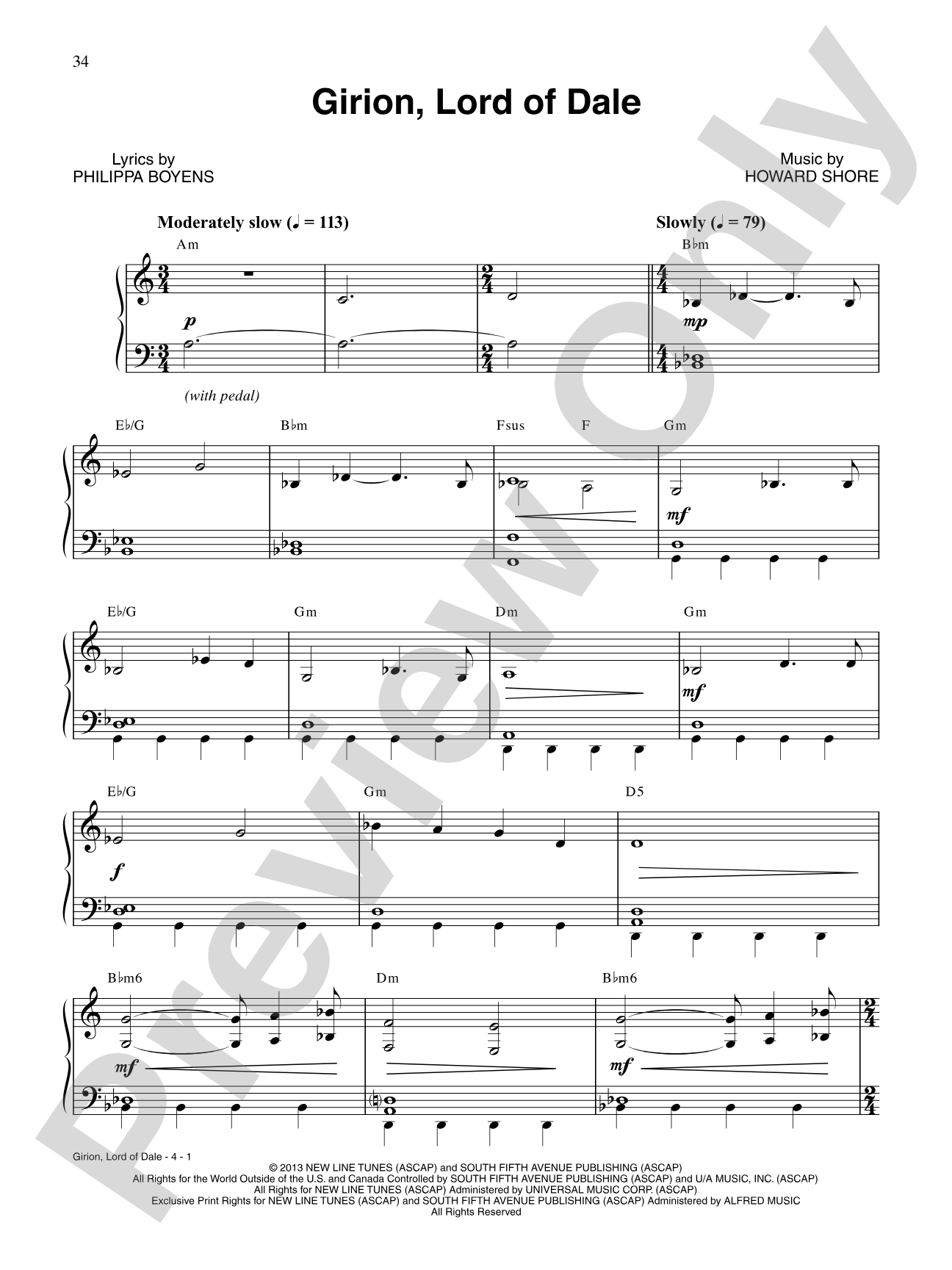

Girion Lord of Dale (from The Hobbit: The Desolation of Smaug): Piano
Sheet Music Selections from the Original Motion Picture Soundtrack
Music composed by Howard Shore
Item: 00-PS-0015920
$4.99
Pickup currently not available
Related Items
The Quest for Erebor (from The Hobbit: The Desolation of Smaug): Piano |
$4.99
|
View | |
Erebor (from The Hobbit: The Desolation of Smaug): Piano |
$4.99
|
View | |
Bree (from The Hobbit: The Desolation of Smaug): Piano |
$4.99
|
View | |
Beorn (from The Hobbit: The Desolation of Smaug): Piano |
$4.99
|
View | |
A Necromancer (from The Hobbit: The Desolation of Smaug): Piano |
$4.99
|
View | |
The Woodland Realm (from The Hobbit: The Desolation of Smaug): Piano |
$4.99
|
View | |
Feast of Starlight (from The Hobbit: The Desolation of Smaug): Piano/Vocal/Chords |
$4.99
|
View | |
Bard A Man of Lake-town (from The Hobbit: The Desolation of Smaug): Piano |
$4.99
|
View | |
Thrice Welcome (from The Hobbit: The Desolation of Smaug): Piano |
$4.99
|
View | |
Bard and Family (from The Hobbit: The Desolation of Smaug): Piano |
$4.99
|
View | |
Lake-town (from The Hobbit: The Desolation of Smaug): Piano |
$4.99
|
View | |
Girion and Bard (from The Hobbit: The Desolation of Smaug): Piano |
$4.99
|
View | |
Lake-town Bard (from The Hobbit: The Desolation of Smaug): Piano |
$4.99
|
View | |
House of Durin (from The Hobbit: The Desolation of Smaug): Piano |
$4.99
|
View | |
Smaug (from The Hobbit: The Desolation of Smaug): Piano |
$4.99
|
View | |
I See Fire (from The Hobbit: The Desolation of Smaug): Piano/Vocal/Chords |
$4.99
|
View | |
Tauriel and Kili (from The Hobbit: The Desolation of Smaug): Piano/Vocal/Chords |
$9.99
|
View | |
Beyond the Forest (from The Hobbit: The Desolation of Smaug): Piano/Vocal/Chords |
$4.99
|
View | |
The Hobbit: The Desolation of Smaug: Piano/Vocal Book |
$19.99
|
View |
Description
With The Hobbit: The Desolation of Smaug, audiences worldwide were transported back to Middle-earth for more thrills and adventure. This officially licensed sheet music collection features 19 piano renditions of Howard Shore's masterful score. Pianists will have both classic and new themes from the epic journey right at their fingertips as they play. In addition to the piano arrangements, this beautifully produced souvenir folio features an array of colorful photos from the film. Titles: The Quest for Erebor * Erebor * Bree * Beorn * A Necromancer * Woodland Realm * Feast of Starlight * Bard, A Man of Lake-town * Thrice Welcome * Bard and Family * Lake-town * Girion, Lord of Dale * Girion and Bard * Lake-town Bard * House of Durin * Smaug * I See Fire * Tauriel and Kili * Beyond the Forest.


Girion Lord of Dale (from The Hobbit: The Desolation of Smaug): Piano isn't in MakeMusic Cloud just yet...but it could be. Let us know you'd like to see it, and you'll help shape what comes next. In the meantime, start a free trial and dive into thousands of interactive titles your students can play along with today.
Request This Title
Tell us you want it.
Start Your Free Trial
Explore everything that's ready to play right now.
Sample Audio
No sample audio found.
Sample Video
No sample videos found.
Additional Details
Publisher:
Alfred Music
Page Count:
64
SKU:
00-PS-0015920
More about this title
About the Composer: Howard Shore
Howard Shore is a three-time Academy Award-winning composer whose orchestral scores have defined cinematic fantasy for generations. His work on Peter Jackson's The Lord of the Rings and The Hobbit trilogies established him as a master of epic film music, combining leitmotif technique with rich harmonic language and emotional depth.
In education settings, Shore's film scores serve as accessible entry points to complex compositional techniques. His music demonstrates how thematic development, orchestration, and harmonic progression create narrative and character, making it valuable repertoire for pianists studying film scoring, arrangement, and expressive performance.
Why we love this
This collection gives pianists direct access to Shore's thematic genius without the complexity of full orchestral reduction. The range of titles (from intimate character themes like "Bard, A Man of Lake-town" to sweeping ensemble pieces like "House of Durin") means students encounter varied textures, keys, and technical demands within a single, cohesive score they already love.
What to expect
These arrangements capture the sweep and grandeur of Middle-earth, moving from intimate character moments to vast, heroic landscapes. Shore's gift for melody and harmonic color translates beautifully to the piano, where each theme unfolds with both lyrical warmth and architectural clarity.
Who it's for
Advanced amateur pianists and music students who want to explore film scoring through repertoire they recognize and love. Teachers seeking material that engages students in harmonic analysis, thematic development, and interpretive choices grounded in visual storytelling.
How to get the most out of it
- Observe Shore's use of ostinato patterns and repeated figures to build momentum; these anchor the harmony and create ensemble coherence when performed by multiple pianists or in collaborative arrangements.
- Lean into the film's visual moments by studying the color palette of each scene; this deepens interpretive choices around pedal, tempo flexibility, and dynamic shaping beyond what notation alone suggests.
- Pay attention to key relationships between adjacent pieces; Shore uses harmonic proximity and tonal contrast strategically to signal emotional shifts, which informs pacing within a longer program.
- Balance the soaring melodic lines typical of Shore's themes with their orchestral orchestration context; pianists often need to voice chords carefully to avoid muddiness while maintaining the warmth of the original score.
How to use it
Feature a single movement as an encore, or construct an entire recital around related themes (for example, pairing "Bard, A Man of Lake-town" with "Lake-town" to show character and setting in musical relief). This collection works equally well as a performance piece or as a study text for understanding leitmotif and film composition techniques.
Skills your students will build
- Reading and interpreting leitmotif technique (identifying recurring themes and their harmonic/melodic variations)
- Voicing thick chords with clarity and balance on piano
- Understanding key relationships and tonal contrast as structural and dramatic tools
- Connecting visual narrative to harmonic and melodic choices (film score interpretation)
- Managing dynamic range and pedal technique to evoke orchestral color on a single instrument