
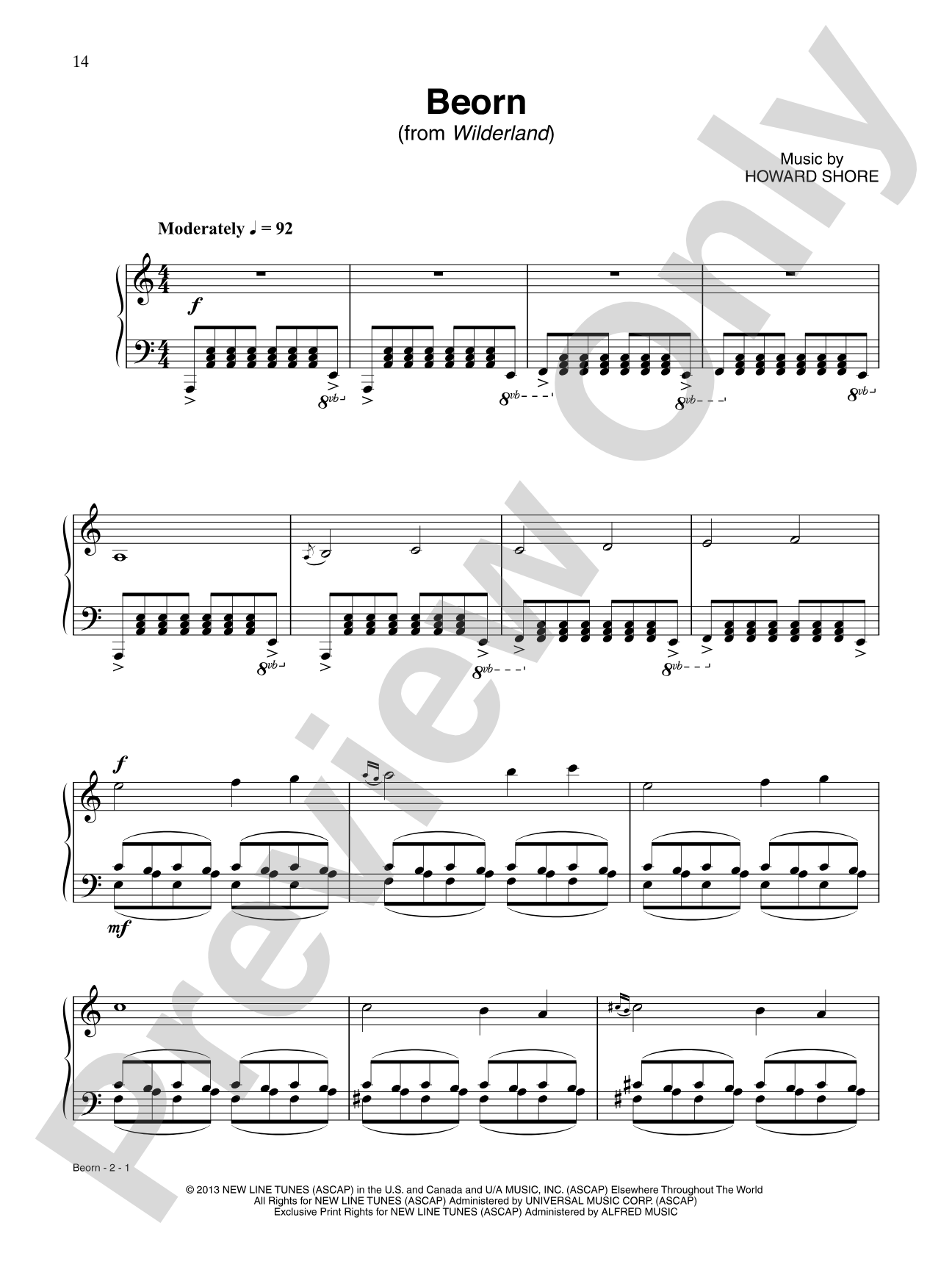

Beorn (from The Hobbit: The Desolation of Smaug): Piano
Sheet Music Selections from the Original Motion Picture Soundtrack
Music composed by Howard Shore
Item: 00-PS-0015912
$4.99
One moment…
Related Items
The Quest for Erebor (from The Hobbit: The Desolation of Smaug): Piano |
$4.99
|
View | |
Erebor (from The Hobbit: The Desolation of Smaug): Piano |
$4.99
|
View | |
Bree (from The Hobbit: The Desolation of Smaug): Piano |
$4.99
|
View | |
A Necromancer (from The Hobbit: The Desolation of Smaug): Piano |
$4.99
|
View | |
The Woodland Realm (from The Hobbit: The Desolation of Smaug): Piano |
$4.99
|
View | |
Feast of Starlight (from The Hobbit: The Desolation of Smaug): Piano/Vocal/Chords |
$4.99
|
View | |
Bard A Man of Lake-town (from The Hobbit: The Desolation of Smaug): Piano |
$4.99
|
View | |
Thrice Welcome (from The Hobbit: The Desolation of Smaug): Piano |
$4.99
|
View | |
Bard and Family (from The Hobbit: The Desolation of Smaug): Piano |
$4.99
|
View | |
Lake-town (from The Hobbit: The Desolation of Smaug): Piano |
$4.99
|
View | |
Girion Lord of Dale (from The Hobbit: The Desolation of Smaug): Piano |
$4.99
|
View | |
Girion and Bard (from The Hobbit: The Desolation of Smaug): Piano |
$4.99
|
View | |
Lake-town Bard (from The Hobbit: The Desolation of Smaug): Piano |
$4.99
|
View | |
House of Durin (from The Hobbit: The Desolation of Smaug): Piano |
$4.99
|
View | |
Smaug (from The Hobbit: The Desolation of Smaug): Piano |
$4.99
|
View | |
I See Fire (from The Hobbit: The Desolation of Smaug): Piano/Vocal/Chords |
$4.99
|
View | |
Tauriel and Kili (from The Hobbit: The Desolation of Smaug): Piano/Vocal/Chords |
$9.99
|
View | |
Beyond the Forest (from The Hobbit: The Desolation of Smaug): Piano/Vocal/Chords |
$4.99
|
View | |
The Hobbit: The Desolation of Smaug: Piano/Vocal Book |
$19.99
|
View |
Description
With The Hobbit: The Desolation of Smaug, audiences worldwide were transported back to Middle-earth for more thrills and adventure. This officially licensed sheet music collection features 19 piano renditions of Howard Shore's masterful score. Pianists will have both classic and new themes from the epic journey right at their fingertips as they play. In addition to the piano arrangements, this beautifully produced souvenir folio features an array of colorful photos from the film. Titles: The Quest for Erebor * Erebor * Bree * Beorn * A Necromancer * Woodland Realm * Feast of Starlight * Bard, A Man of Lake-town * Thrice Welcome * Bard and Family * Lake-town * Girion, Lord of Dale * Girion and Bard * Lake-town Bard * House of Durin * Smaug * I See Fire * Tauriel and Kili * Beyond the Forest.


Beorn (from The Hobbit: The Desolation of Smaug): Piano isn't in MakeMusic Cloud just yet...but it could be. Let us know you'd like to see it, and you'll help shape what comes next. In the meantime, start a free trial and dive into thousands of interactive titles your students can play along with today.
Request This Title
Tell us you want it.
Start Your Free Trial
Explore everything that's ready to play right now.
Sample Audio
No sample audio found.
Sample Video
No sample videos found.
Additional Details
Publisher:
Alfred Music
Page Count:
64
SKU:
00-PS-0015912
More about this title
About the Composer: Howard Shore
Howard Shore is a three-time Academy Award winner whose orchestral scores have defined epic cinema for decades. His work on The Lord of the Rings trilogy and The Hobbit films demonstrates mastery of leitmotif writing and the ability to craft music that operates independently while remaining inseparable from visual storytelling.
Why we love this
These piano arrangements capture Shore's architectural approach to film scoring, where thematic material builds and transforms across the narrative. Pianists get access to genuinely singable melodies paired with harmonic sophistication that rewards careful pedal work and voice leading, making this collection both musically engaging and performable.
What to expect
These pieces carry the weight and grandeur of Middle-earth while remaining intimate at the keyboard. You'll move between moments of darkness and menace to passages of wonder and beauty, with Shore's gift for memorable melody grounding every transition.
Who it's for
Pianists with intermediate to advanced facility will find substantial musical material in this collection, from the dramatic chords of Smaug to the lyrical writing in tracks like Tauriel and Kili. This folio works equally well for recital performance and for musicians interested in film music scoring and arrangement techniques.
How to get the most out of it
- Shape the thematic material as you would a vocal line, even in passages where the melody sits in the right hand among accompaniment textures. Shore's themes are built to sing.
- Pay attention to key relationships between pieces. Moving from one track to another in order reveals Shore's harmonic journey through the film, so transitions between arrangements deserve rehearsal time.
- Balance the orchestral density implied by these arrangements; use pedal strategically to create space rather than blur harmonic changes, particularly in the more delicate passages like the Woodland Realm material.
- Establish a steady tempo first, then shape individual phrases. Shore's themes often work best when the underlying pulse feels inevitable rather than rigid.
How to use it
Curate a thematic program by selecting pieces that tell their own story; pairing Erebor with The Quest for Erebor and Smaug creates a coherent arc. Individual pieces also work as standalone recital selections or as thematic interludes in a concert program exploring film music.
Skills your students will build
- Pedal control in music with sustained harmonic colors
- Identifying and shaping leitmotifs across related pieces
- Balance between melody and accompaniment texture
- Rubato and phrasing techniques in film music contexts
- Reading and interpreting arrangement-specific articulation markings