
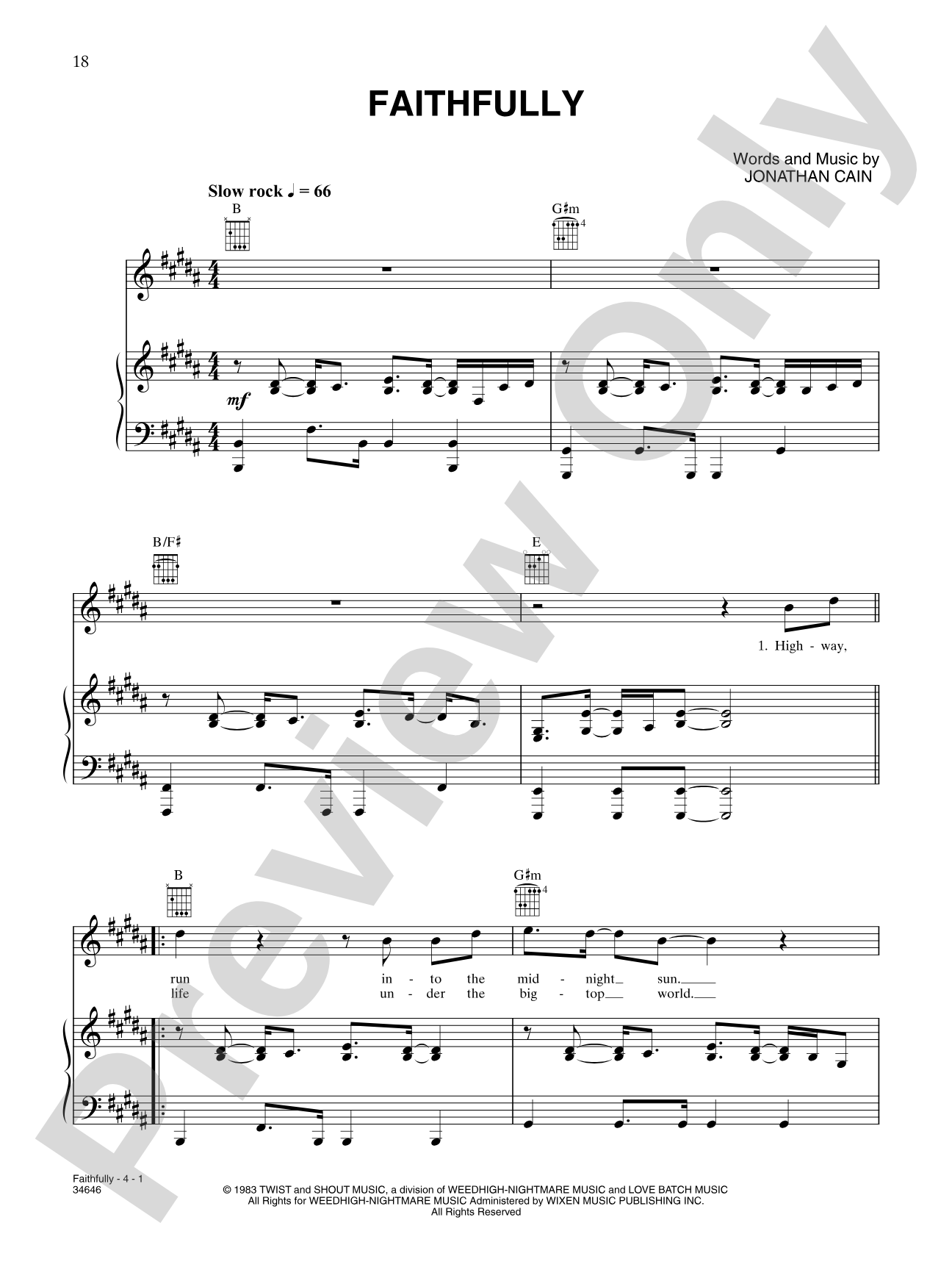

Faithfully: Piano/Vocal/Chords
Journey
Item: 00-XS-0000013
$4.99
Pickup currently not available
Related Items
Separate Ways: Piano/Vocal/Chords |
$5.99
|
View | |
Don't Stop Believin': Piano/Vocal/Chords |
$4.99
|
View | |
Send Her My Love: Piano/Vocal/Chords |
$4.99
|
View | |
Open Arms: Piano/Vocal/Chords |
$4.99
|
View | |
Who's Crying Now: Piano/Vocal/Chords |
$4.99
|
View | |
Any Way You Want It: Piano/Vocal/Chords |
$5.99
|
View | |
Lovin', Touchin', Squeezin': Piano/Vocal/Chords |
$5.99
|
View | |
Wheel In The Sky: Piano/Vocal/Chords |
$5.99
|
View | |
Only The Young: Piano/Vocal/Chords |
$5.99
|
View | |
Ask The Lonely: Piano/Vocal/Chords |
$5.99
|
View | |
Lights: Piano/Vocal/Chords |
$4.99
|
View | |
Journey: Greatest Hits (Updated Edition): Piano/Vocal/Guitar Book |
$24.99
|
View |
Description
Pianists will delight in this updated songbook, in which the piano/vocal arrangements have been notably improved (compared to older published sheet music renditions) to accurately reflect what was played on the band's original hit recordings. Basic guitar chord grids are also included. (A note-for-note guitar tablature edition is also available; sold separately.) Titles: Only the Young * Don't Stop Believin' * Wheel in the Sky * Faithfully * I'll Be Alright Without You * Any Way You Want It * Ask the Lonely * Who's Crying Now * Separate Ways (Worlds Apart) * Lights * Lovin', Touchin', Squeezin' * Open Arms * Girl Can't Help It * Send Her My Love * Be Good to Yourself.


Faithfully: Piano/Vocal/Chords isn't in MakeMusic Cloud just yet...but it could be. Let us know you'd like to see it, and you'll help shape what comes next. In the meantime, start a free trial and dive into thousands of interactive titles your students can play along with today.
Request This Title
Tell us you want it.
Start Your Free Trial
Explore everything that's ready to play right now.
Sample Audio
No sample audio found.
Sample Video
No sample videos found.
Additional Details
Publisher:
Alfred Music
Page Count:
84
SKU:
00-XS-0000013
More about this title
About the Composer: Johathan Cain
Jonathan Cain joined Journey as keyboardist in 1981 and became the band's primary songwriter during their most commercially successful era. His ability to craft memorable melodies and emotionally direct progressions helped define the band's stadium rock sound across multiple platinum albums. Cain's compositions balance technical sophistication with accessibility, making them rewarding for musicians across skill levels.
Why we love this
These arrangements restore the actual keyboard parts from Journey's original recordings instead of relying on simplified generic versions. The vocal lines sit naturally in the voice part, and the piano writing captures both the harmonic richness and rhythmic drive that made these songs endure. Pianists get authentic material to learn from, not approximations.
What to expect
Energetic and emotionally direct. The writing captures Journey's signature blend of soaring vocals over driving keyboards and layered harmonies, with moments of restraint in the ballads that let the melody breathe. These songs live in the space where earnest sentiment meets confident showmanship.
Who it's for
Pianists, keyboardists, and singer-pianists looking for rock repertoire that reflects what was actually performed on the recordings. This collection works well for musicians preparing covers, students exploring 1980s pop-rock songwriting, and teachers building a library of attainable yet musically substantial material.
How to get the most out of it
- Study the original recordings while working through these arrangements. The piano voicings were deliberately crafted to sit alongside the other band instruments, and hearing how they interact will deepen your interpretation.
- Pay attention to the rhythm section relationship between piano and drums. Journey's groove often depends on the keyboard locking into specific syncopations that differ from typical pop ballad phrasing.
- Balance the bass line in your left hand with the upper voicings. These arrangements often feature independent bass movement that carries melodic weight rather than just harmonic support.
- Use the guitar chord grids to understand the harmonic foundation, even if you're playing only piano. This context strengthens your sense of where the piano voicings sit harmonically.
How to use it
Feature individual songs as recital selections, solo spots in chamber or ensemble contexts, or as a complete set for a themed evening celebrating 1980s rock songwriting. The variety across the 15 tracks accommodates different skill levels and moods, making it possible to build a cohesive program from a single book.
Skills your students will build
- Voicing contemporary rock progressions on keyboard
- Balancing melody, harmony, and bass line independence
- Reading and performing syncopated rhythmic figures in rock contexts
- Coordinating piano and vocal phrasing across a range of tempos
- Interpreting chord symbols and building variations from harmonic frameworks