
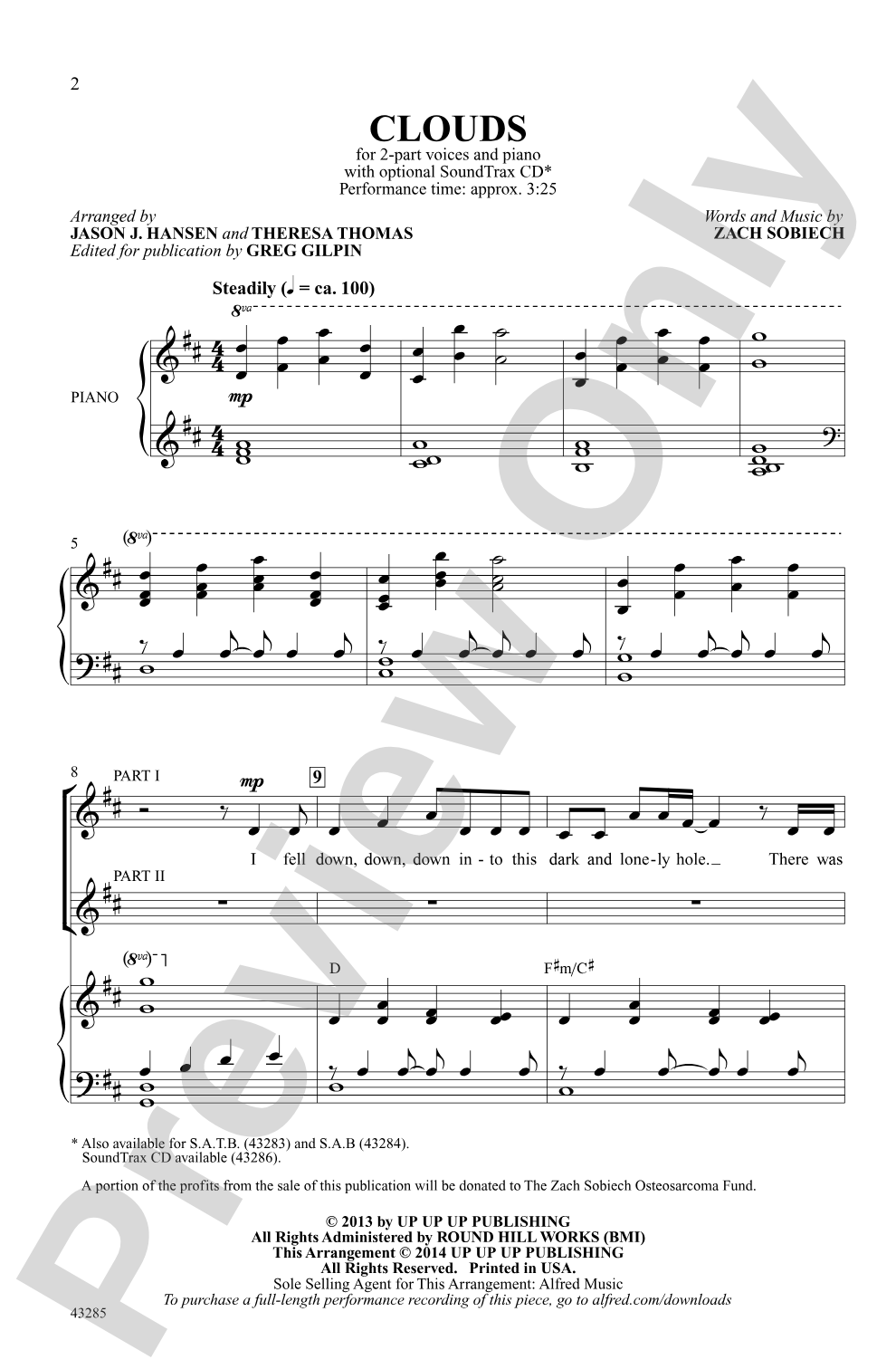
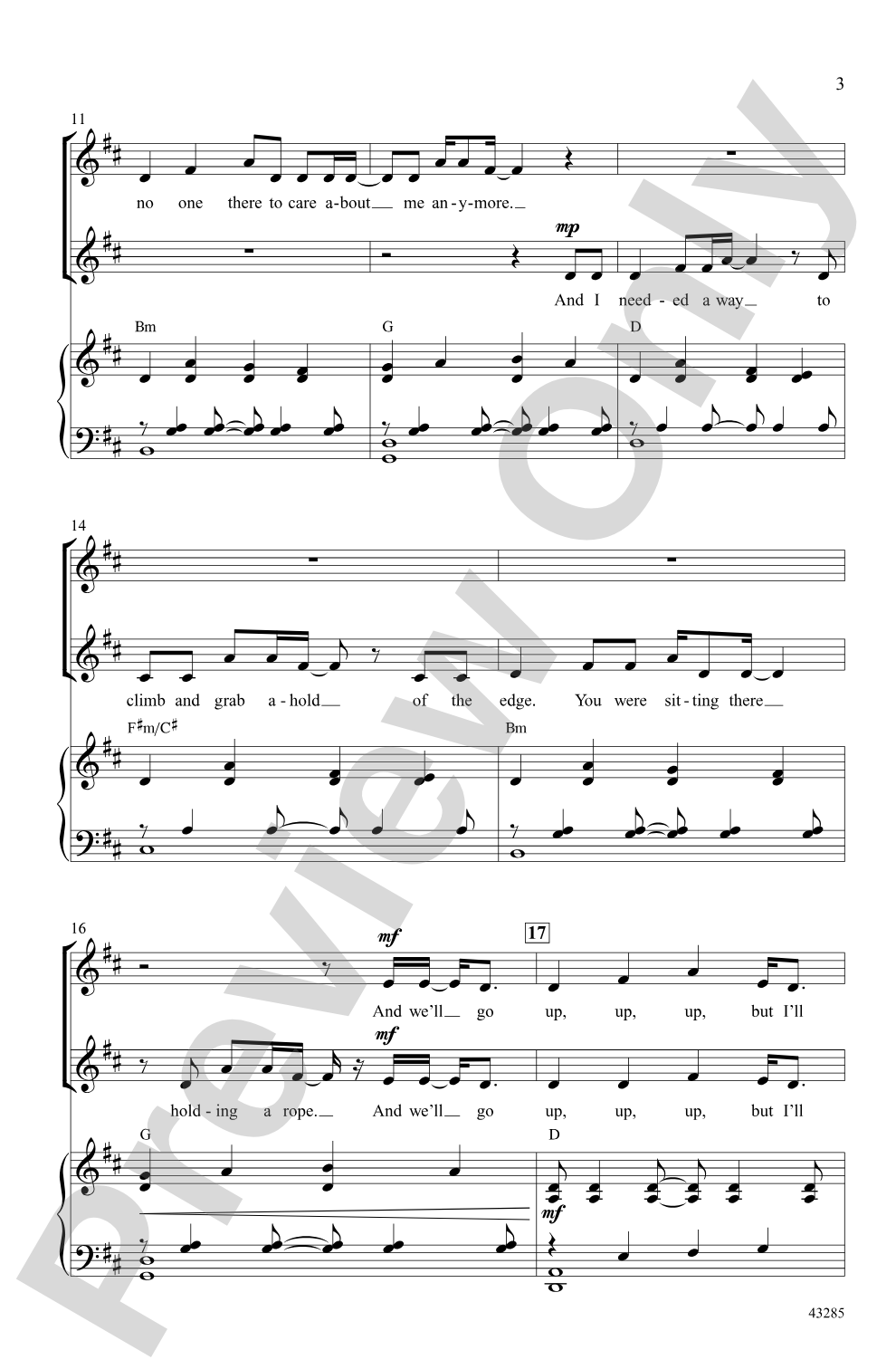
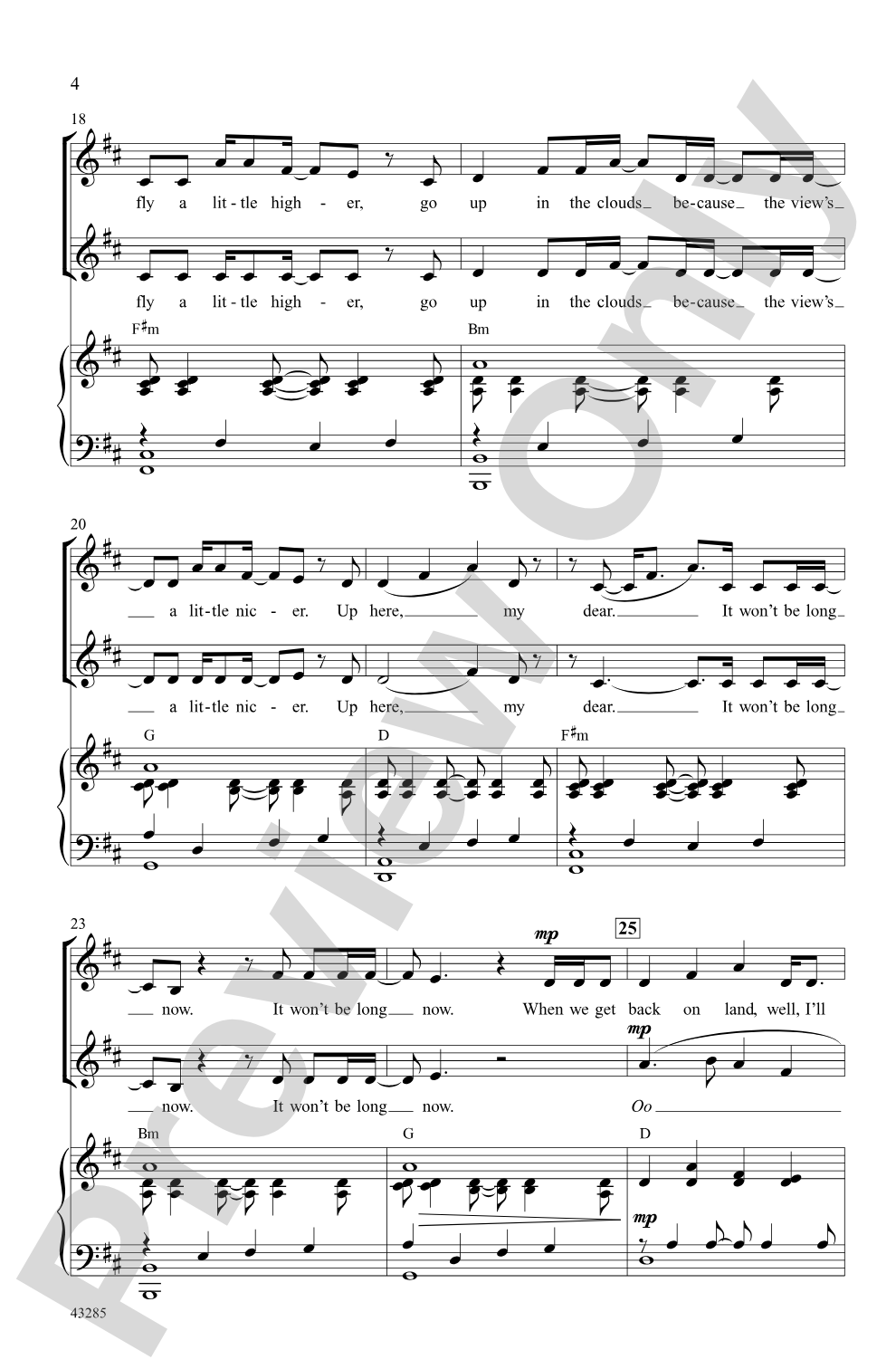

Clouds (2-Part): 2-Part Choral Octavo
Words and music by Zach Sobiech / arr. Jason J. Hansen and Theresa Thomas / ed. Greg Gilpin
Item: 00-PO-0002046
$2.10
Minimum order quantity: 20 copies
Pickup currently not available
Related Items
Clouds: SoundTrax Digital Audio Download |
$27.99
|
View | |
Clouds (SATB): SATB Choral Octavo |
$2.10
|
View | |
Clouds (SAB): SAB Choral Octavo |
$2.00
|
View | |
Clouds: SATB Choral Octavo |
$2.10
|
View | |
Clouds: SAB Choral Octavo |
$2.00
|
View | |
Clouds: 2-Part Choral Octavo |
$2.10
|
View | |
Clouds: Choral Octavo SoundTrax CD |
$27.99
|
View |
Description
After being given a year to live, 17-year old Zach Sobiech wrote a powerful goodbye song that quickly gained international attention in the form of celebrity tribute videos and other high-profile covers. Zach passed away in 2013, but his legacy lives on in this positive message of hope. A portion of the royalties from this arrangement will be donated to the Zach Sobiech Osteosarcoma Fund.


Clouds (2-Part): 2-Part Choral Octavo isn't in MakeMusic Cloud just yet...but it could be. Let us know you'd like to see it, and you'll help shape what comes next. In the meantime, start a free trial and dive into thousands of interactive titles your students can play along with today.
Request This Title
Tell us you want it.
Start Your Free Trial
Explore everything that's ready to play right now.
Sample Audio
1
Audio File
--:--
0:00
0:00
Sample Video
No sample videos found.
Additional Details
Series:
Alfred Pop Choral Series
Publisher:
Alfred Music
Page Count:
12
SKU:
00-PO-0002046
More about this title
About the Composer: Zach Sobiech
Zach Sobiech was a Minnesota teenager who turned his diagnosis of osteosarcoma into a song of defiance and hope. Facing a year to live, he wrote "Clouds" at 17 and released it with his band Cats Cats Cats in 2011. The song resonated across generations, inspiring celebrity covers and tribute videos before his death in 2013.
Sobiech's music became a platform for courage in the face of mortality. Rather than fade into private memory, his composition has entered choral repertoire as a statement about resilience and meaning-making. Educators and singers continue to discover in "Clouds" both an extraordinary human story and a song with genuine emotional depth.
Why we love this
This arrangement honors the song's vulnerability while making it accessible for young singers. Hansen and Thomas preserve the emotional directness of Sobiech's original while crafting lines that sit naturally in treble ranges, allowing students to engage authentically with a text about mortality and hope without musical barriers. Programming it signals to your students that their voices can carry real stories.
What to expect
The music honors the song's original character: direct, unadorned, and shot through with quiet determination. There is nothing manufactured about it. Singing this piece asks students to sit with difficult themes while discovering that hope and sorrow can coexist in the same breath. The arrangement respects the emotional register of the original rather than attempting to uplift or soften it.
Who it's for
Middle and high school choirs working with contemporary repertoire that carries genuine substance. This piece suits mixed-age ensembles and all-treble choirs, and it works equally well in secular school settings and faith-based programs that value meaningful modern texts. Students who may feel distant from classical choral literature often connect immediately with Sobiech's voice.
How to get the most out of it
- Lean into the conversational tone of the lyrics. This isn't a hymn or an anthem; Sobiech speaks directly to the listener. Encourage singers to find the human intimacy in their phrases rather than pushing for projection.
- Balance the recorded accompaniment carefully so your singers' voices remain the focus. The original pop production can easily overshadow young voices if the track level runs too high.
- Give particular attention to moments where parts divide or come together. Even in 2-part writing, the interlocking of lines creates harmonic depth that rewards precise ensemble work.
- Consider the pacing of emotional beats in the text. Some phrases need space to land; rushing through them flattens the impact of what Sobiech wrote.
How to use it
Consider placing this on a concert exploring themes of resilience, change, or living fully. It pairs naturally with both classical art songs about loss and contemporary pop arrangements that address serious subjects. The piece also serves well as an anchor for a community-building conversation about why choirs sing beyond technique. Its 12-page length makes it workable for most rehearsal calendars without requiring extensive time investment.
Skills your students will build
- Sustained lyrical phrasing in pop-influenced harmonic language
- Emotional authenticity and storytelling through music
- Blend and balance in 2-part voicing with recorded accompaniment
- Connection between text meaning and musical expression