

Changamano (Join Together-Swahili): 3-Part Mixed Choral Octavo
(Join Together--Swahili)
Music by Sally K. Albrecht and Jay Althouse
Item: 00-PO-0004262
$2.25
Minimum order quantity: 20 copies
Pickup currently not available
Related Items
Changamano (Join Together-Swahili): SATB Choral Octavo |
$2.25
|
View | |
Changamano (Join Together-Swahili): 2-Part Choral Octavo |
$2.25
|
View | |
Changamano: SATB Choral Octavo |
$2.25
|
View | |
Changamano: 3-Part Mixed Choral Octavo |
$2.25
|
View | |
Changamano: 2-Part Choral Octavo |
$2.25
|
View | |
Changamano: Choral Octavo SoundTrax CD |
$27.99
|
View |
Description
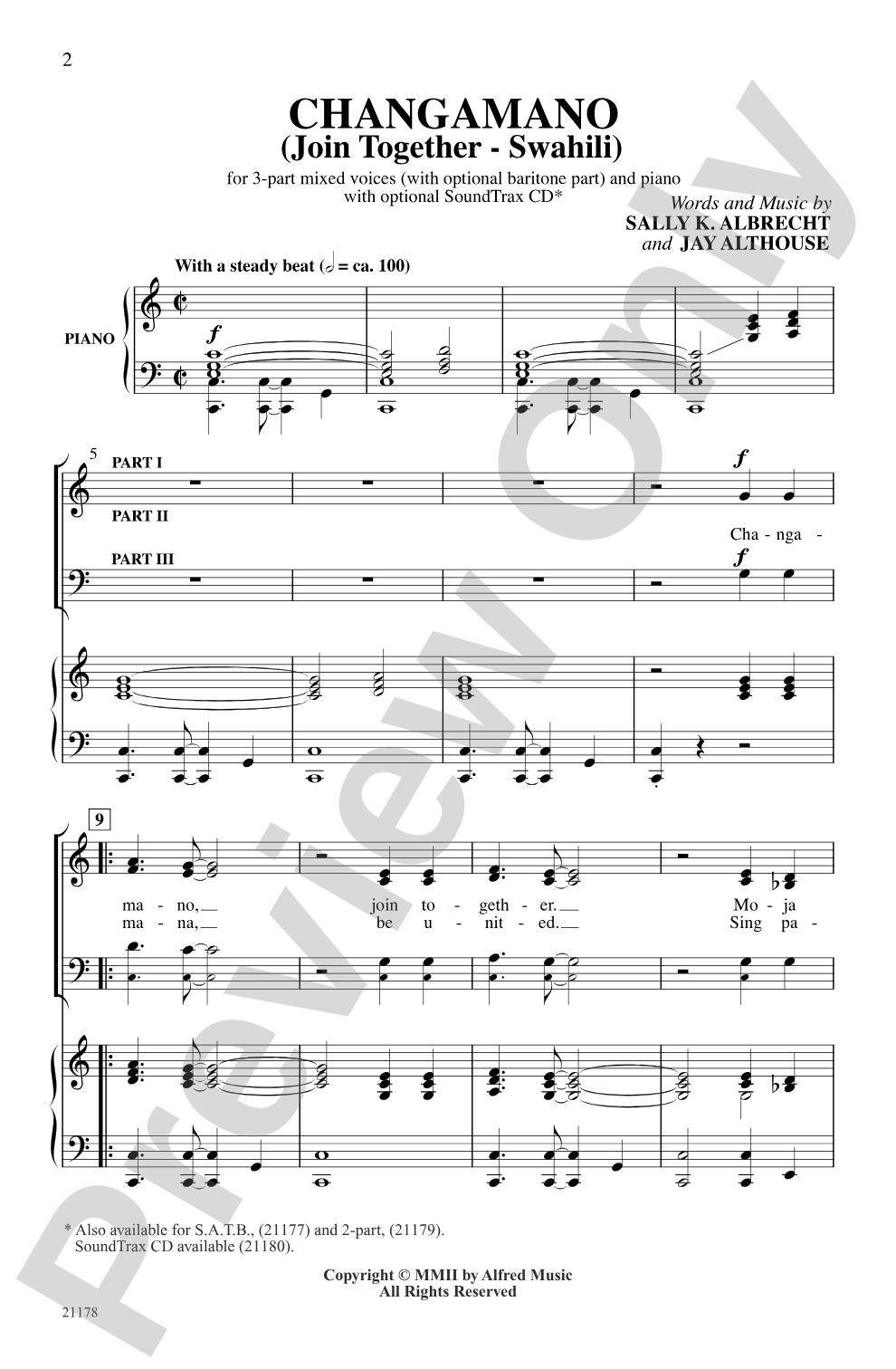
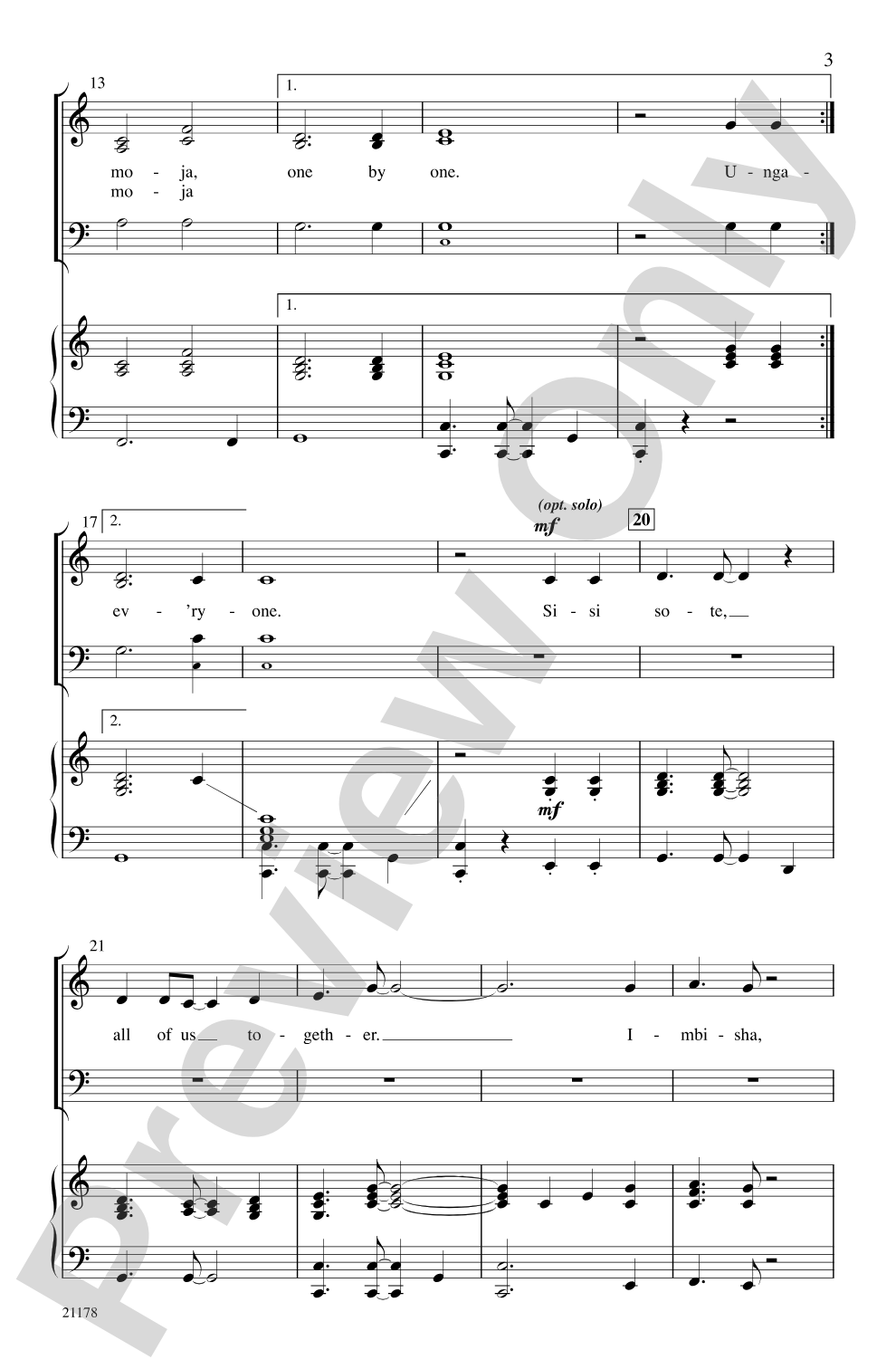
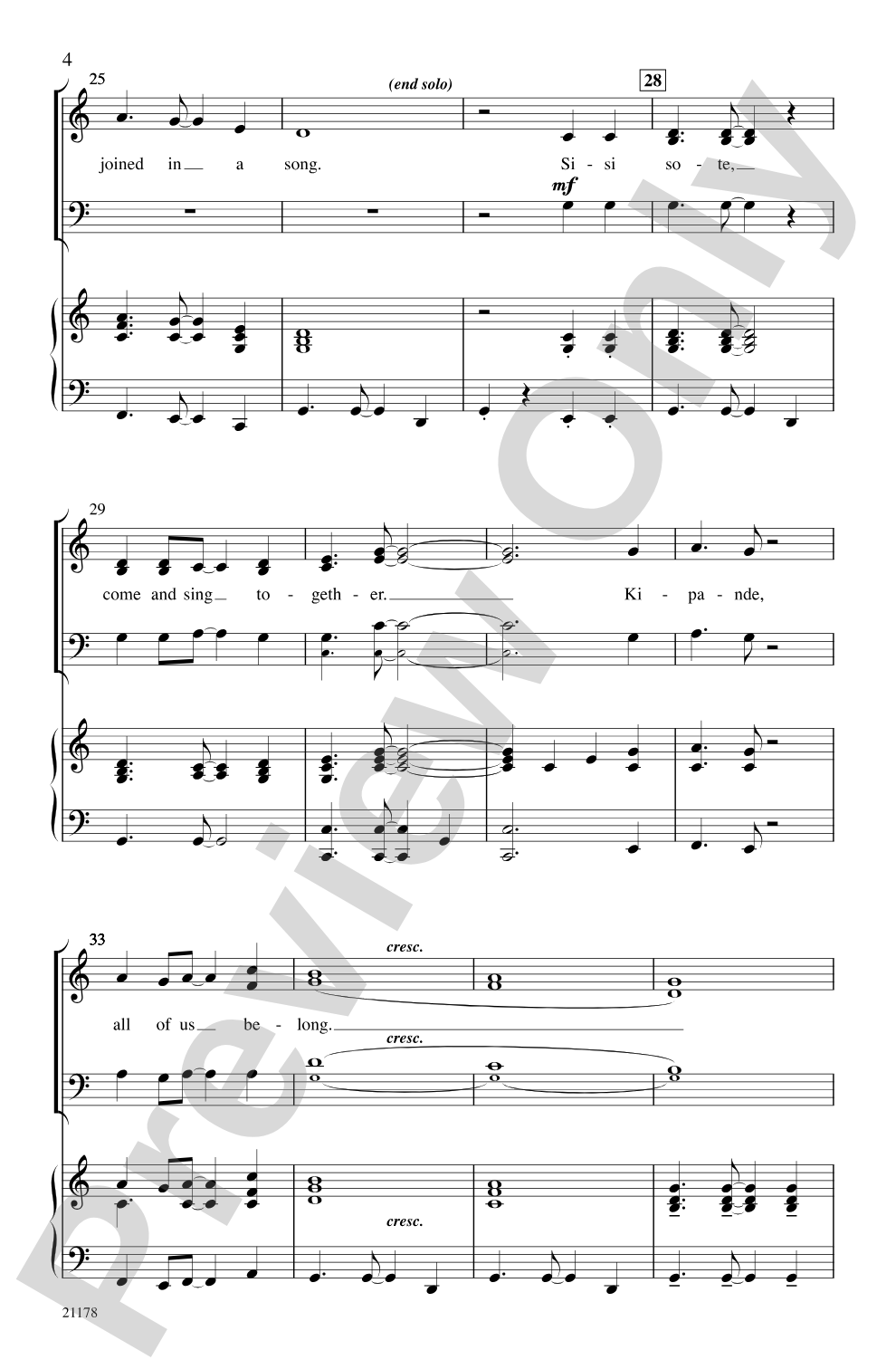
You'll feel the African pulse of this piece from the first measure. "Changamano, join together. Moja, moja, one by one." The text features seven Swahili words or phrases; a pronunciation guide and translations are included in the publication. It's a "music" song, it's a "unite as one" song, but most of all, it's a joy to sing. Includes optional solos and a treble trio descant. Staging Suggestions are featured on Sally's "Showtime!" video, Alfred #21176.


Changamano (Join Together-Swahili): 3-Part Mixed Choral Octavo isn't in MakeMusic Cloud just yet...but it could be. Let us know you'd like to see it, and you'll help shape what comes next. In the meantime, start a free trial and dive into thousands of interactive titles your students can play along with today.
Request This Title
Tell us you want it.
Start Your Free Trial
Explore everything that's ready to play right now.
Sample Audio
1
Audio File
--:--
0:00
0:00
Sample Video
No sample videos found.
Additional Details
Series:
Alfred Archive Edition: Alfred Choral Designs
Publisher:
Alfred Music
Page Count:
12
SKU:
00-PO-0004262
Instrumentation:
Opt. Baritone
More about this title
About the Composer: Sally K. Albrecht
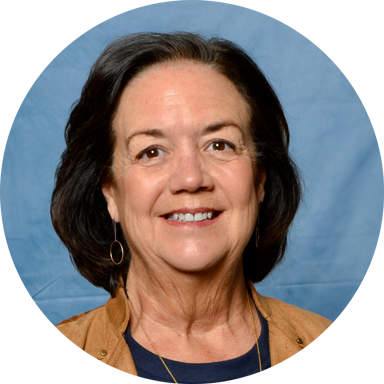
Sally K. Albrecht has built a remarkable career as a choral composer, conductor, and clinician with a distinctive focus on integrating movement into choral performance. Since 1987, she has received annual ASCAP Special Music Awards, and her catalog includes more than 600 choral publications alongside 75 larger works for stage. She has guest-conducted honor choirs at prestigious venues including Lincoln Center, Carnegie Hall, and The Kennedy Center, and spent over thirty years leading choral, vocal, and elementary music publications at major educational publishers, including her tenure as Director of School Choral Publications at Alfred Music.
Albrecht holds degrees from Rollins College (B.A. in Music and Theater, 1976), the University of Miami (M.A. in Drama, 1977, and M.M. in Accompanying, 1979), and has taught at Oakland University in Michigan, Jersey City State College in New Jersey, and Meredith College in North Carolina. A Cleveland native, she lives in Wake Forest, North Carolina, with her husband, composer and arranger Jay Althouse. She was honored with the Distinguished Alumna Award from both the University of Miami Frost School of Music and Rollins College in 2021, and previously served as Chair of the Board of Trustees for the Omicron Delta Kappa National Leadership Honor Society.
Why we love this
Albrecht and Althouse craft pieces that honor cultural traditions while remaining immediately accessible to student singers. The Swahili text paired with a pronunciation guide and translations removes barriers to authentic performance, and the optional solos and treble descant give you flexibility to customize for your ensemble's strengths. Most importantly, this piece radiates joy from the opening measure, creating the kind of rehearsal energy that reminds singers why they love choral music.
What to expect
From the first phrase, you feel the earthy, propulsive rhythm that Albrecht builds into the arrangement. The text "Changamano, join together" becomes more than words; it's an invitation to community and unity that singers feel in their bodies and voices. The piece radiates warmth and celebration, the kind of song that stays with singers long after the final note.
Who it's for
Directors looking for a genuine multicultural piece that goes beyond tokenism, with built-in cultural context and accessibility. This works beautifully for mixed choirs of all levels, especially those performing during winter concert season or for Kwanzaa celebrations, and it rewards both new and experienced singers equally.
How to get the most out of it
- Lean into the African pulse from the start. This isn't a piece to sing with European phrasing; the rhythm should feel grounded and physical, which connects naturally to the staged choreography Albrecht suggests on her "Showtime!" video.
- Use the pronunciation guide and translations during the first few rehearsals to build singers' confidence with the Swahili text. Once pronunciation is secure, the text becomes a vehicle for deeper cultural engagement rather than an obstacle.
- If you're using the optional solos, give singers adequate rehearsal time in sections before featuring them. A soloist in the context of "Changamano" becomes an invitation for the ensemble to listen and respond, so preparation makes the moment meaningful.
- Consider how the optional baritone part might expand your arrangement if you have strong lower voices available. Even doubling it in a trio section adds textural interest without overwhelming the piece's essential simplicity.
How to use it
Place this in the heart of a winter concert as a moment of cultural celebration and joy, where it lifts the energy of an audience while honoring Swahili tradition. It also serves as a perfect companion to other multicultural repertoire or as a standalone finale for a concert themed around unity and community. If you're programming a Kwanzaa concert or celebration, this is repertoire that earns its place rather than filling time.
Skills your students will build
- Singing in a non-English language with accurate pronunciation and musicality
- Balancing three-part mixed voicing with attention to blend and independence
- Responding to rhythmic patterns rooted in African music traditions
- Coordinating vocal performance with staged movement (when using suggested choreography)
- Building confidence as a soloist within a choral context (optional solo sections)