
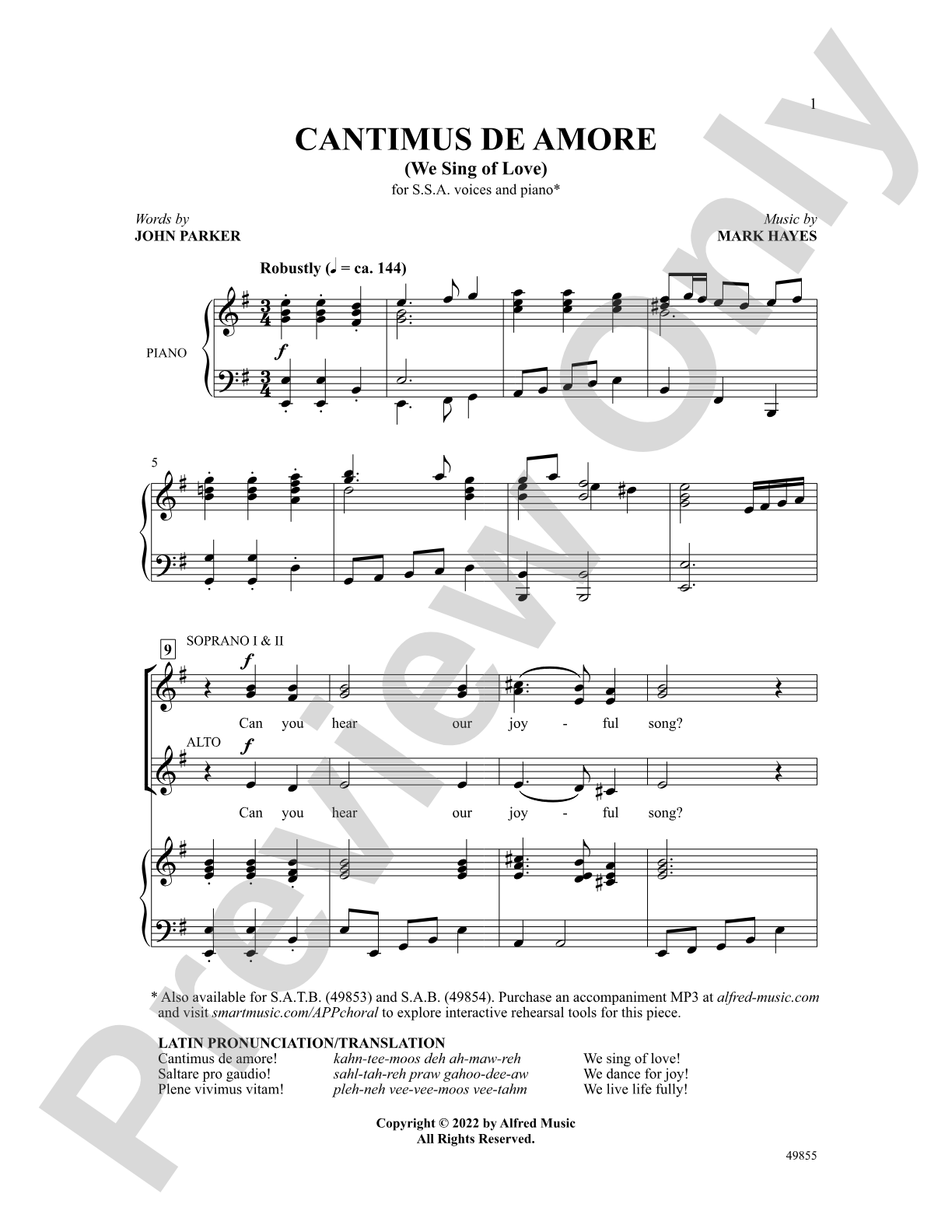
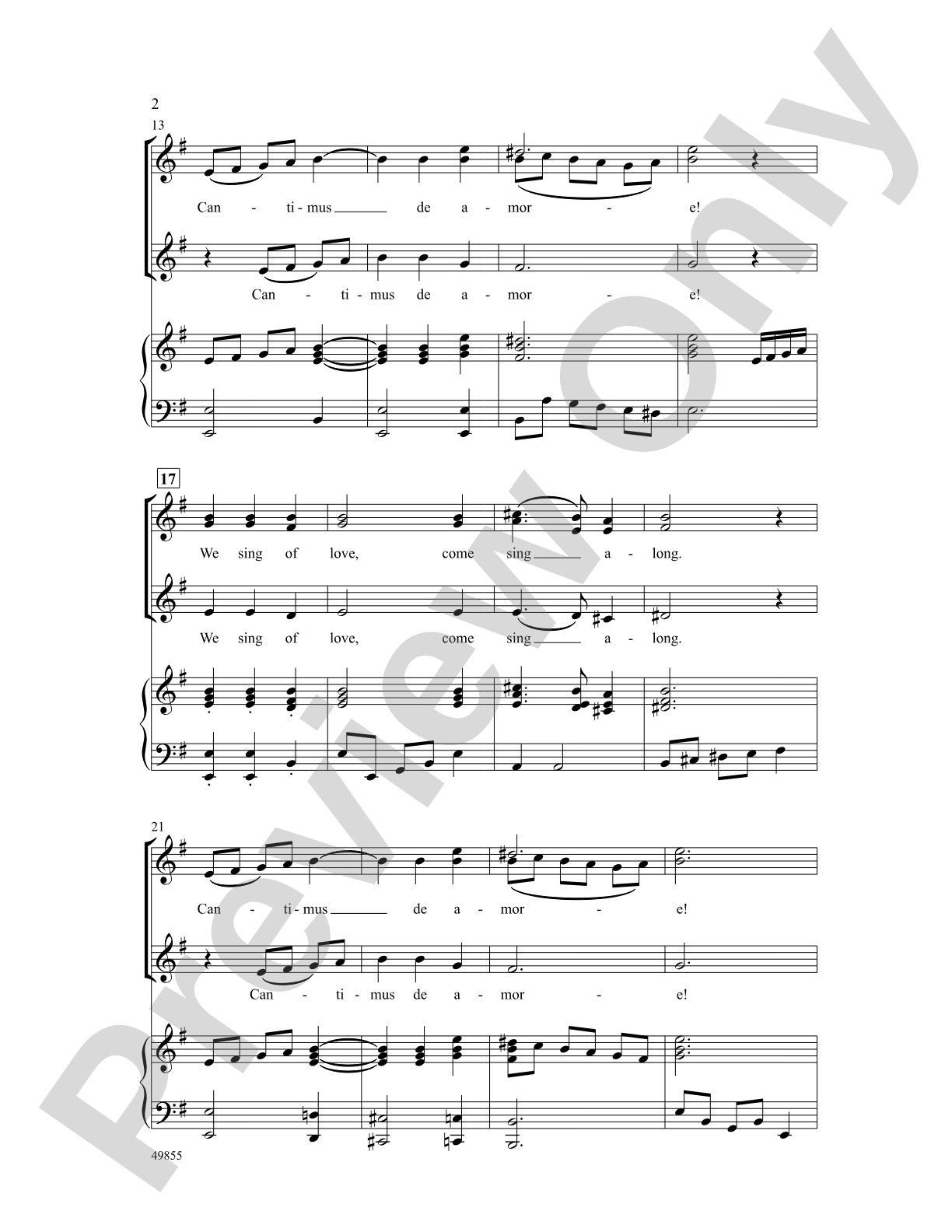
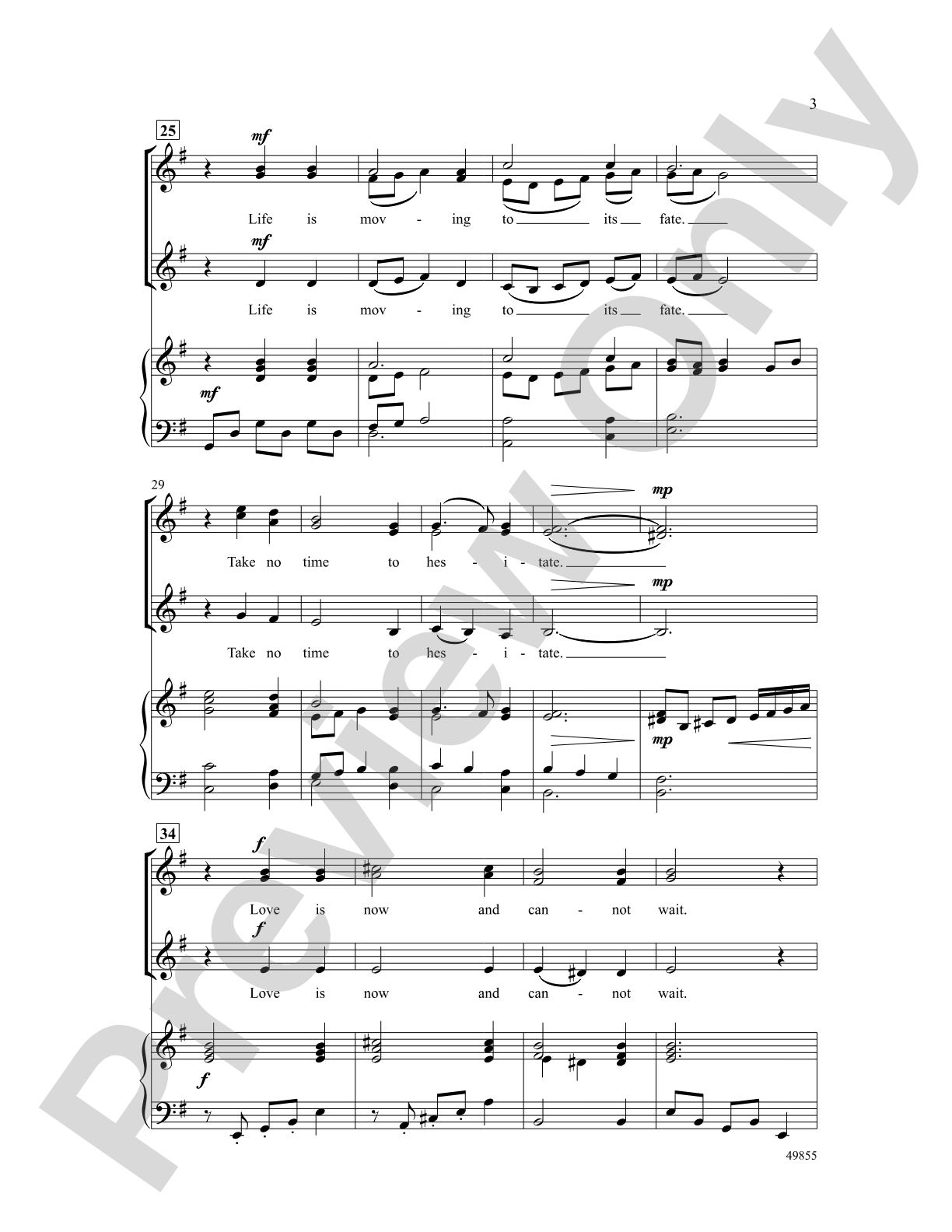

Cantimus de Amore: SSA Choral Octavo
(We Sing of Love)
Words by John Parker, music by Mark Hayes
Item: 00-PO-0006985

$2.40
Minimum order quantity: 20 copies
Pickup currently not available
Related Items
Cantimus de Amore: SATB Choral Octavo |
$2.40
|
View | |
Cantimus de Amore: SAB Choral Octavo |
$2.40
|
View | |
Cantimus de Amore: PianoTrax Digital Audio Download |
$9.99
|
View | |
Cantimus de Amore: PartTrax Digital Audio Download |
$49.99
|
View | |
Cantimus de Amore: PartTrax Digital Audio Download |
$49.99
|
View | |
Cantimus de Amore: PartTrax Digital Audio Download |
$49.99
|
View | |
Cantimus de Amore: SATB Choral Octavo |
$2.40
|
View | |
Cantimus de Amore: SAB Choral Octavo |
$2.40
|
View | |
Cantimus de Amore: SSA Choral Octavo |
$2.40
|
View |
Description
The Baroque-era sound of this minor key concert work is truly captivating. Three phrases in Latin alternate with a largely English text about living life fully. Program as an opener/closer or madrigal choir feature.
As part of the PerformancePlus+ series, this title is in the MakeMusic Cloud interactive library. Subscribers can access additional resources, including assessment and recording tools, part-predominant and accompaniment tracks, PDF rehearsal guides, and more.


As part of the PerformancePlus+ series, this title is in the MakeMusic Cloud interactive library. Subscribers can access additional resources, including assessment and recording tools, part-predominant and accompaniment tracks, PDF rehearsal guides, and more.
Don't just read it, hear it, play along with it, and watch your students grow with it. In MakeMusic Cloud, Cantimus de Amore: SSA Choral Octavo comes alive with professional accompaniment, adjustable tempo, and built-in practice tools that turn solo practice into real progress.
Open in the Player
Jump straight in and assign it today.
Start Your Free Trial
Open this title and explore the full library in minutes.
Sample Audio
1
Audio File
--:--
0:00
0:00
Sample Video
Additional Details
Series:
Alfred Choral Designs
Publisher:
Alfred Music
Page Count:
16
SKU:
00-PO-0006985
More about this title
About the Composer: Mark Hayes
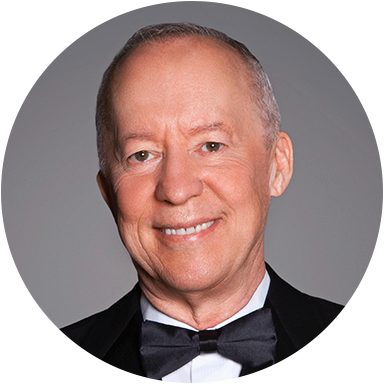
Mark Hayes brings three decades of prolific output to the choral and instrumental music world, with a published catalog exceeding 1,750 works spanning sacred and secular genres. A summa cum laude graduate in Piano Performance from Baylor University, Hayes has established himself as a composer, arranger, conductor, and pianist of international standing. His sacred works, including the Te Deum, Magnificat, and Gloria, have been featured at Lincoln Center, the National Cathedral, and Carnegie Hall. He conducted the world premiere of his Requiem at Lincoln Center in 2013 and again in Rome at St. Ignatius Basilica in 2014 as part of the Vatican-sponsored Festival Pro Musica E Arte Sacra.
Beyond sacred music, Hayes demonstrates equal mastery in secular choral literature, orchestration, and musical theater. He orchestrated the musical Madame Buttermilk and arranged music for theatrical productions performed at historic venues across North America. His passion for piano composition has yielded over 100 published piano works across gospel, classical, jazz, and Broadway idioms. In 2010, Baylor University honored Hayes with the Award for Exemplary Leadership in Christian Music, recognizing his sustained contributions to the field.
Why we love this
Hayes crafts a genuine baroque aesthetic here, complete with minor key gravitas and three-phrase Latin passages that give the work concert-hall weight. The juxtaposition of Latin and English text creates a sophisticated dual-language arc that appeals to both purist tastes and contemporary programming needs. It works equally well as an opener that commands attention or as a reflective closer that lingers in memory.
What to expect
The work unfolds with Baroque restraint and introspection, its minor key creating an intimate yet formally structured soundscape. The alternating Latin and English phrases feel like meditations on the same philosophical theme, with each language bringing its own gravitas and poetry to the question of living fully.
Who it's for
Intermediate to advanced SSA choirs seeking repertoire that combines concert sophistication with accessible three-part writing. This piece suits mixed-ability groups where some singers have solid sight-reading skills and the ensemble is ready to tackle minor key tonality and bilingual text with musical intention.
How to get the most out of it
- Approach the minor key tonality with focus on phrase shape rather than textural density; the Baroque character depends on clean, transparent voicing across all three voice parts.
- Use the recorded accompaniment during early rehearsals to establish the harmonic framework, then gradually reduce reliance on it as singers internalize the harmonic language.
- Give special attention to the Latin phrases as textural anchors; these moments should feel like a shift in perspective, not merely a change in language.
- Balance the English text sections with clarity of diction while preserving the meditative quality of the overall work.
How to use it
Schedule this as a concert opener to establish a reflective, substantive tone for an entire program, or place it as a closing work where its Baroque character and bilingual text create a memorable final impression. It also functions beautifully in a madrigal or chamber choir context, where its harmonic sophistication can shine without the demands of a full choral ensemble.
Skills your students will build
- Singing in minor key tonalities with confidence and accurate intonation
- Latin pronunciation and diction in a choral context
- Code-switching between two languages while maintaining musical continuity and phrase shape
- Understanding Baroque compositional techniques through performance (parallel motion, harmonic structure, textural clarity)
- Interpretation of secular concert repertoire with appropriate weight and sophistication