

Cantimus de Amore: SAB Choral Octavo
(We Sing of Love)
Words by John Parker, music by Mark Hayes
Item: 00-PO-0006984
$2.40
Minimum order quantity: 20 copies
Pickup currently not available
Related Items
Cantimus de Amore: SATB Choral Octavo |
$2.40
|
View | |
Cantimus de Amore: SSA Choral Octavo |
$2.40
|
View | |
Cantimus de Amore: PianoTrax Digital Audio Download |
$9.99
|
View | |
Cantimus de Amore: PartTrax Digital Audio Download |
$49.99
|
View | |
Cantimus de Amore: PartTrax Digital Audio Download |
$49.99
|
View | |
Cantimus de Amore: PartTrax Digital Audio Download |
$49.99
|
View | |
Cantimus de Amore: SATB Choral Octavo |
$2.40
|
View | |
Cantimus de Amore: SAB Choral Octavo |
$2.40
|
View | |
Cantimus de Amore: SSA Choral Octavo |
$2.40
|
View |
Description
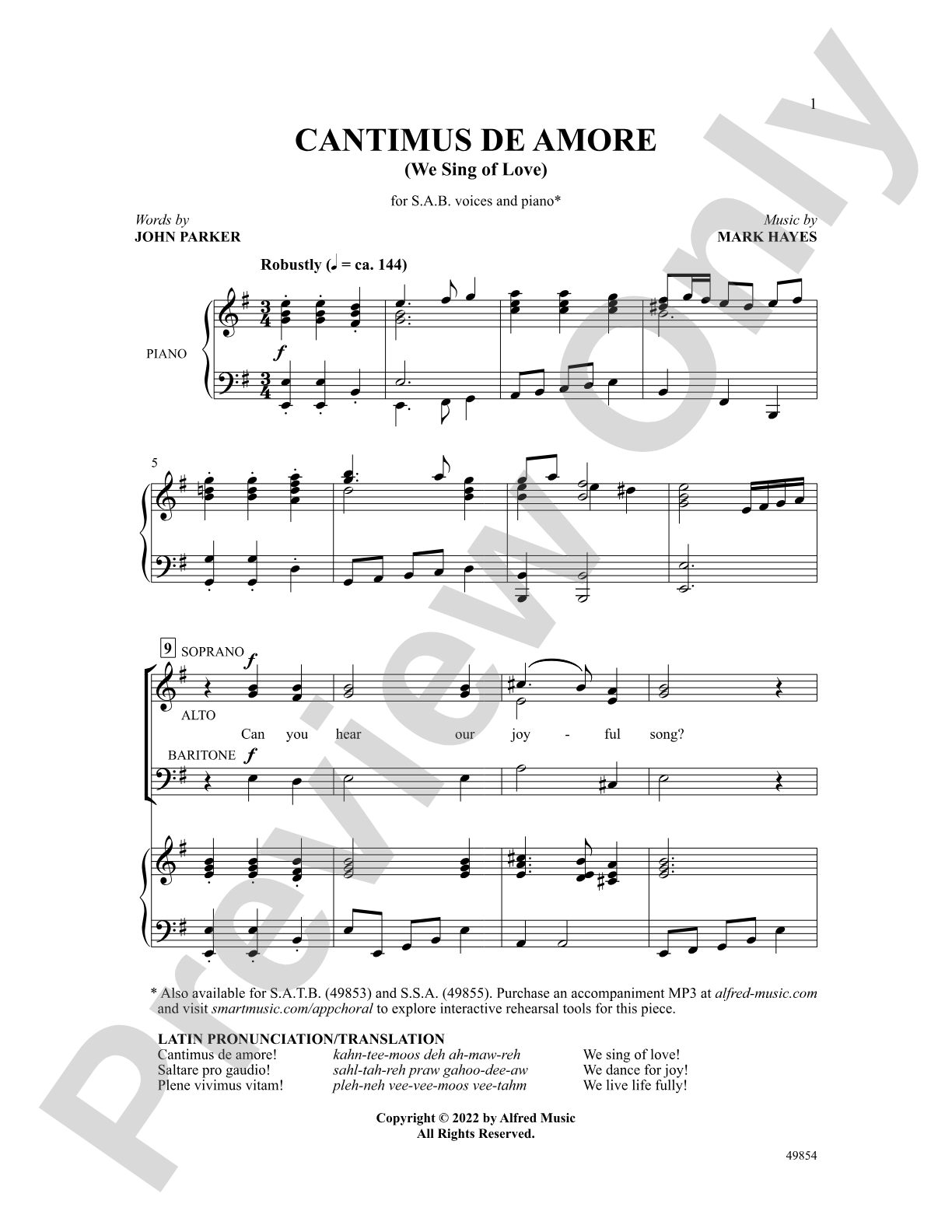
The Baroque-era sound of this minor key concert work is truly captivating. Three phrases in Latin alternate with a largely English text about living life fully. Program as an opener/closer or madrigal choir feature.
As part of the PerformancePlus+ series, this title is in the MakeMusic Cloud interactive library. Subscribers can access additional resources, including assessment and recording tools, part-predominant and accompaniment tracks, PDF rehearsal guides, and more.


As part of the PerformancePlus+ series, this title is in the MakeMusic Cloud interactive library. Subscribers can access additional resources, including assessment and recording tools, part-predominant and accompaniment tracks, PDF rehearsal guides, and more.
Cantimus de Amore: SAB Choral Octavo isn't in MakeMusic Cloud just yet...but it could be. Let us know you'd like to see it, and you'll help shape what comes next. In the meantime, start a free trial and dive into thousands of interactive titles your students can play along with today.
Request This Title
Tell us you want it.
Start Your Free Trial
Explore everything that's ready to play right now.
Sample Audio
1
Audio File
--:--
0:00
0:00
Sample Video
Additional Details
Series:
Alfred Choral Designs
Publisher:
Alfred Music
Page Count:
16
SKU:
00-PO-0006984
More about this title
About the Composer: Mark Hayes
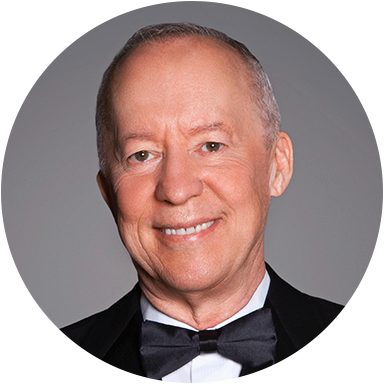
Mark Hayes stands among the most prolific composers working in choral and keyboard music today, with over 1,750 published works spanning sacred, secular, orchestral, and theatrical genres. Educated at Baylor University (summa cum laude, Piano Performance, 1975), Hayes has conducted at Lincoln Center, the National Cathedral, and Carnegie Hall, and in 2010 received the Award for Exemplary Leadership in Christian Music from his alma mater. He premiered his Requiem at Lincoln Center in 2013 and again in Rome at St. Ignatius Basilica in 2014 as part of the Vatican-sponsored Festival Pro Musica E Arte Sacra.
Beyond the concert hall, Hayes has composed for musical theater, orchestrated works for commercial production, and earned recognition in competitive festivals. His catalog includes over 100 piano publications ranging from gospel to classical to jazz, alongside extensive contributions to choral literature. Based in Kansas City, Missouri, Hayes continues to compose and arrange across all musical styles, bringing the same craftsmanship to a Broadway arrangement as to a liturgical work.
Why we love this
Hayes crafts a genuinely sophisticated text setting here, weaving Latin phrases into an English reflection on living fully without ever feeling forced or precious. The Baroque harmonic language and minor tonality give the piece real gravitas, yet it remains accessible to mixed choirs at this level. It's the kind of opener or encore that reminds audiences why they came to hear singers instead of a playlist.
What to expect
Contemplative and assured, with the careful architecture of Baroque vocal writing applied to contemporary text. The minor tonality lends introspection, yet the piece never feels heavy; instead, it invites singers and listeners into genuine reflection on what matters in life.
Who it's for
Auditioned choral ensembles and madrigal singers looking for a concert work with real musical substance and a manageable range. The SAB voicing makes it accessible to mixed choirs with limited lower male voices without sacrificing Hayes's sophisticated harmonic language.
How to get the most out of it
- Balance the alternation between Latin and English text carefully; the shift between languages should feel intentional and musical, not like a sudden tonal break.
- Make full use of the part-predominant tracks from PerformancePlus+ during sectional rehearsals to lock each voice part before blending voices.
- The minor key rewards attention to vowel color; keep the tone warm and unified across all three parts to let the harmonic movement speak.
- Consider the recorded accompaniment as a conductor's tool first, using it to establish tempo and harmonic clarity before moving to a live pianist.
How to use it
Program this as a concert opener to establish an attentive mood, or use it as a closing number to send audiences home thoughtfully. It also serves beautifully as a feature for your madrigal ensemble or smaller chamber choir within a larger concert, bridging serious repertoire with accessible performance requirements.
Skills your students will build
- Singing in Latin with accurate pronunciation and clear vowels
- Balancing text projection between two languages within a single work
- Part independence in three-part mixed voicing
- Interpreting Baroque harmonic progressions with musical shape and sustain
- Ensemble blend while maintaining part clarity in minor-key harmony