
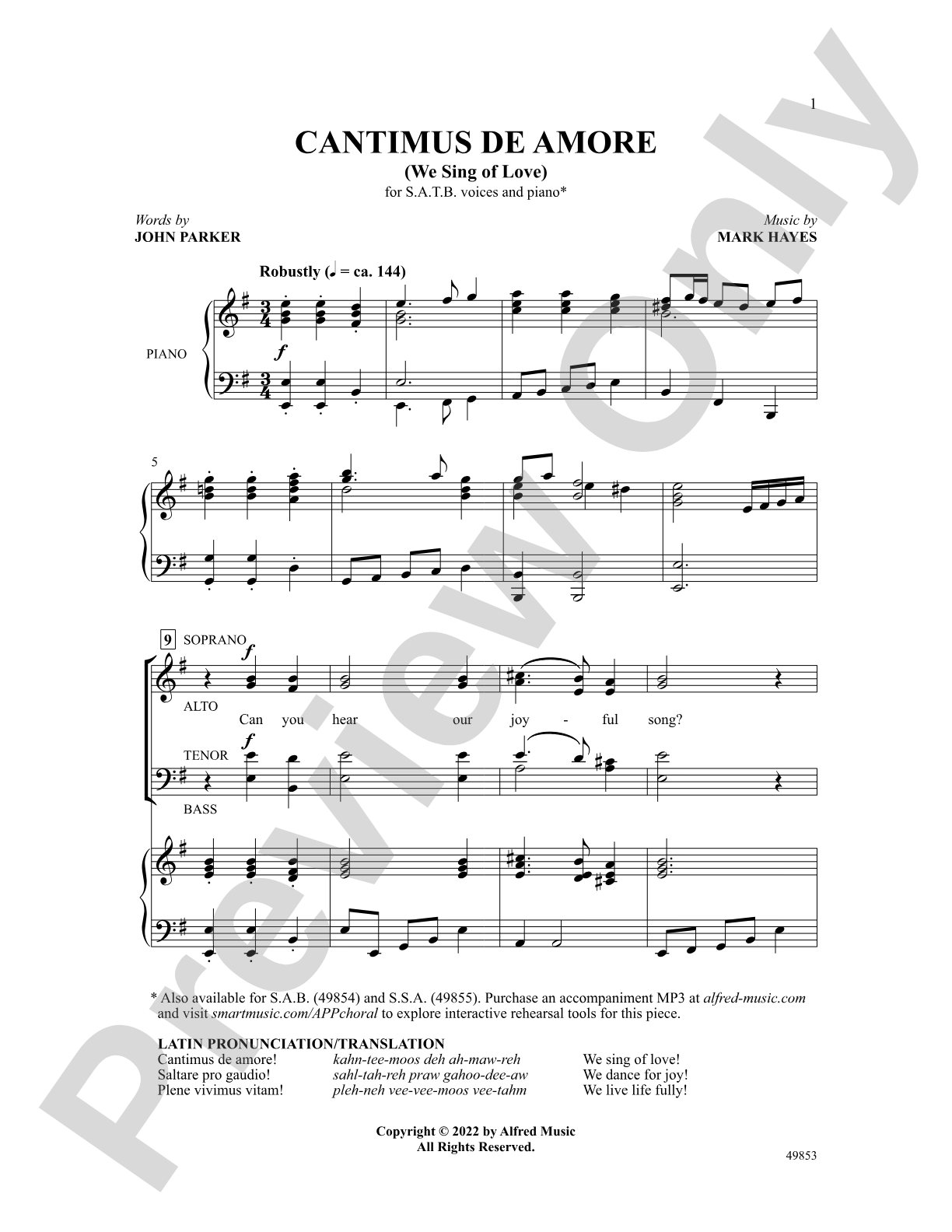
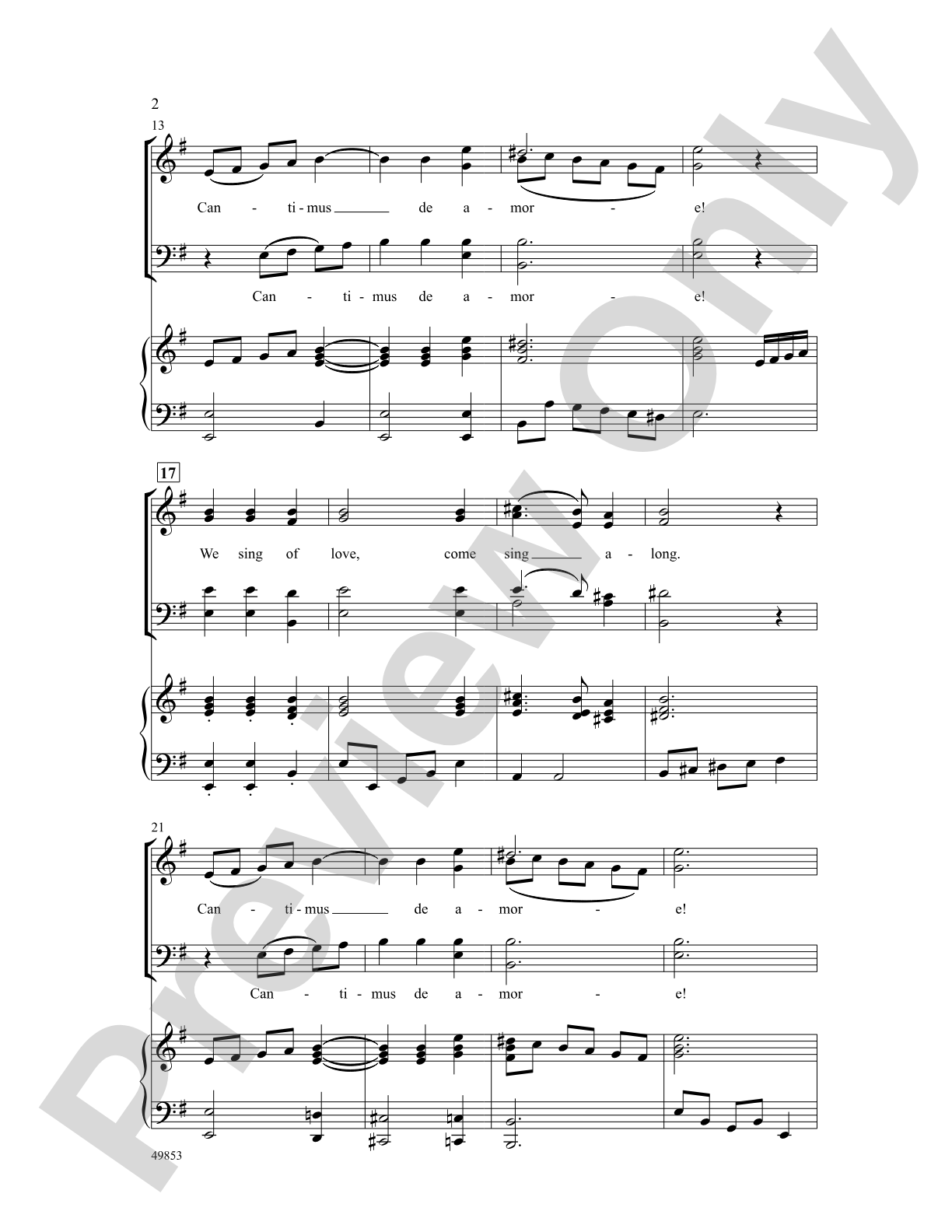
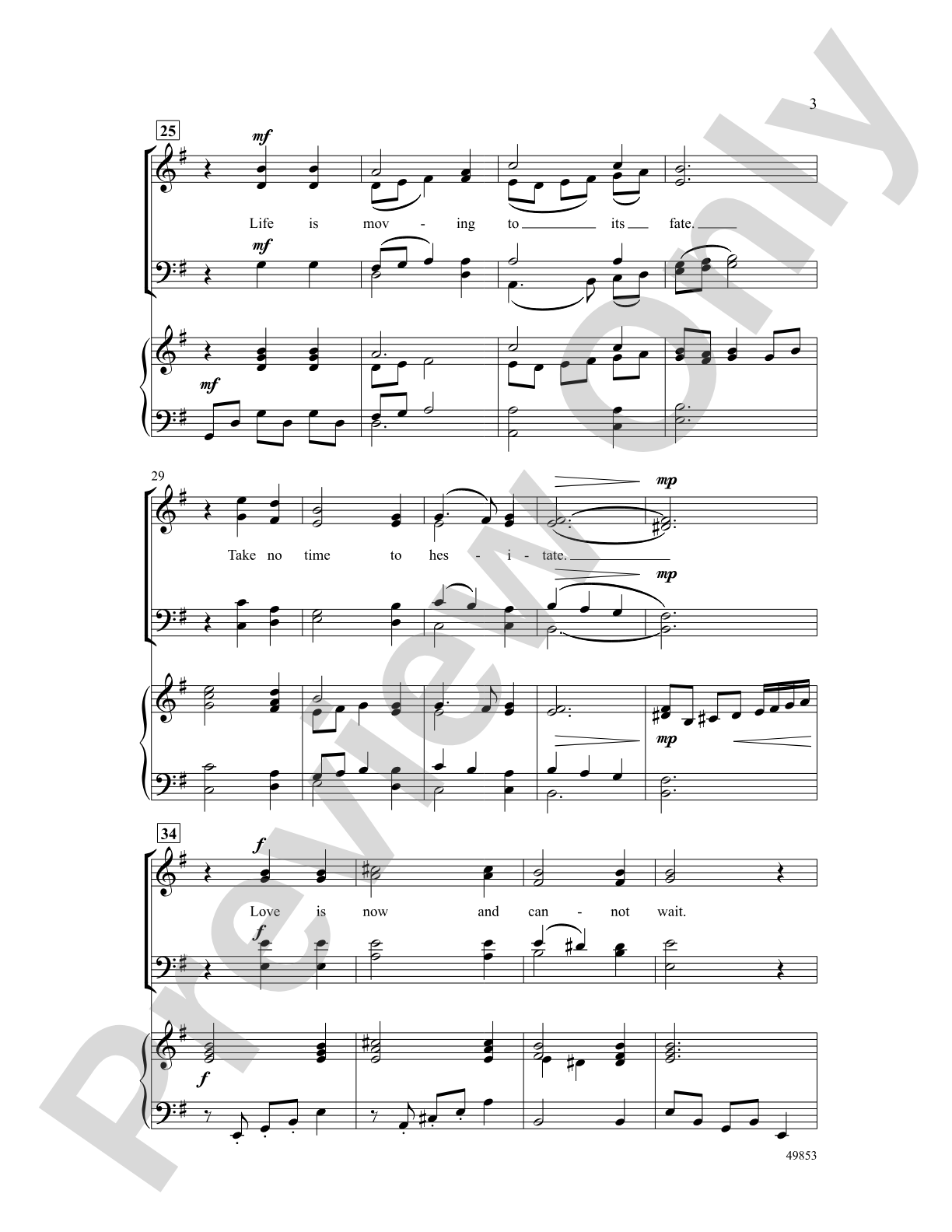

Cantimus de Amore: SATB Choral Octavo
(We Sing of Love)
Words by John Parker, music by Mark Hayes
Item: 00-PO-0006983
$2.40
Minimum order quantity: 20 copies
Pickup currently not available
Related Items
Cantimus de Amore: SAB Choral Octavo |
$2.40
|
View | |
Cantimus de Amore: SSA Choral Octavo |
$2.40
|
View | |
Cantimus de Amore: PianoTrax Digital Audio Download |
$9.99
|
View | |
Cantimus de Amore: PartTrax Digital Audio Download |
$49.99
|
View | |
Cantimus de Amore: PartTrax Digital Audio Download |
$49.99
|
View | |
Cantimus de Amore: PartTrax Digital Audio Download |
$49.99
|
View | |
Cantimus de Amore: SATB Choral Octavo |
$2.40
|
View | |
Cantimus de Amore: SAB Choral Octavo |
$2.40
|
View | |
Cantimus de Amore: SSA Choral Octavo |
$2.40
|
View |
Description
The Baroque-era sound of this minor key concert work is truly captivating. Three phrases in Latin alternate with a largely English text about living life fully. Program as an opener/closer or madrigal choir feature.
As part of the PerformancePlus+ series, this title is in the MakeMusic Cloud interactive library. Subscribers can access additional resources, including assessment and recording tools, part-predominant and accompaniment tracks, PDF rehearsal guides, and more.


As part of the PerformancePlus+ series, this title is in the MakeMusic Cloud interactive library. Subscribers can access additional resources, including assessment and recording tools, part-predominant and accompaniment tracks, PDF rehearsal guides, and more.
Cantimus de Amore: SATB Choral Octavo isn't in MakeMusic Cloud just yet...but it could be. Let us know you'd like to see it, and you'll help shape what comes next. In the meantime, start a free trial and dive into thousands of interactive titles your students can play along with today.
Request This Title
Tell us you want it.
Start Your Free Trial
Explore everything that's ready to play right now.
Sample Audio
1
Audio File
--:--
0:00
0:00
Sample Video
Additional Details
Series:
Alfred Choral Designs
Publisher:
Alfred Music
Page Count:
16
SKU:
00-PO-0006983
More about this title
About the Composer: Mark Hayes

Mark Hayes has established himself as a prolific composer and arranger with more than 1,750 published works spanning sacred music, secular choral literature, orchestration, and piano composition. A summa cum laude graduate of Baylor University in Piano Performance, Hayes has conducted at major venues including Lincoln Center, the National Cathedral, and Carnegie Hall, where he has premiered large-scale works such as his Requiem and commissioned pieces for international institutions. In 2010, Baylor University's Center for Christian Music Studies recognized him with the Award for Exemplary Leadership in Christian Music.
Beyond the concert hall, Hayes has contributed substantially to musical theater, orchestrating the hit musical Madame Buttermilk and arranging music for theatrical productions premiered at historic venues across the United States. His compositional voice spans from classical and jazz to gospel and Broadway idioms, with over 100 piano books in print. Hayes currently resides in Kansas City, Missouri, where he continues to compose and perform internationally.
Why we love this
Hayes crafts a sophisticated blend of Baroque harmonic language with contemporary text setting, creating a piece that sounds both timeless and accessible to modern choirs. The alternating Latin and English text gives programming flexibility and adds textural intrigue, while the minor-key setting provides the kind of expressive depth that audiences remember. This is the work of a composer who understands what makes choral music both singable and compelling.
What to expect
The minor key and Baroque idiom create an introspective, elegant mood that draws the listener inward. When the English text emerges against this harmonic backdrop, the effect is both intimate and grand, as if the singers are inviting the audience into a philosophical conversation about living fully.
Who it's for
This octavo works well for concert choirs, madrigal ensembles, and advanced high school or collegiate singers comfortable with minor-key harmonies and text in two languages. The 16-page score and PerformancePlus+ resources make it accessible for directors seeking a concert-quality piece with robust rehearsal support.
How to get the most out of it
- Balance the treble and lower voices carefully through the Latin phrases; the Baroque texture requires clarity rather than blend, so each voice line should register distinctly.
- Use the part-predominant tracks during sectional rehearsals to lock individual lines before bringing voices together.
- Shape the English text sections with natural speech rhythms to prevent them from sounding overwrought; let the meaning of the words guide your phrasing.
- The recorded accompaniment can anchor your tempo choices during early rehearsals, but consider finding your own interpretive tempo once the piece is secure.
How to use it
Program this as a concert opener to set a sophisticated tone for the evening, or reserve it as a closing number to leave the audience in a reflective state. Its distinctive character makes it an excellent feature for a madrigal choir concert or a centerpiece in a program exploring the intersection of sacred musical language and secular themes.
Skills your students will build
- Reading and sustaining minor-key harmonic progressions with Baroque voice-leading
- Code-switching between Latin and English text with appropriate stylistic inflection
- Balancing independent melodic lines in homophonic texture
- Interpreting performance cues and text expression in PerformancePlus+ interactive tools