
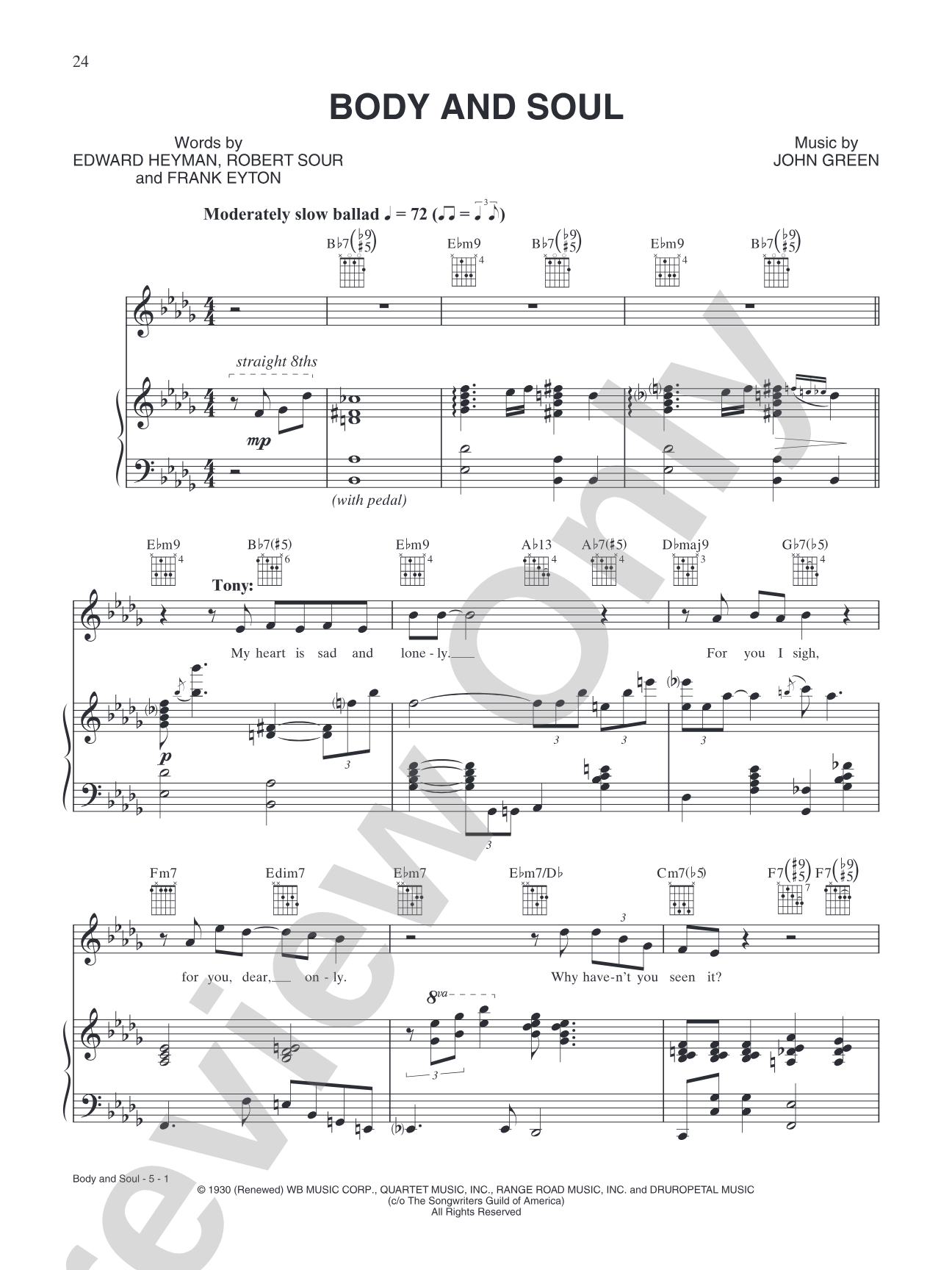

Body And Soul: Piano/Vocal/Chords
Tony Bennett
Item: 00-XS-0000488
$4.99
One moment…
Description
This songbook contains sheet music arrangements of every song on Tony Bennett's 2011 album of vocal collaborations with pop music stars like Lady Gaga, Michael Buble, and 15 others. The piano/vocal arrangements match the album's renditions of 17 Great American Songbook standards as interpreted by Bennett and his fellow celebrities, including the famous "Body and Soul" duet recorded with Amy Winehouse just months prior to her passing. Titles: * The Lady Is a Tramp * One for My Baby (And One More for the Road) * Body and Soul * Don't Get Around Much Anymore * Blue Velvet * How Do You Keep the Music Playing? * The Girl I Love * On the Sunny Side of the Street * Who Can I Turn To (When Nobody Needs Me) * Speak Low * This Is All I Ask * Watch What Happens * Stranger in Paradise * The Way You Look Tonight * Yesterday I Heard the Rain * It Had to Be You * When Do The Bells Ring for Me.


Body And Soul: Piano/Vocal/Chords isn't in MakeMusic Cloud just yet...but it could be. Let us know you'd like to see it, and you'll help shape what comes next. In the meantime, start a free trial and dive into thousands of interactive titles your students can play along with today.
Request This Title
Tell us you want it.
Start Your Free Trial
Explore everything that's ready to play right now.
Sample Audio
No sample audio found.
Sample Video
No sample videos found.
Additional Details
Publisher:
Alfred Music
Page Count:
116
SKU:
00-XS-0000488
More about this title
About the Composer: John Green
John Green stands as one of the most prolific and respected composers of the American Songbook, with a catalog spanning decades of film scores, standards, and popular songs. His ability to craft memorable melodies and sophisticated harmonic structures made him a cornerstone of the Great American Songbook era, influencing generations of composers and singers.
Why we love this
This collection captures the Songbook at its most intimate and star-studded, with each arrangement preserving the specific interpretations Tony Bennett created for his 2011 collaborations. The pairing of world-class vocalists with Bennett's timeless phrasing gives singers genuine insight into how to inhabit these standards, and the piano/vocal scores remain true to the recorded versions without requiring a band or orchestra.
What to expect
Sophisticated and conversational. These are not uptempo novelties or stripped-down folk arrangements; they are mature interpretations that honor the emotional weight of songs written decades ago while welcoming fresh voices. The album's collaborative spirit brings intimacy and gentle refinement to each standard.
Who it's for
Singers preparing for jazz or cabaret recitals, music theater performers building their Songbook foundation, and pianists seeking authentic arrangements of standards that work equally well in lesson studios or small venue performances. This collection serves artists at the intermediate-advanced level who want reference points from world-class singers.
How to get the most out of it
- Study the recorded versions first. Bennett's phrasing and the guest artists' interpretations are part of the arrangement's DNA; hearing how each vocalist approaches their lines will inform your own choices about rubato and breath placement.
- Balance the vocal melody against the piano's harmonic language. These arrangements use sophisticated chord substitutions and jazz voicings that deserve attention; the piano is not merely accompanying but actively shaping the song's color.
- Respect the space between phrases. The Songbook thrives on restraint and emotional clarity. Resist the urge to fill every silence with ornament or vibrato.
- Pay attention to dynamics marked in the score. Bennett's interpretations often hinge on subtle dynamic shifts that build emotional arc without sacrificing elegance.
How to use it
Feature a single duet arrangement or group of three related songs in a jazz or cabaret concert, allowing singers to draw from Bennett's collaborative model. Alternatively, assign individual selections as repertoire for studio study, since each song functions as a complete, radio-ready performance that doesn't require orchestration or backing band.
Skills your students will build
- Phrasing and interpretation of standards through professional recorded models
- Jazz piano voicing recognition and comping within a melody-driven context
- Vocal coordination with sophisticated harmonic accompaniment
- Understanding of how arrangements can honor a song's original composition while reflecting a performer's personal style