
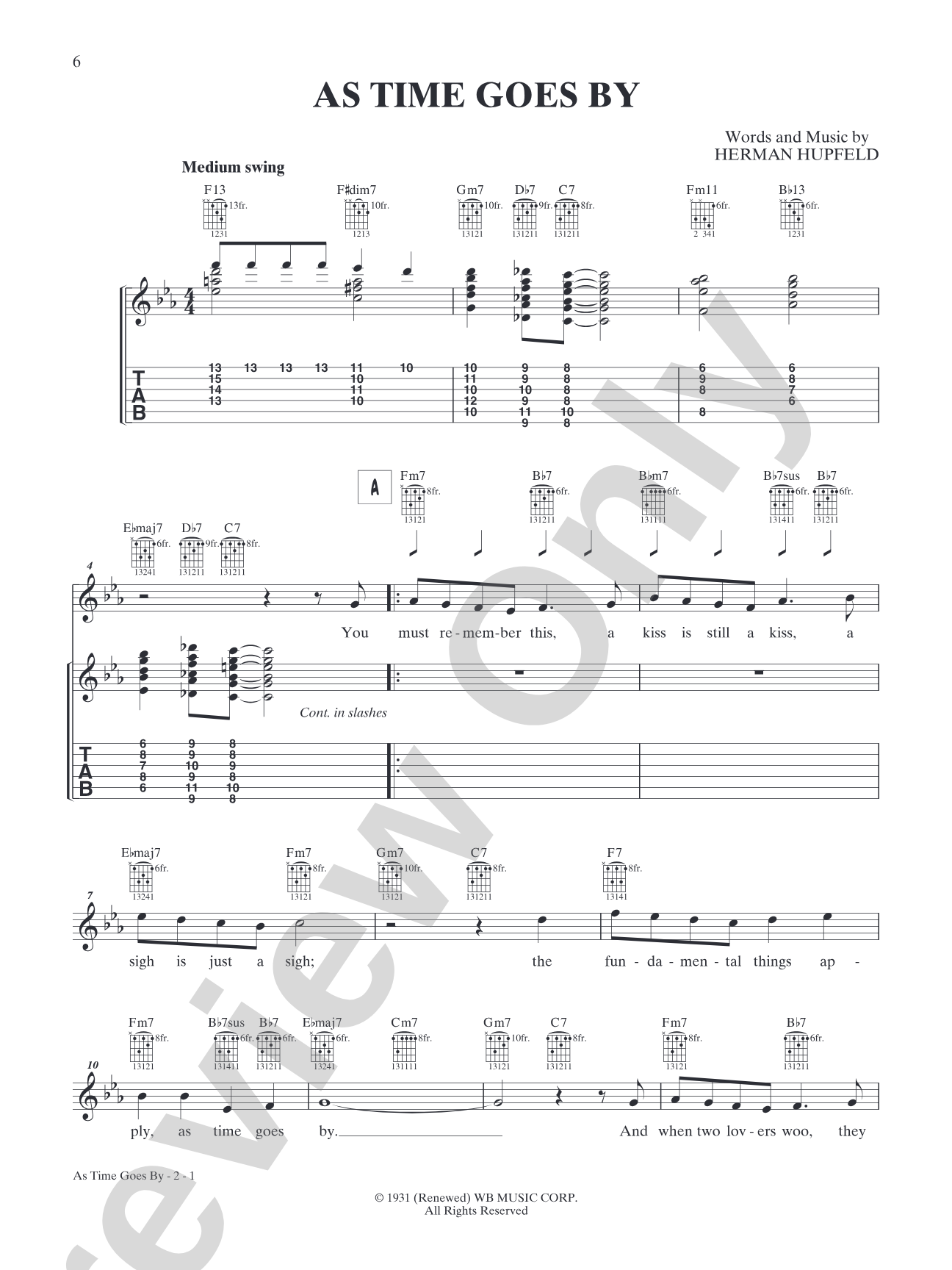

As Time Goes By: Interm./Easy Guitar TAB
12 Great Songs of the '20s & '30s
Item: 00-PS-0011839
$4.99
One moment…
Related Items
Makin' Whoopee: Interm./Easy Guitar TAB |
$4.99
|
View | |
Five Foot Two, Eyes of Blue: Interm./Easy Guitar TAB |
$4.99
|
View | |
Ain't Misbehavin': Interm./Easy Guitar TAB |
$4.99
|
View | |
It Don't Mean a Thing: Interm./Easy Guitar TAB |
$4.99
|
View | |
Tonight You Belong to Me: Interm./Easy Guitar TAB |
$4.99
|
View | |
It Had to Be You: Interm./Easy Guitar TAB |
$4.99
|
View | |
Sweet Georgia Brown: Interm./Easy Guitar TAB |
$4.99
|
View | |
Ain't She Sweet: Interm./Easy Guitar TAB |
$4.99
|
View | |
I'll See You in My Dreams: Interm./Easy Guitar TAB |
$4.99
|
View | |
Dream a Little Dream of Me: Interm./Easy Guitar TAB |
$4.99
|
View |
Description
Swingin' Jazz Guitar is designed for your total enjoyment. Each song is arranged in a fun and lively way with a strum-and-sing approach. The chords are simple, yet entirely appropriate to the jazz-age style of the '20s and '30s. We've also included classic intros, endings, and turnarounds that will make you sound like an authentic early jazzer. Titles: Ain't Misbehavin' * Ain't She Sweet * As Time Goes By * Bye Bye Blackbird * Dream a Little Dream of Me * Five Foot Two, Eyes of Blue * I'll See You in My Dreams * It Don't Mean a Thing (If It Ain't Got That Swing) * It Had to Be You * Makin' Whoopee * Sweet Georgia Brown * Tonight You Belong to Me.


As Time Goes By: Interm./Easy Guitar TAB isn't in MakeMusic Cloud just yet...but it could be. Let us know you'd like to see it, and you'll help shape what comes next. In the meantime, start a free trial and dive into thousands of interactive titles your students can play along with today.
Request This Title
Tell us you want it.
Start Your Free Trial
Explore everything that's ready to play right now.
Sample Audio
No sample audio found.
Sample Video
No sample videos found.
Additional Details
Series:
Just for Fun
Publisher:
Alfred Music
Page Count:
44
SKU:
00-PS-0011839
More about this title
About the Composer: Herman Hupfeld
Herman Hupfeld (1894-1951) was an American composer and lyricist who became one of the defining voices of the Jazz Age. His ability to craft memorable melodies with witty, sophisticated lyrics made him a fixture of Broadway and popular music in the 1920s and 1930s. "As Time Goes By," perhaps his most enduring composition, exemplifies his gift for writing songs that feel both timeless and deeply rooted in the swing era.
Hupfeld's work bridged the worlds of Broadway theater and jazz standards, giving him unique insight into how songs could work across both contexts. For guitar educators, his catalog offers a window into the harmonic language and melodic sensibility that defined early jazz composition, making his pieces ideal teaching material for students exploring jazz vocabulary and swing phrasing.
Why we love this
This collection gives guitarists a genuine taste of jazz-age playing without overwhelming them with complex changes or demanding technical requirements. The arrangements nail the authentic feel of 1920s-30s jazz while keeping the chords accessible, so students can focus on swing rhythm and phrasing rather than fighting the fingerboard. You'll find working intros, endings, and turnarounds included, which means players leave here with real tools for sounding like they belong in that era.
What to expect
Stepping into a smoky 1920s jazz club where the guitar lines are warm and unpretentious, the rhythm bounces with easy swing, and the melodies land with instant familiarity. There's a lightness to these songs, a conversational quality that invites you to lean in and make them your own rather than deliver them formally.
Who it's for
Guitarists with intermediate to easy-level reading who want to explore jazz standards without getting tangled in advanced harmonic theory. This collection works equally well for adults returning to guitar, students developing jazz vocabulary, and anyone drawn to the style and sound of early twentieth-century popular music.
How to get the most out of it
- Work the swing rhythm separately from the melody. These songs live or die on feel, so spend time with a metronome locking into that shuffle before adding melody or lyrics.
- Shape your chord voicings to sit under the melody naturally. Jazz-era guitar thrives on tasteful reductions, not full block voicing on every beat.
- Let the classic intros and turnarounds breathe. Treat them as genuine musical moments, not filler between verses.
- If singing along, keep your vocal phrasing loose and conversational. The charm of these tunes depends on sounding unhurried and conversational, not metronomic.
How to use it
Build a themed evening around early jazz standards, pairing these guitar arrangements with vocals or other acoustic instruments for an intimate concert setting. You might also use individual pieces as intermission solos or encore material, since each tune stands alone and connects instantly with audiences. For a jazz history unit, this collection provides direct entry into the compositional voice of the era itself.
Skills your students will build
- Swing rhythm and groove feel in the context of early jazz standards
- Reading lead sheet notation with chord symbols and TAB simultaneously
- Comping patterns and voicing choices appropriate to 1920s-30s jazz style
- Phrasing and interpretation of melody over jazz changes
- Playing authentic intros, turnarounds, and endings in period style