
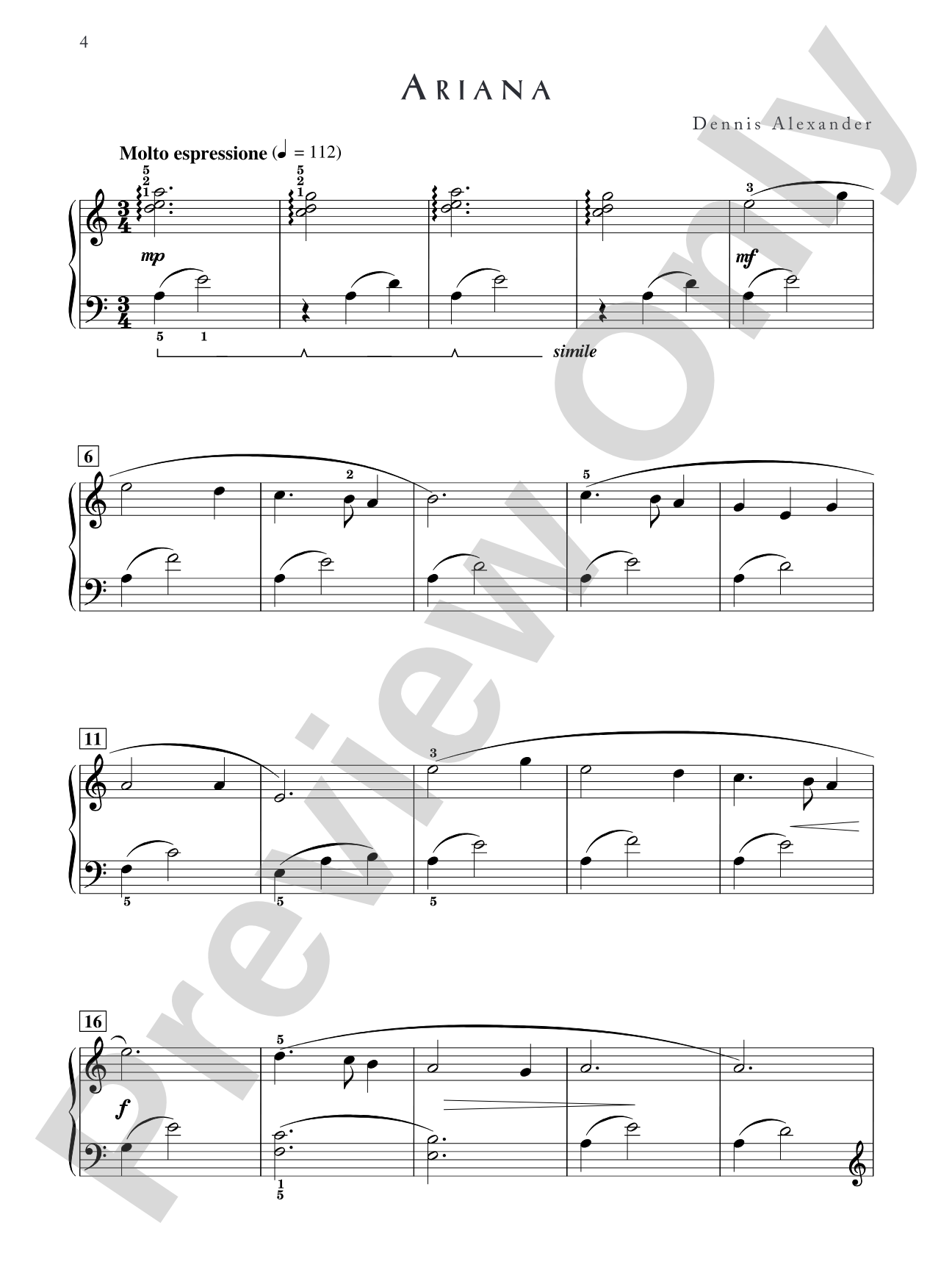

Arianna - Piano Solo: Piano Solo
7 Romantic Late Elementary Piano Solos
By Dennis Alexander
Level: Late Elementary
Item: 00-PS-0017473
$4.99
Pickup currently not available
Related Items
Arioso in C - Piano Solo: Piano Solo |
$4.99
|
View | |
Cello Song - Piano Solo: Piano Solo |
$4.99
|
View | |
Falling Leaves - Piano Solo: Piano Solo |
$4.99
|
View | |
Moonshadows - Piano Solo: Piano Solo |
$4.99
|
View | |
Snowscape - Piano Solo: Piano Solo |
$4.99
|
View | |
Soul Mates - Piano Solo: Piano Solo |
$5.99
|
View | |
Mr. "A" Presents First Lyric Pieces, Book 1: Piano Book |
$5.99
|
View |
Description
This collection is for teacher wanting to prepare students for the Romantic style early in the development of the student. Since no intervals larger than a 6th are used, these are good for small hands. Offers a lot of variety. Late elementary. A Federation Festivals 2024-2028 selection.


Arianna - Piano Solo: Piano Solo isn't in MakeMusic Cloud just yet...but it could be. Let us know you'd like to see it, and you'll help shape what comes next. In the meantime, start a free trial and dive into thousands of interactive titles your students can play along with today.
Request This Title
Tell us you want it.
Start Your Free Trial
Explore everything that's ready to play right now.
Sample Audio
No sample audio found.
Sample Video
No sample videos found.
Additional Details
Publisher:
Alfred Music
Page Count:
16
SKU:
00-PS-0017473
More about this title
About the Composer: Dennis Alexander

Dennis Alexander has shaped music education for decades through his work with Alfred Music Publishing, where his association began in 1986. His catalog of over 400 published works has established him as a leading voice in pedagogical composition, recognized internationally for creating piano music that meets students at every developmental stage. He held the position of piano pedagogy instructor at the University of Montana for 24 years and later taught at Cal State Fullerton and Cal State Northridge. Beyond the classroom, Alexander has maintained an active performance career as soloist and collaborative artist, making his Carnegie Recital Hall debut in 1987 and touring internationally across Asia and beyond.
Alexander's influence extends across the profession. He has served as a clinician and adjudicator at state and national conventions, conducted master classes at the MTNA national convention, and been commissioned by numerous music organizations to create new works. His deep understanding of how students learn, combined with his experience as both performer and teacher, informs every piece he writes. Today based in Albuquerque, New Mexico, he continues an active composing schedule while maintaining his reputation as one of the most trusted names in educational piano literature.
Why we love this
Alexander writes with a clear pedagogical eye; every phrase in this collection is purposeful. The variety packed into 16 pages keeps students engaged while the hand-friendly writing means you're building technique without frustration, making this an ideal entry point to Romantic style before students encounter the technical demands of Chopin or Schumann.
What to expect
The collection opens a door into 19th-century musical thinking without requiring large reaches or technical virtuosity. You encounter lyricism, harmonic color, and expressive subtlety that define the Romantic period, yet the writing never overreaches for young hands. Each piece feels fresh and distinctive, a quality that keeps students wanting to return to practice.
Who it's for
Teachers introducing students to Romantic-era language through accessible, hand-comfortable writing. Late elementary pianists ready to move beyond early training repertoire but still developing independence in both hands will find pieces that genuinely feel like "real" music rather than exercises.
How to get the most out of it
- Shape the melodic line with subtle dynamic shaping rather than dramatic gestures; Romantic style at this level thrives on understated expression
- Listen across the pieces for recurring stylistic elements and discuss how Alexander adapts them; this builds interpretive awareness alongside technique
- Allow rubato to emerge naturally from the harmonic phrasing rather than imposing it artificially; let the music breathe
- Record yourself playing through the collection to track progress across the whole set; hearing growth across multiple pieces builds confidence
How to use it
Use this collection as your core repertoire for students preparing for festival or competition in the late elementary division. The variety means you can select pieces that suit individual student temperaments and strengths, from more singing passages to pieces with rhythmic momentum. The Federation Festivals inclusion makes program building straightforward for the 2024-2028 cycle.
Skills your students will build
- Reading and performing Romantic-era harmonic language (chromaticism, secondary dominants) at accessible level
- Voicing melody against accompaniment in both hands with independence and clarity
- Interpreting dynamic and expressive markings within a stylistic context
- Hand position management in pieces using intervals no larger than a sixth
- Sustaining musical shape across longer phrases without pedal reliance