
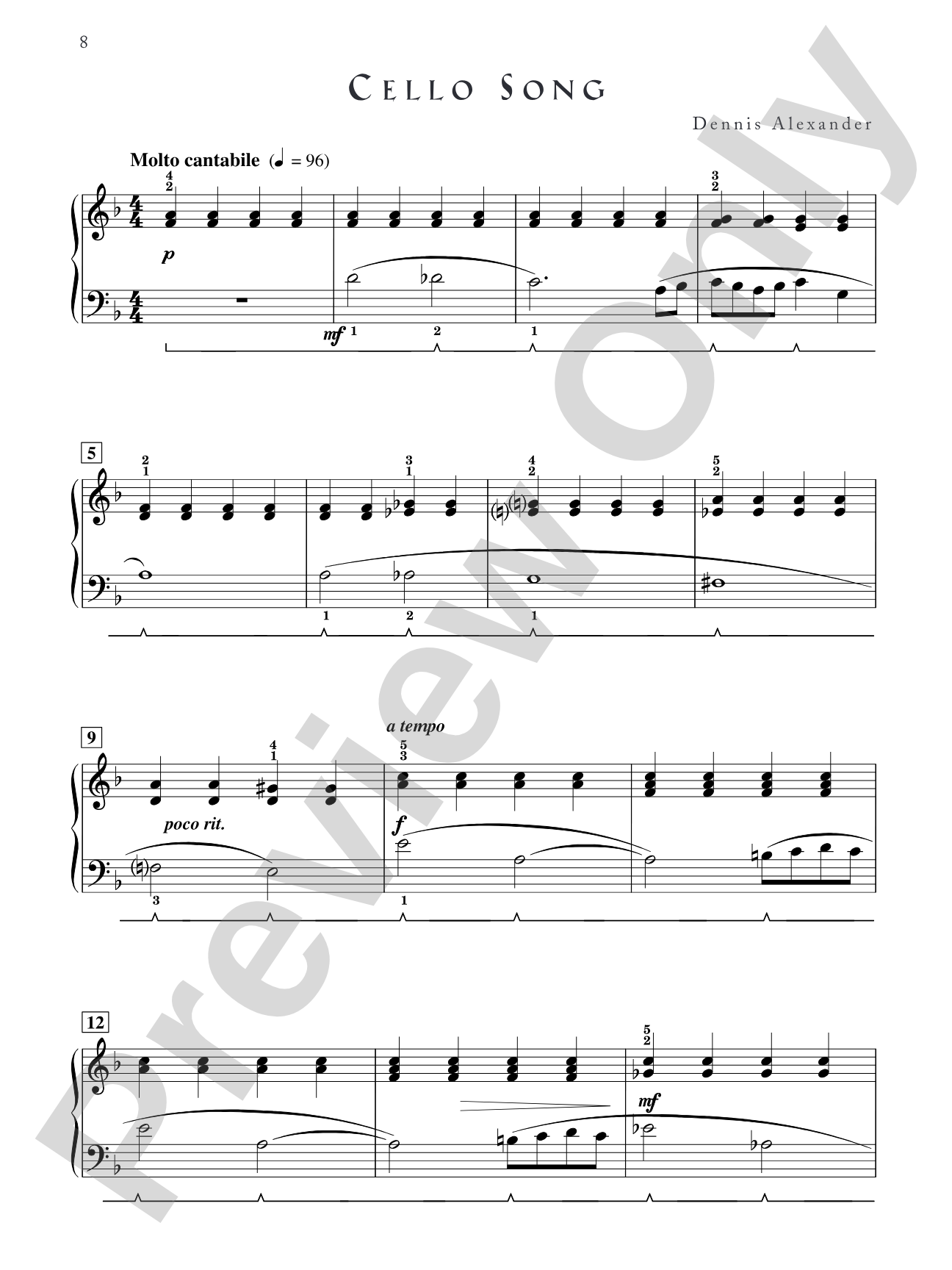

Cello Song - Piano Solo: Piano Solo
7 Romantic Late Elementary Piano Solos
By Dennis Alexander
Level: Late Elementary
Item: 00-PS-0017475
$4.99
Pickup currently not available
Related Items
Arianna - Piano Solo: Piano Solo |
$4.99
|
View | |
Arioso in C - Piano Solo: Piano Solo |
$4.99
|
View | |
Falling Leaves - Piano Solo: Piano Solo |
$4.99
|
View | |
Moonshadows - Piano Solo: Piano Solo |
$4.99
|
View | |
Snowscape - Piano Solo: Piano Solo |
$4.99
|
View | |
Soul Mates - Piano Solo: Piano Solo |
$5.99
|
View | |
Mr. "A" Presents First Lyric Pieces, Book 1: Piano Book |
$5.99
|
View |
Description
This collection is for teacher wanting to prepare students for the Romantic style early in the development of the student. Since no intervals larger than a 6th are used, these are good for small hands. Offers a lot of variety. Late elementary. A Federation Festivals 2024-2028 selection.


Cello Song - Piano Solo: Piano Solo isn't in MakeMusic Cloud just yet...but it could be. Let us know you'd like to see it, and you'll help shape what comes next. In the meantime, start a free trial and dive into thousands of interactive titles your students can play along with today.
Request This Title
Tell us you want it.
Start Your Free Trial
Explore everything that's ready to play right now.
Sample Audio
No sample audio found.
Sample Video
No sample videos found.
Additional Details
Publisher:
Alfred Music
Page Count:
16
SKU:
00-PS-0017475
More about this title
About the Composer: Dennis Alexander

Dennis Alexander has shaped American music education for decades through his prolific output with Alfred Music Publishing, producing over 400 compositions and recordings since 1986. His career spans from 24 years teaching piano pedagogy at the University of Montana through faculty positions at Cal State Fullerton and Cal State Northridge, establishing him as one of the most respected voices in educational piano composition.
Beyond the classroom, Alexander maintains an active performance schedule as soloist, accompanist, and chamber musician, having made his Carnegie Recital Hall debut in 1987 and toured internationally across Southeast Asia and beyond. He has judged national competitions, led master classes at MTNA conventions, and received numerous commissions from music organizations. Now based in Albuquerque, Alexander continues composing while remaining a sought-after clinician at state and national conventions.
Why we love this
Alexander writes with an ear for what intermediate students actually need: musical substance without technical barriers. The constraint of sixth intervals or smaller might sound limiting, but it frees students to focus on phrasing, voicing, and the expressive possibilities of the Romantic style rather than stretching for big leaps. With this collection selected for Federation Festivals 2024-2028, you're giving your students repertoire that builds both artistry and confidence.
What to expect
These pieces carry genuine Romantic warmth without sentimentality. The writing sits comfortably under the hands while inviting lyrical phrasing and harmonic exploration, giving young pianists a taste of 19th-century expressiveness in language they can actually speak.
Who it's for
Late elementary pianists beginning to engage with Romantic idioms and expression. Students with smaller hands benefit from the deliberate interval choices, while all players at this level gain from Alexander's gift for melodic writing that feels immediately singable and musically mature.
How to get the most out of it
- Listen to how the accompaniment breathes beneath the melody; students often rush through dialogue between hands that should feel conversational rather than simultaneous.
- Encourage color changes in the left hand beyond what looks obvious on the page, using dynamic shaping to support the right-hand singing line.
- Map phrase shapes with your student before diving into notes; these pieces reward attention to structural arc and emotional contour.
- Experiment with tempo flexibility within pieces that invite a Romantic sensibility; rigidity works against the style.
How to use it
Build a Romantic era showcase by pairing selections from this collection with other period works; the variety within the book supports a cohesive recital with multiple contrasting pieces. These also serve as anchor repertoire for a festival-focused studio, since the Federation selection means students can prepare with confidence for adjudication.
Skills your students will build
- Legato phrasing across hand position changes
- Left-hand accompaniment patterns common to Romantic era (Alberti bass variations, broken chords)
- Dynamic shaping and expressive nuance within shorter forms
- Chord voicing awareness and harmonic color
- Sight-reading confidence through varied but accessible notation